MTA-DE Laboratory of Protein Dynamics, Department of Biochemistry and Molecular Biology, H-4032 Debrecen, Hungary.
Molecules. 2018 Nov 17;23(11):3008. doi: 10.3390/molecules23113008.
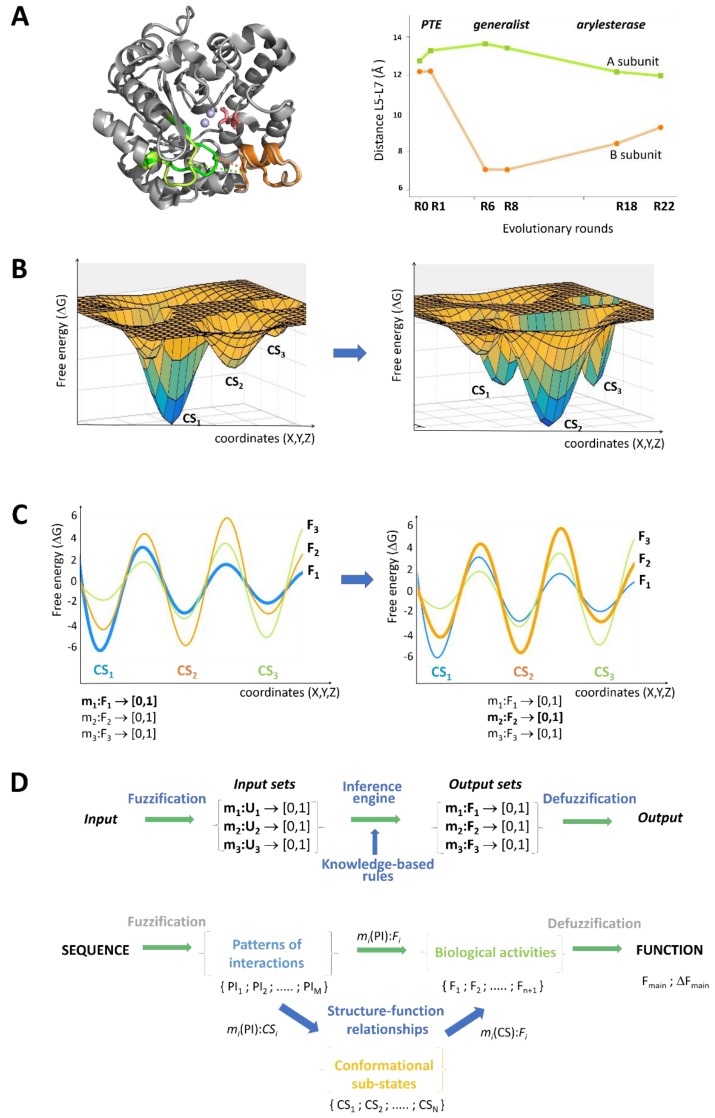
The deterministic sequence → structure → function relationship is not applicable to describe how proteins dynamically adapt to different cellular conditions. A stochastic model is required to capture functional promiscuity, redundant sequence motifs, dynamic interactions, or conformational heterogeneity, which facilitate the decision-making in regulatory processes, ranging from enzymes to membraneless cellular compartments. The fuzzy set theory offers a quantitative framework to address these problems. The fuzzy formalism allows the simultaneous involvement of proteins in multiple activities, the degree of which is given by the corresponding memberships. Adaptation is described via a fuzzy inference system, which relates heterogeneous conformational ensembles to different biological activities. Sequence redundancies (e.g., tandem motifs) can also be treated by fuzzy sets to characterize structural transitions affecting the heterogeneous interaction patterns (e.g., pathological fibrillization of stress granules). The proposed framework can provide quantitative protein models, under stochastic cellular conditions.
确定性的序列-结构-功能关系并不适用于描述蛋白质如何动态适应不同的细胞条件。需要一个随机模型来捕捉功能的混杂性、冗余的序列基序、动态相互作用或构象异质性,这有助于在从酶到无膜细胞区室的调控过程中做出决策。模糊集理论提供了一个定量框架来解决这些问题。模糊形式主义允许蛋白质同时参与多种活动,其程度由相应的隶属度给出。适应性通过模糊推理系统来描述,该系统将异构构象集合与不同的生物学活性联系起来。序列冗余(例如,串联基序)也可以用模糊集来描述影响异构相互作用模式的结构转变(例如,应激颗粒的病理性纤维化)。所提出的框架可以在随机细胞条件下提供定量的蛋白质模型。