Emerg Infect Dis. 2018 Dec;24(12):2317-2323. doi: 10.3201/eid2412.181204.
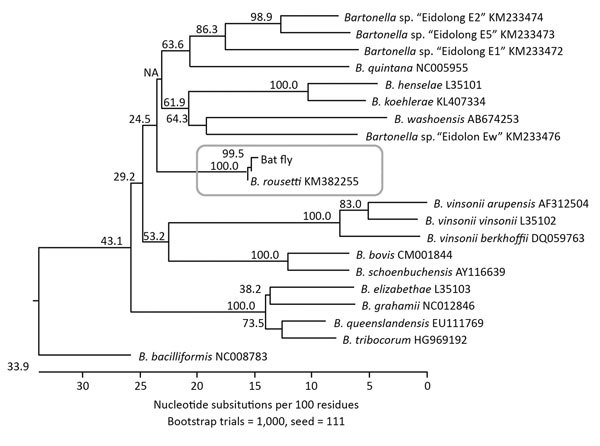
Twice a year in southwestern Nigeria, during a traditional bat festival, community participants enter designated caves to capture bats, which are then consumed for food or traded. We investigated the presence of Bartonella species in Egyptian fruit bats (Rousettus aegyptiacus) and bat flies (Eucampsipoda africana) from these caves and assessed whether Bartonella infections had occurred in persons from the surrounding communities. Our results indicate that these bats and flies harbor Bartonella strains, which multilocus sequence typing indicated probably represent a novel Bartonella species, proposed as Bartonella rousetti. In serum from 8 of 204 persons, we detected antibodies to B. rousetti without cross-reactivity to other Bartonella species. This work suggests that bat-associated Bartonella strains might be capable of infecting humans.
每年在尼日利亚西南部都会举办两次传统的蝙蝠节,社区参与者会进入指定的洞穴捕捉蝙蝠,然后将其作为食物食用或交易。我们调查了来自这些洞穴的埃及果蝠(Rousettus aegyptiacus)和蝙蝠蝇(Eucampsipoda africana)中是否存在巴尔通体物种,并评估了周围社区的人是否感染了巴尔通体。我们的结果表明,这些蝙蝠和苍蝇携带巴尔通体菌株,多位点序列分型表明,这些菌株可能代表一种新的巴尔通体物种,被提议命名为 Rousettus 巴尔通体(Bartonella rousetti)。在 204 人血清中的 8 人血清中,我们检测到了针对 Rousettus 巴尔通体的抗体,而与其他巴尔通体物种没有交叉反应。这项工作表明,与蝙蝠相关的巴尔通体菌株可能能够感染人类。