Meyer Amanda J, Babirye Diana, Armstrong-Hough Mari, Mark David, Ayakaka Irene, Katamba Achilles, Haberer Jessica E, Davis J Lucian
Department of Epidemiology of Microbial Diseases, Yale School of Public Health, Yale University, New Haven, CT, United States.
Uganda Tuberculosis Implementation Research Consortium, Makerere University, Kampala, Uganda.
JMIR Mhealth Uhealth. 2018 Nov 20;6(11):e10239. doi: 10.2196/10239.
Previous studies have reported the inconsistent effectiveness of text messaging (short message service, SMS) for improving health outcomes, but few have examined to what degree the quality, or "fidelity," of implementation may explain study results.
The aim of this study was to determine the fidelity of a one-time text messaging (SMS) intervention to promote the uptake of tuberculosis evaluation services among household contacts of index patients with tuberculosis.
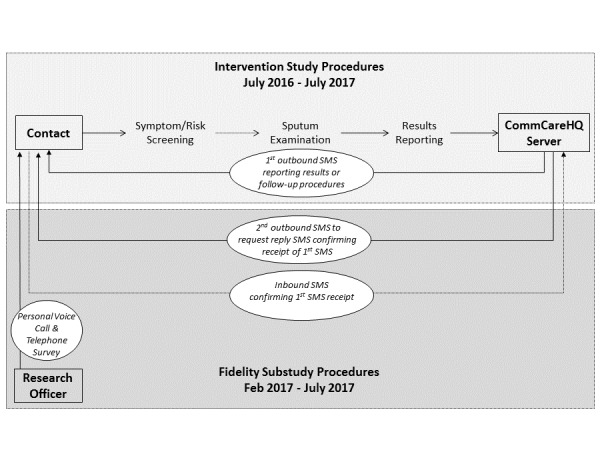
From February to June 2017, we nested a process evaluation of text message (SMS) delivery within the intervention arm of a randomized controlled trial of tuberculosis contact investigation in Kampala, Uganda. Because mobile service providers in Uganda do not provide delivery confirmations, we asked household tuberculosis contacts to confirm the receipt of a one-time tuberculosis-related text message (SMS) by sending a text message (SMS) reply through a toll-free "short code." Two weeks later, a research officer followed up by telephone to confirm the receipt of the one-time text message (SMS) and administer a survey. We considered participants lost to follow-up after 3 unsuccessful call attempts on 3 separate days over a 1-week period.
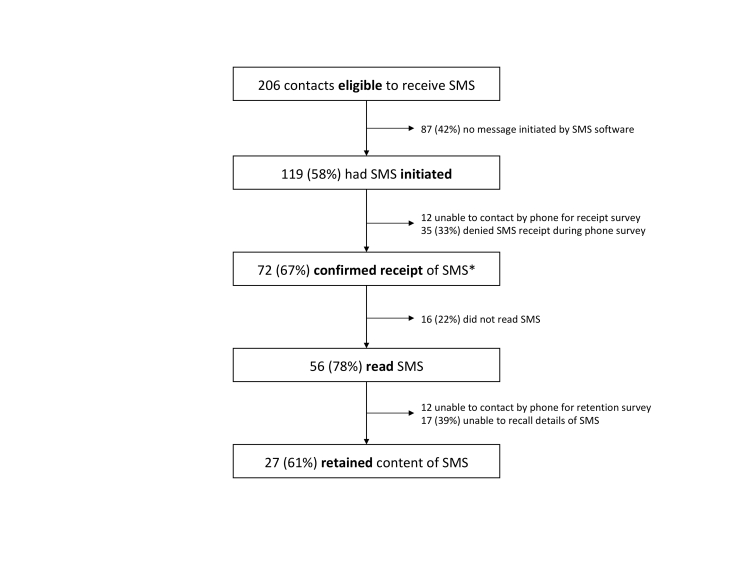
Of 206 consecutive household contacts, 119 had a text message (SMS) initiated from the server. While 33% (39/119) were children aged 5-14 years, including 20% (24/119) girls and 13% (15/119) boys, 18 % (21/119) were adolescents or young adults, including 12% (14/119) young women and 6% (7/119) young men. 50% (59/119) were adults, including 26% (31/119) women and 24% (28/119) men. Of 107 (90%) participants for whom we could ascertain text message (SMS) receipt status, 67% (72/107) confirmed text message (SMS) receipt, including 22% (24/107) by reply text message (SMS) and 45% (48/107) during the follow-up telephone survey. No significant clinical or demographic differences were observed between those who did and did not report receiving the text message (SMS). Furthermore, 52% (56/107) reported ever reading the SMS. The cumulative likelihood of a text message (SMS) reaching its target and being read and retained by a participant was 19%.
The fidelity of a one-time text message (SMS) intervention to increase the uptake of household tuberculosis contact investigation and linkage to care was extremely low, a fact only discoverable through detailed process evaluation. This study suggests the need for systematic process monitoring and reporting of implementation fidelity in both research studies and programmatic interventions using mobile communications to improve health.
以往研究报告了短信服务(SMS)在改善健康结局方面的效果不一,但很少有研究探讨实施的质量或“保真度”在多大程度上可以解释研究结果。
本研究旨在确定一次性短信干预措施在促进结核病确诊患者家庭接触者接受结核病评估服务方面的保真度。
2017年2月至6月,我们在乌干达坎帕拉结核病接触者调查随机对照试验的干预组中嵌套了一项短信(SMS)发送过程评估。由于乌干达的移动服务提供商不提供发送确认信息,我们要求结核病家庭接触者通过拨打免费“短代码”发送短信回复来确认收到一条与结核病相关的一次性短信。两周后,一名研究人员通过电话进行随访,以确认收到一次性短信并进行调查。如果在1周内3个不同日期进行3次不成功的电话尝试后仍无法联系到参与者,我们将其视为失访。
在连续206名家庭接触者中,有119人收到了服务器发出的短信。其中33%(39/119)为5至14岁儿童,包括20%(24/119)女孩和13%(15/119)男孩;18%(21/119)为青少年或青年,包括12%(14/119)年轻女性和6%(7/119)年轻男性;50%(59/119)为成年人,包括26%(31/119)女性和24%(28/119)男性。在我们能够确定短信接收状态的107名(90%)参与者中,67%(72/107)确认收到了短信,其中22%(24/107)通过回复短信确认,45%(48/107)在随访电话调查中确认。报告收到短信和未收到短信的参与者之间未观察到显著的临床或人口统计学差异。此外,52%(56/107)报告曾阅读过该短信。短信到达目标对象并被参与者阅读和留存的累积可能性为19%。
一次性短信干预措施在提高家庭结核病接触者调查参与率和促进与医疗服务联系方面的保真度极低,这一事实只有通过详细的过程评估才能发现。本研究表明,在使用移动通信改善健康状况的研究和项目干预中,需要对实施保真度进行系统的过程监测和报告。