Guo Wei, Imai Satoshi, Yang Jia-Le, Zou Shiping, Li Huijuan, Xu Huakun, Moudgil Kamal D, Dubner Ronald, Wei Feng, Ren Ke
Department of Neural and Pain Sciences, School of Dentistry & Program in Neuroscience, University of Maryland, Baltimore, MD, United States.
Department of Clinical Pharmacology & Therapeutics, Kyoto University Hospital, Kyoto, Japan.
Front Integr Neurosci. 2018 Oct 16;12:49. doi: 10.3389/fnint.2018.00049. eCollection 2018.
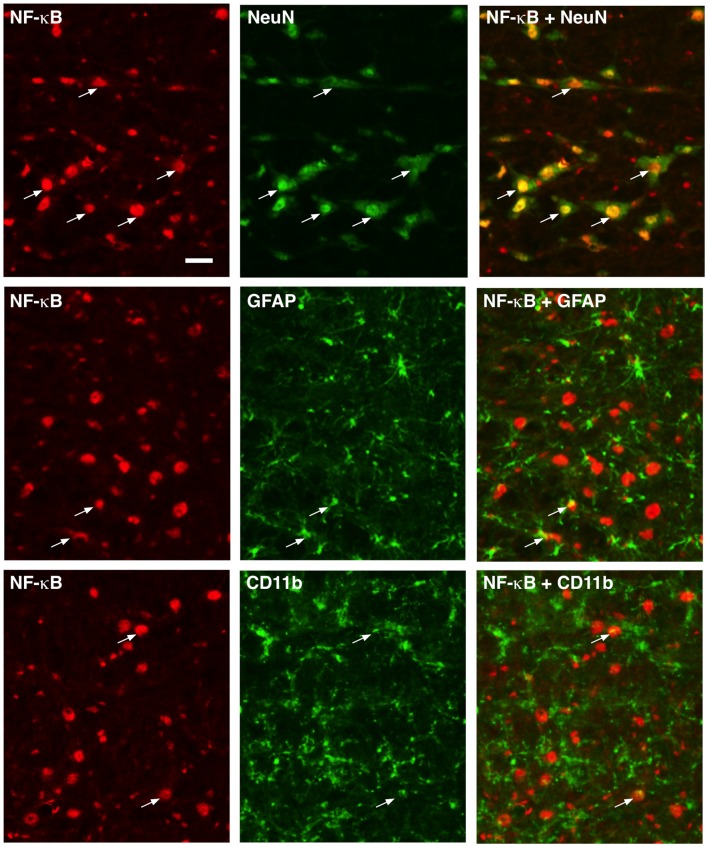
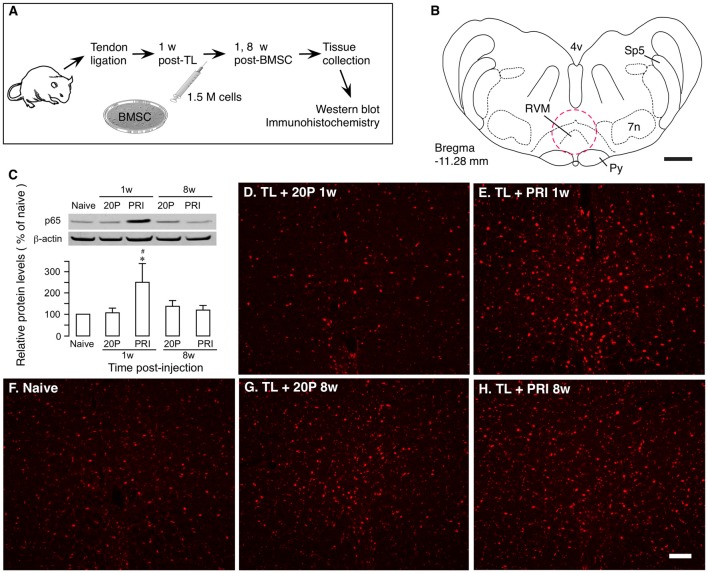
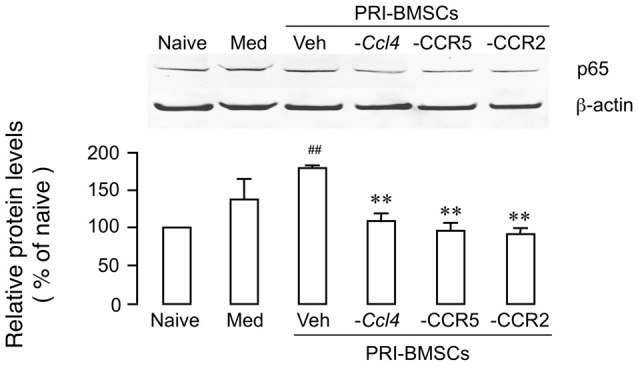
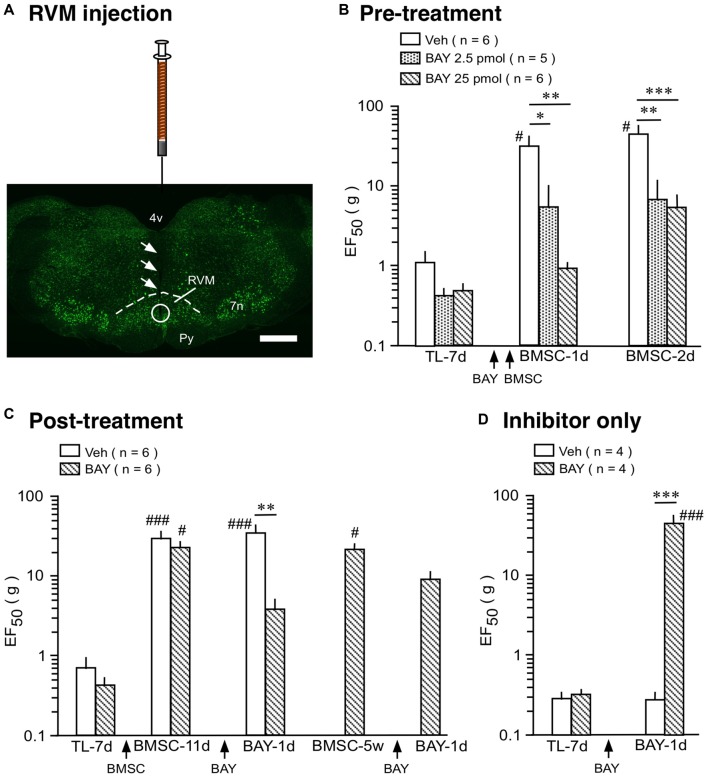
Bone marrow stromal cells (BMSCs) produce long-lasting attenuation of pain hypersensitivity. This effect involves BMSC's ability to interact with the immune system and activation of the endogenous opioid receptors in the pain modulatory circuitry. The nuclear factor kappa B (NF-κB) protein complex is a key transcription factor that regulates gene expression involved in immunity. We tested the hypothesis that the NF-κB signaling plays a role in BMSC-induced pain relief. We focused on the rostral ventromedial medulla (RVM), a key structure in the descending pain modulatory pathway, that has been shown to play an important role in BMSC-produced antihyperalgesia. In Sprague-Dawley rats with a ligation injury of the masseter muscle tendon (TL), BMSCs (1.5 M/rat) from donor rats were infused i.v. at 1 week post-TL. P65 exhibited predominant neuronal localization in the RVM with scattered distribution in glial cells. At 1 week, but not 8 weeks after BMSC infusion, western blot and immunostaining showed that p65 of NF-κB was significantly increased in the RVM. Given that chemokine signaling is critical to BMSCs' pain-relieving effect, we further evaluated a role of chemokine signaling in p65 upregulation. Prior to infusion of BMSCs, we transduced BMSCs with shRNA, incubated BMSCs with RS 102895, a CCR2b antagonist, or maraviroc, a CCR5 antagonist. The antagonism of chemokines significantly reduced BMSC-induced upregulation of p65, suggesting that upregulation of p65 was related to BMSCs' pain-relieving effect. We then tested the effect of a selective NF-κB activation inhibitor, BAY 11-7082. The mechanical hyperalgesia of the rat was assessed with the von Frey method. In the pre-treatment experiment, BAY 11-7082 (2.5 and 25 pmol) was injected into the RVM at 2 h prior to BMSC infusion. Pretreatment with BAY 11-7082 attenuated BMSCs' antihyperalgesia, but post-treatment at 5 weeks post-BMSC was not effective. On the contrary, in TL rats receiving BAY 11-7082 without BMSCs, TL-induced hyperalgesia was attenuated, consistent with dual roles of NF-κB in pain hypersensitivity and BMSC-produced pain relief. These results indicate that the NF-κB signaling pathway in the descending circuitry is involved in initiation of BMSC-produced behavioral antihyperalgesia.
骨髓基质细胞(BMSCs)可产生持久的痛觉过敏减轻作用。这种效应涉及BMSC与免疫系统相互作用的能力以及疼痛调节回路中内源性阿片受体的激活。核因子κB(NF-κB)蛋白复合物是一种关键的转录因子,可调节参与免疫的基因表达。我们测试了NF-κB信号传导在BMSC诱导的疼痛缓解中起作用的假设。我们聚焦于延髓头端腹内侧(RVM),它是下行疼痛调节通路中的关键结构,已被证明在BMSC产生的抗痛觉过敏中起重要作用。在患有咬肌肌腱结扎损伤(TL)的Sprague-Dawley大鼠中,在TL后1周经静脉注射来自供体大鼠的BMSCs(1.5 M/只大鼠)。P65在RVM中主要定位于神经元,在胶质细胞中呈散在分布。在BMSC注射后1周而非8周,蛋白质印迹和免疫染色显示RVM中NF-κB的p65显著增加。鉴于趋化因子信号传导对BMSCs的止痛作用至关重要,我们进一步评估了趋化因子信号传导在p65上调中的作用。在注射BMSCs之前,我们用短发夹RNA转导BMSCs,用CCR2b拮抗剂RS 102895或CCR5拮抗剂马拉维若与BMSCs孵育。趋化因子的拮抗作用显著降低了BMSC诱导的p65上调,表明p65的上调与BMSCs的止痛作用有关。然后我们测试了选择性NF-κB激活抑制剂BAY 11-7082的作用。用von Frey方法评估大鼠的机械性痛觉过敏。在预处理实验中,在注射BMSCs前2小时将BAY 11-7082(2.5和25 pmol)注射到RVM中。用BAY 11-7082预处理减弱了BMSCs的抗痛觉过敏作用,但在BMSC注射后5周进行后处理则无效。相反,在未注射BMSCs而接受BAY 11-7082的TL大鼠中,TL诱导的痛觉过敏减弱,这与NF-κB在痛觉过敏和BMSC产生的疼痛缓解中的双重作用一致。这些结果表明下行回路中的NF-κB信号通路参与了BMSC产生的行为性抗痛觉过敏的起始过程。