Gomez-Marcos Manuel A, Gomez-Sanchez Leticia, Patino-Alonso Maria Carmen, Recio-Rodriguez Jose I, Gomez-Sanchez Marta, Rigo Fernando, Marti Ruth, Agudo-Conde Cristina, Ramos Rafel, Rodriguez-Sanchez Emiliano, Maderuelo-Fernandez Jose A, Garcia-Ortiz Luis
Institute of Biomedical Research of Salamanca (IBSAL), Primary Health Care Research Unit The Alamedilla Health Center.
Health Service of Castilla and León (SACyL).
Medicine (Baltimore). 2018 Nov;97(47):e13299. doi: 10.1097/MD.0000000000013299.
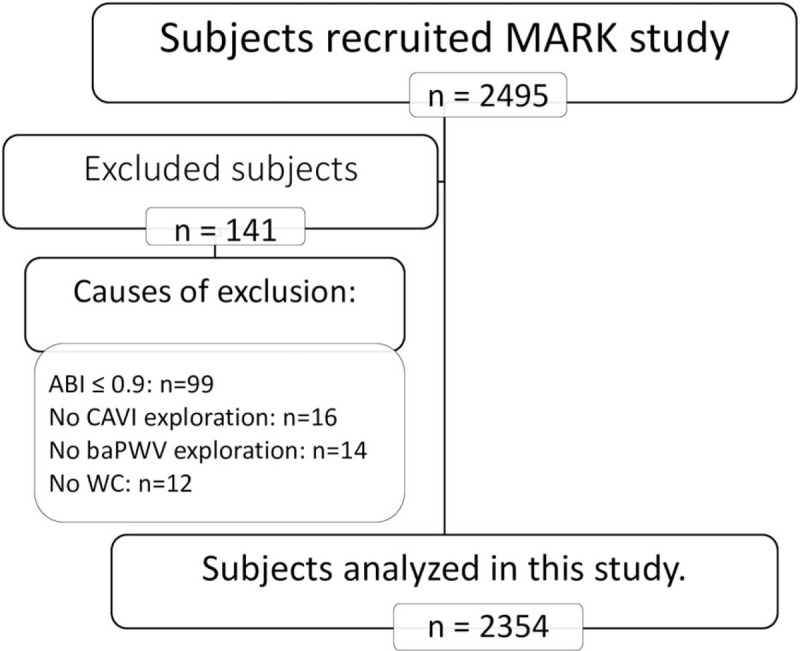
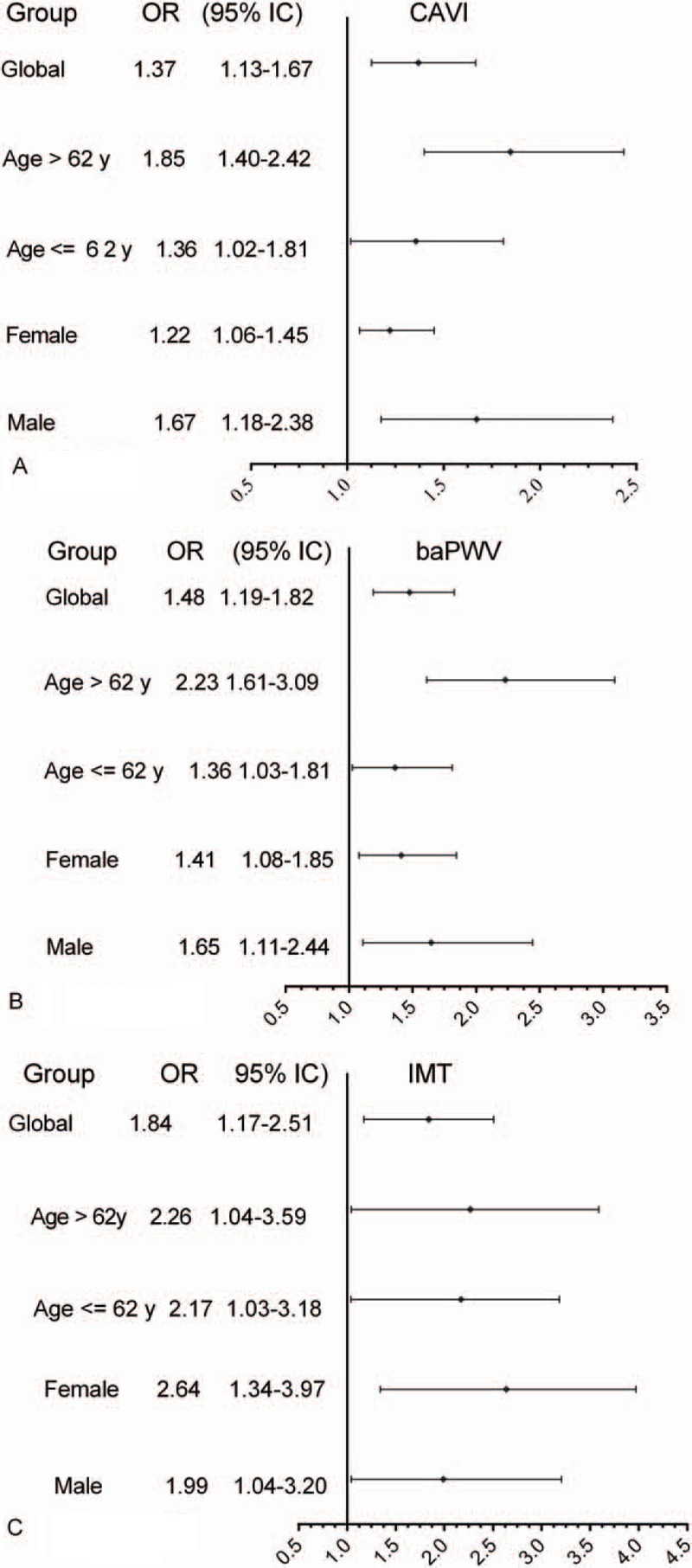
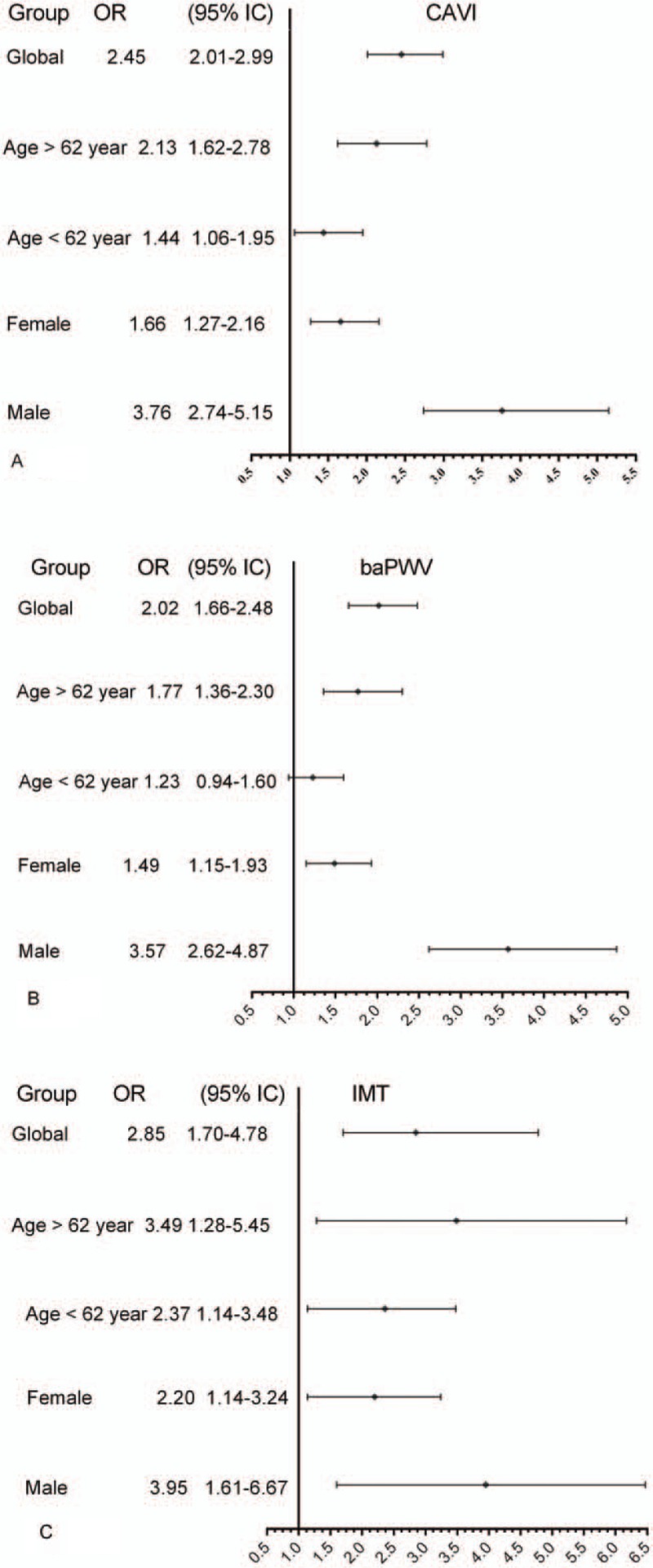
A body shape index (ABSI) has been introduced as a marker of the relationship between body composition and all-cause mortality. However, until now, the relationships between ABSI and vascular structure and function have not been evaluated. The aim of this study was to investigate the association of ABSI with vascular structure and function in Spanish adults with intermediate cardiovascular risk. This cross-sectional study analyzed the data of 2354 subjects [age, 35-74 years (median, 62.0 years [range, 56.0-67.0 years]), 61.9% men] enrolled into the MediAte Risk management (MARK) study. ABSI was calculated by using the following formula: ABSI = waist circumference (m)/[body mass index × height (m))]. Vascular function was assessed by measuring cardio-ankle vascular index (CAVI) with the VaSera device and brachial ankle pulse wave velocity (baPWV) by using a validated equation. Vascular structure was assessed by measuring carotid intima-media thickness (IMT) by ultrasonography. Median value of ABSI was 0.083 (range, 0.081-0.090), mean CAVI was (8.5 ± 1.2), and median IMT was 0.727 (range, 0.672-0.799). The values of ABSI and CAVI were higher in men. After adjusting for confounders, ABSI was positively associated with CAVI, baPWV, and average mean IMT. Thus, for each unit increase in ABSI, CAVI increased by 0.16 units, baPWV by 0.25 m/s, and IMT by 0.033 mm. In the logistic regression analysis, the odds ratio of ABSI was > 1 for high CAVI ≥ 9, baPWV ≥ 15 m/s, and IMT ≥ 0.90 mm in the overall subject group, and in the sex- and age-specific (> 62 years, ≤ 62 years) subgroups, after adjusting for confounders. The area under the receiver-operating characteristic curve of the ABSI was 0.631 (95% confidence interval [CI], 0.608-0.654) for CAVI ≥ 9, and 0.617 (95% CI, 0.593-0.641) for high baPWV ≥ 15 m/s. ABSI showed a positive association with vascular structure and function, independent of other confounders that might influence weight and fat mass distribution in Spanish subjects at intermediate cardiovascular risk.Trial Registration: ClinicalTrials.gov Identifier: NCT01428934 (registered: September 2, 2011; last updated: September 8, 2016).
身体形态指数(ABSI)已被引入作为身体成分与全因死亡率之间关系的一个标志物。然而,到目前为止,ABSI与血管结构和功能之间的关系尚未得到评估。本研究的目的是调查西班牙具有中等心血管风险的成年人中ABSI与血管结构和功能之间的关联。这项横断面研究分析了纳入中介风险管理(MARK)研究的2354名受试者的数据[年龄,35 - 74岁(中位数,62.0岁[范围,56.0 - 67.0岁]),61.9%为男性]。ABSI通过以下公式计算:ABSI = 腰围(米)/[体重指数×身高(米)]。血管功能通过使用VaSera设备测量心踝血管指数(CAVI)以及使用经过验证的公式测量臂踝脉搏波速度(baPWV)来评估。血管结构通过超声测量颈动脉内膜中层厚度(IMT)来评估。ABSI的中位数为0.083(范围,0.081 - 0.090),平均CAVI为(8.5 ± 1.2),IMT的中位数为0.727(范围,0.672 - 0.799)。男性的ABSI和CAVI值更高。在对混杂因素进行调整后,ABSI与CAVI、baPWV和平均IMT呈正相关。因此,ABSI每增加一个单位,CAVI增加0.16个单位,baPWV增加0.25米/秒,IMT增加0.033毫米。在逻辑回归分析中,在总体受试者组以及按性别和年龄划分(>62岁,≤62岁)的亚组中,在对混杂因素进行调整后,对于高CAVI≥9、baPWV≥15米/秒和IMT≥0.90毫米,ABSI的比值比>1。对于CAVI≥9,ABSI的受试者工作特征曲线下面积为0.631(95%置信区间[CI],0.608 - 0.654),对于高baPWV≥15米/秒,为0.617(95%CI,0.593 - 0.641)。ABSI与血管结构和功能呈正相关,独立于其他可能影响西班牙具有中等心血管风险受试者体重和脂肪质量分布的混杂因素。试验注册:ClinicalTrials.gov标识符:NCT01428934(注册时间:2011年9月2日;最后更新时间:2016年9月8日)。