Department of Nutrition and Food Science, Graduate School of Humanities and Sciences, Ochanomizu University, 2-1-1 Otsuka, Bunkyo, Tokyo 112-8610, Japan.
Laboratory of Applied Nutrition, Faculty of Human Life and Environmental Sciences, Ochanomizu University, Tokyo 112-8610, Japan..
Int J Mol Sci. 2018 Nov 19;19(11):3649. doi: 10.3390/ijms19113649.
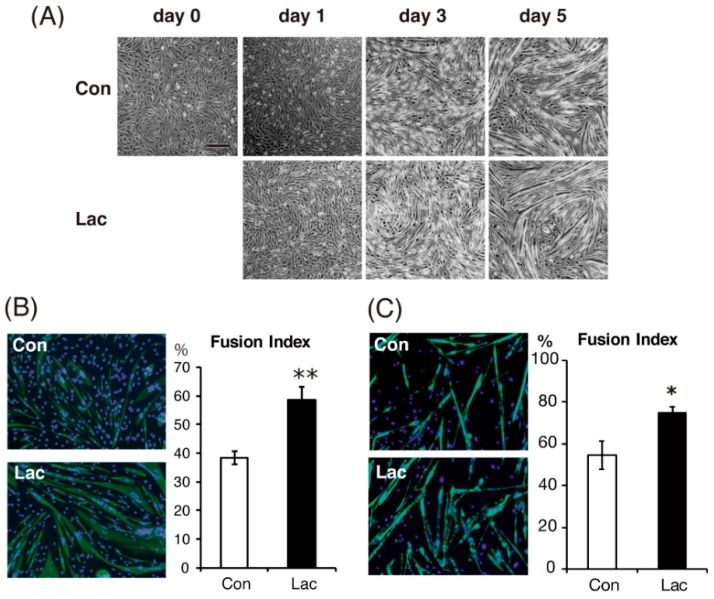
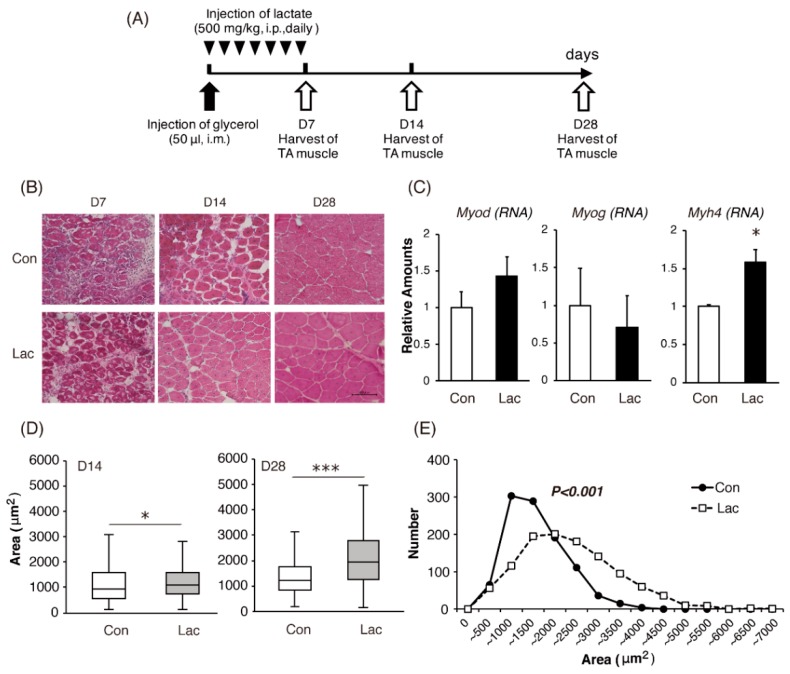
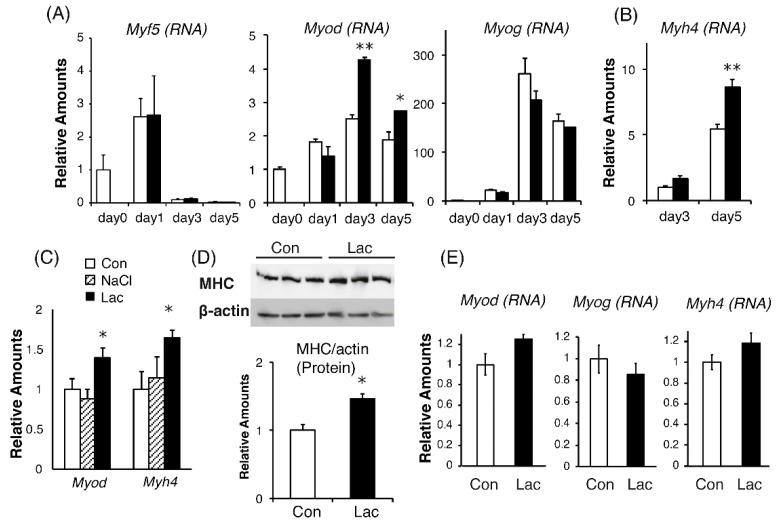
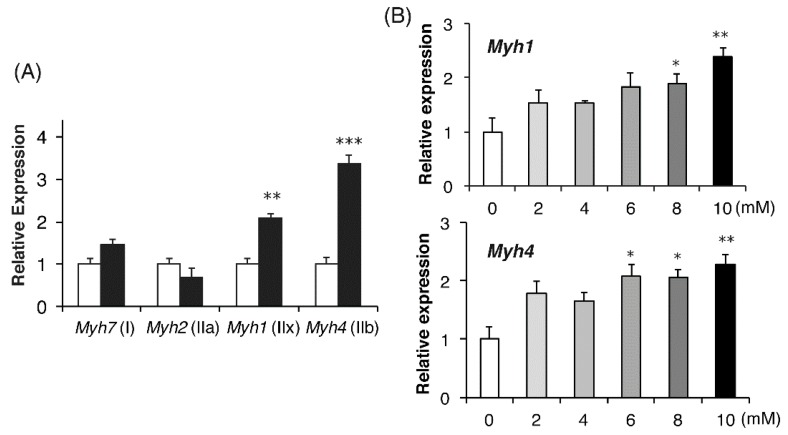
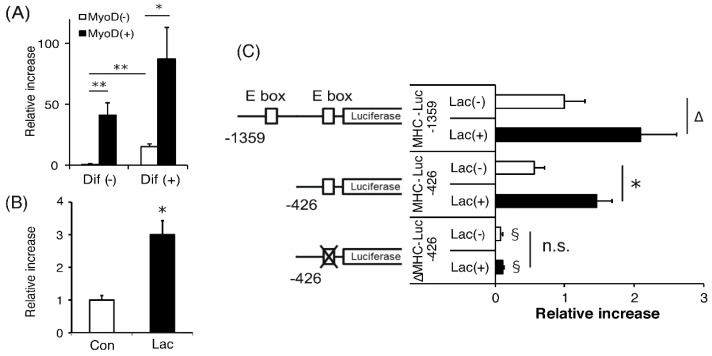
Lactate is a metabolic substrate mainly produced in muscles, especially during exercise. Recently, it was reported that lactate affects myoblast differentiation; however, the obtained results are inconsistent and the in vivo effect of lactate remains unclear. Our study thus aimed to evaluate the effects of lactate on myogenic differentiation and its underlying mechanism. The differentiation of C2C12 murine myogenic cells was accelerated in the presence of lactate and, consequently, myotube hypertrophy was achieved. Gene expression analysis of myogenic regulatory factors showed significantly increased myogenic determination protein (MyoD) gene expression in lactate-treated cells compared with that in untreated ones. Moreover, lactate enhanced gene and protein expression of myosin heavy chain (MHC). In particular, lactate increased gene expression of specific MHC isotypes, MHCIIb and IId/x, in a dose-dependent manner. Using a reporter assay, we showed that lactate increased promoter activity of the MHCIIb gene and that a MyoD binding site in the promoter region was necessary for the lactate-induced increase in activity. Finally, peritoneal injection of lactate in mice resulted in enhanced regeneration and fiber hypertrophy in glycerol-induced regenerating muscles. In conclusion, physiologically high lactate concentrations modulated muscle differentiation by regulating MyoD-associated networks, thereby enhancing MHC expression and myotube hypertrophy in vitro and, potentially, in vivo.
乳酸是一种主要在肌肉中产生的代谢底物,特别是在运动时。最近有报道称,乳酸会影响成肌细胞的分化;然而,得到的结果并不一致,乳酸在体内的作用仍不清楚。因此,我们的研究旨在评估乳酸对成肌分化的影响及其潜在机制。在乳酸存在的情况下,C2C12 鼠成肌细胞的分化加速,从而实现肌管肥大。成肌调节因子的基因表达分析显示,与未处理组相比,乳酸处理组的成肌决定蛋白(MyoD)基因表达显著增加。此外,乳酸增强了肌球蛋白重链(MHC)的基因和蛋白表达。特别是,乳酸以剂量依赖的方式增加了特定 MHC 同工型 MHCIIb 和 IId/x 的基因表达。通过报告基因检测,我们表明乳酸增加了 MHCIIb 基因的启动子活性,并且启动子区域中的 MyoD 结合位点对于乳酸诱导的活性增加是必需的。最后,在甘油诱导的再生肌肉中,腹腔内注射乳酸可导致肌肉再生和纤维肥大增强。总之,生理浓度的高乳酸通过调节 MyoD 相关网络来调节肌肉分化,从而增强体外和成体 MHC 的表达和肌管肥大。