Light Michael T, Miller T Y
Department of Sociology, University of Wisconsin-Madison.
Department of Sociology, Purdue University.
Criminology. 2017 May;56(2):370-401. doi: 10.1111/1745-9125.12175. Epub 2018 Mar 25.
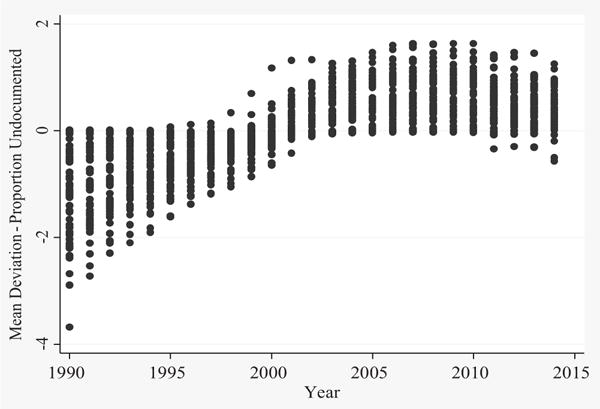
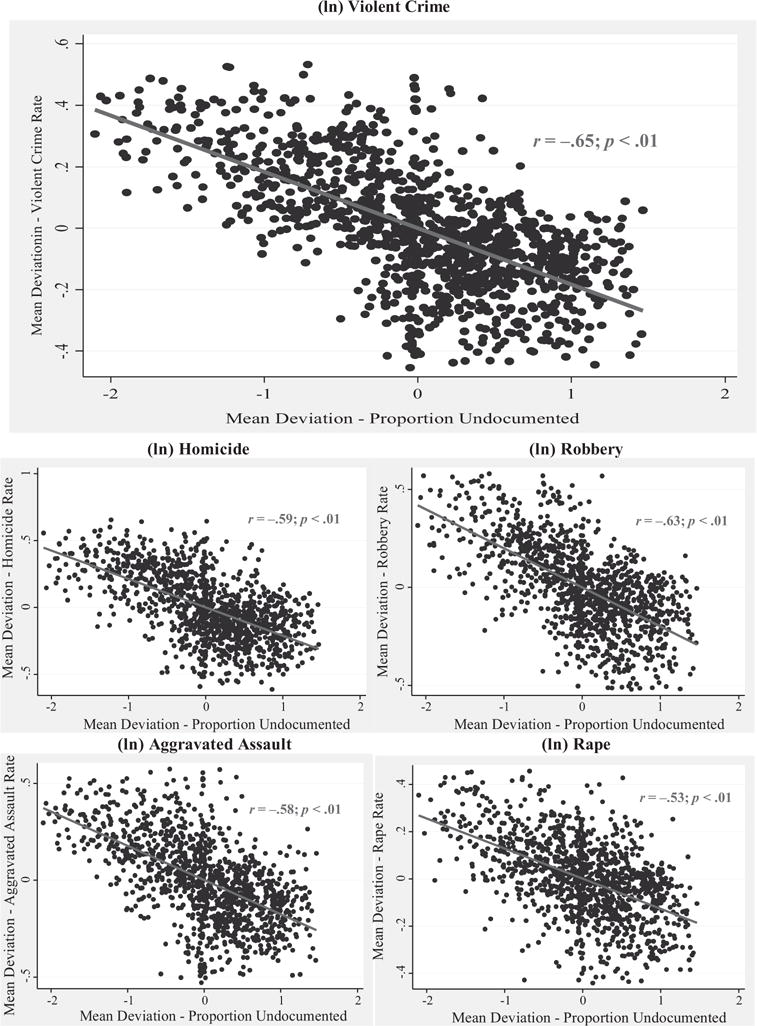
Despite substantial public, political, and scholarly attention to the issue of immigration and crime, we know little about the criminological consequences of undocumented immigration. As a result, fundamental questions about whether undocumented immigration increases violent crime remain unanswered. In an attempt to address this gap, we combine newly developed estimates of the unauthorized population with multiple data sources to capture the criminal, socioeconomic, and demographic context of all 50 states and Washington, DC, from 1990 to 2014 to provide the first longitudinal analysis of the macro-level relationship between undocumented immigration and violence. The results from fixed-effects regression models reveal that undocumented immigration does not increase violence. Rather, the relationship between undocumented immigration and violent crime is generally negative, although not significant in all specifications. Using supplemental models of victimization data and instrumental variable methods, we find little evidence that these results are due to decreased reporting or selective migration to avoid crime. We consider the theoretical and policy implications of these findings against the backdrop of the dramatic increase in immigration enforcement in recent decades.
尽管公众、政治界和学术界对移民与犯罪问题给予了大量关注,但我们对无证移民的犯罪学后果却知之甚少。因此,关于无证移民是否会增加暴力犯罪的基本问题仍未得到解答。为了填补这一空白,我们将新开发的非法移民人口估计数据与多个数据源相结合,以捕捉1990年至2014年期间美国50个州和华盛顿特区的犯罪、社会经济和人口背景,从而首次对无证移民与暴力之间的宏观层面关系进行纵向分析。固定效应回归模型的结果显示,无证移民并不会增加暴力犯罪。相反,无证移民与暴力犯罪之间的关系总体上呈负相关,尽管并非在所有设定中都显著。通过使用补充性的受害数据模型和工具变量方法,我们几乎没有发现证据表明这些结果是由于报告减少或为避免犯罪而进行的选择性移民所致。我们在近几十年来移民执法力度急剧增加的背景下考虑了这些发现的理论和政策含义。