Al-Shabib Nasser A, Husain Fohad Mabood, Ahmed Faheem, Khan Rais Ahmad, Khan Mohammad Shavez, Ansari Firoz Ahmad, Alam Mohammad Zubair, Ahmed Mohammed Asif, Khan Mohd Shahnawaz, Baig Mohammad Hassan, Khan Javed Masood, Shahzad Syed Ali, Arshad Mohammed, Alyousef Abdullah, Ahmad Iqbal
Department of Food Science and Nutrition, College of Food and Agriculture, King Saud University, Riyadh, Saudi Arabia.
College of Science and General Studies, Alfaisal University, Riyadh, Saudi Arabia.
Front Microbiol. 2018 Nov 5;9:2567. doi: 10.3389/fmicb.2018.02567. eCollection 2018.
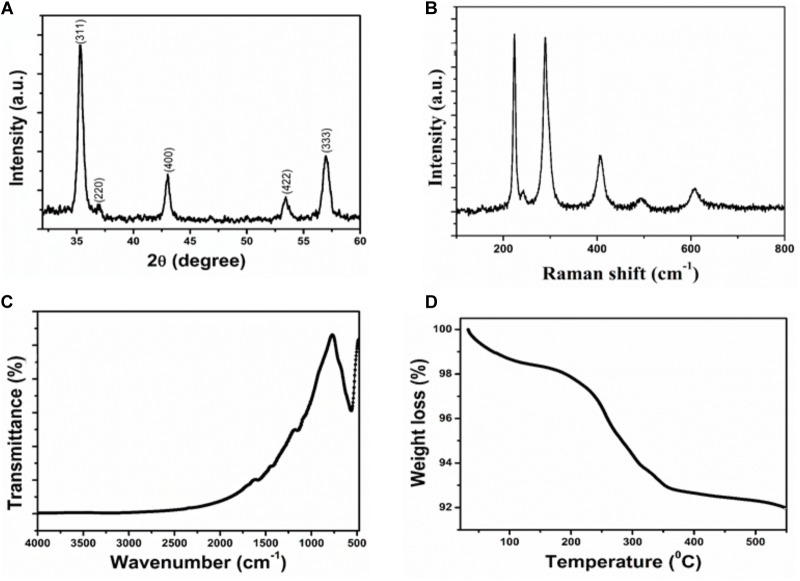
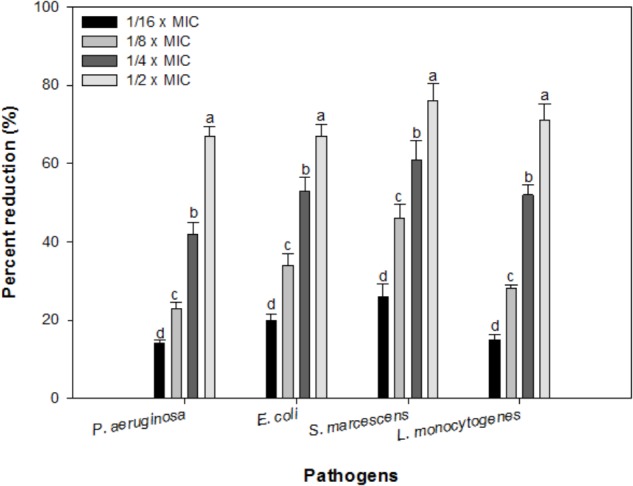
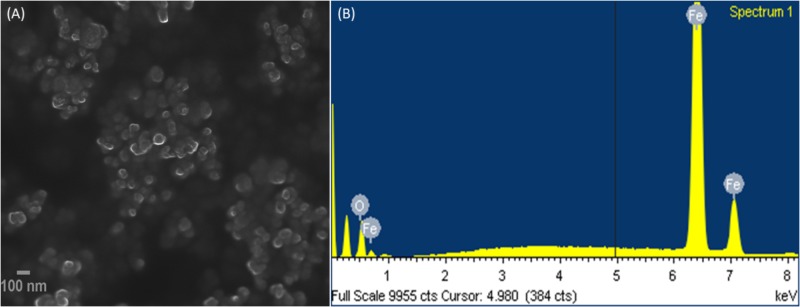
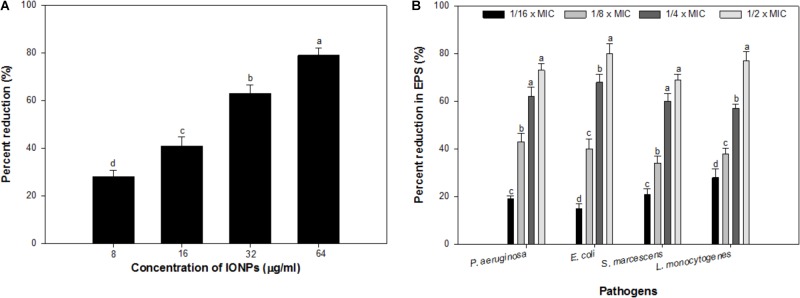
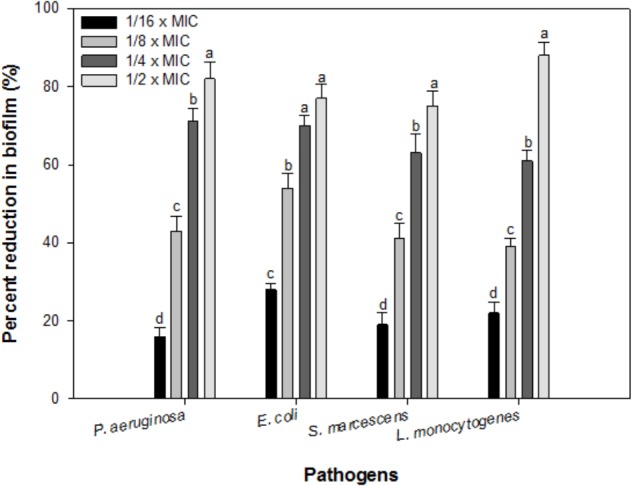
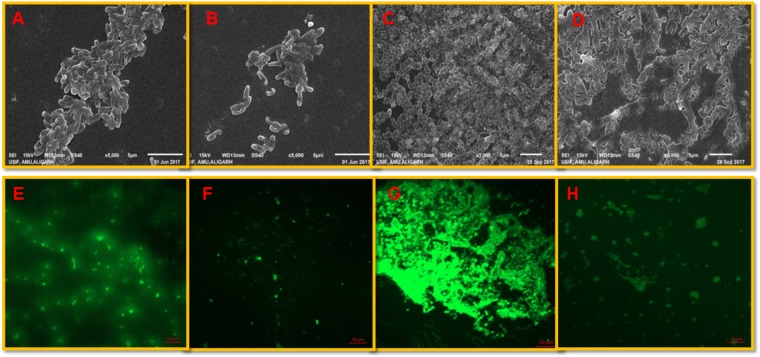
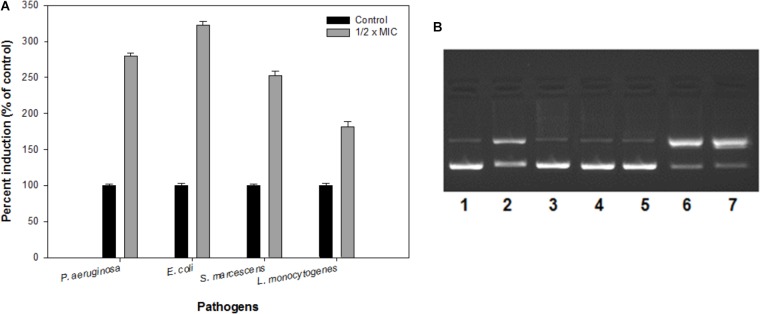
In the present study, a facile environmentally friendly approach was described to prepare monodisperse iron oxide (FeO) nanoparticles (IONPs) by low temperature solution route. The synthesized nanoparticles were characterized using x-ray diffraction spectroscopy (XRD), Raman spectroscopy, field emission scanning electron microscopy (FESEM) measurements, Fourier-Transform Infrared Spectroscopy (FTIR), and Thermogravimetric analysis (TGA) analyses. XRD patterns revealed high crystalline quality of the nanoparticles. SEM micrographs showed the monodispersed IONPs with size ranging from 6 to 9 nm. Synthesized nanoparticles demonstrated MICs of 32, 64, and 128 μg/ml against Gram negative bacteria i.e., , and , respectively, and 32 μg/ml against Gram positive bacteria . IOPNs at its respective sub-MICs demonstrated significant reduction of alginate and exopolysaccharide production and subsequently demonstrated broad-spectrum inhibition of biofilm ranging from 16 to 88% in the test bacteria. Biofilm reduction was also examined using SEM and Confocal Laser Scanning Microscopy (CLSM). Interaction of IONPs with bacterial cells generated ROS contributing to reduced biofilm formation. The present study for the first time report that these IONPs were effective in obliterating pre-formed biofilms. Thus, it is envisaged that these nanoparticles with broad-spectrum biofilm inhibitory property could be exploited in the food industry as well as in medical settings to curtail biofilm based infections and losses.
在本研究中,描述了一种简便的环保方法,通过低温溶液法制备单分散的氧化铁(FeO)纳米颗粒(IONPs)。使用X射线衍射光谱(XRD)、拉曼光谱、场发射扫描电子显微镜(FESEM)测量、傅里叶变换红外光谱(FTIR)和热重分析(TGA)分析对合成的纳米颗粒进行了表征。XRD图谱显示纳米颗粒具有高结晶质量。SEM显微照片显示了尺寸范围为6至9nm的单分散IONPs。合成的纳米颗粒对革兰氏阴性菌即 、 和 的最低抑菌浓度(MIC)分别为32、64和128μg/ml,对革兰氏阳性菌 的MIC为32μg/ml。IONPs在其各自的亚MIC浓度下显著降低了藻酸盐和胞外多糖的产生,并随后在测试细菌中表现出16%至88%的广谱生物膜抑制作用。还使用SEM和共聚焦激光扫描显微镜(CLSM)检查了生物膜减少情况。IONPs与细菌细胞的相互作用产生了活性氧,有助于减少生物膜形成。本研究首次报道这些IONPs对消除预先形成的生物膜有效。因此,可以设想,这些具有广谱生物膜抑制特性的纳米颗粒可用于食品工业以及医疗环境中,以减少基于生物膜的感染和损失。