Ünal Ayça Berfu, Steg Linda, Gorsira Madelijne
University of Groningen, The Netherlands.
Vrije Universiteit Amsterdam, The Netherlands.
Environ Behav. 2018 Dec;50(10):1092-1118. doi: 10.1177/0013916517728991. Epub 2017 Sep 20.
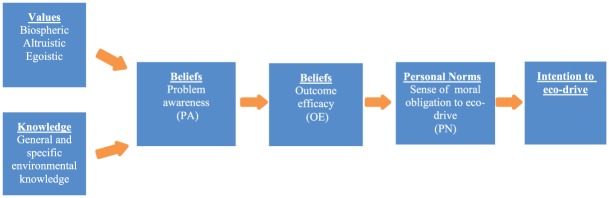
Eco-driving can be an effective strategy to save fuel and reduce CO emissions on the road. In the current study, we reason that personal norms are important predictors of eco-driving, and that they are activated when people are aware of environmental problems caused by behavior (problem awareness) and believe that they can contribute to the solution of the problem by changing behavior (outcome efficacy). Extending previous research, we aim at testing two antecedents of this norm activation process: values and environmental knowledge. Results revealed that in comparison with knowledge, values-in particular biospheric values-were strongly associated with the intention to eco-drive by being highly related to awareness of problems caused by car use, which in turn was associated with stronger outcome efficacy beliefs and personal norms for eco-driving. Findings indicate that values are more likely to be a motivational force for pro-environmental intentions than is environmental knowledge.
生态驾驶可能是一种在路上节省燃料和减少一氧化碳排放的有效策略。在当前的研究中,我们推断个人规范是生态驾驶的重要预测因素,并且当人们意识到行为所造成的环境问题(问题意识)并相信他们可以通过改变行为来为解决问题做出贡献(结果效能)时,这些规范就会被激活。在扩展先前研究的基础上,我们旨在测试这种规范激活过程的两个先行因素:价值观和环境知识。结果显示,与知识相比,价值观——尤其是生物圈价值观——与生态驾驶意图密切相关,因为它们与汽车使用所造成问题的意识高度相关,而这种意识反过来又与更强的结果效能信念和生态驾驶的个人规范相关。研究结果表明,与环境知识相比,价值观更有可能成为环保意图的一种激励力量。