RIKEN Center for Developmental Biology, Kobe 650-0047, Japan.
PRESTO, Japan Science and Technology Agency, Kawaguchi 332-0012, Japan.
Sci Adv. 2018 Nov 21;4(11):eaau1354. doi: 10.1126/sciadv.aau1354. eCollection 2018 Nov.
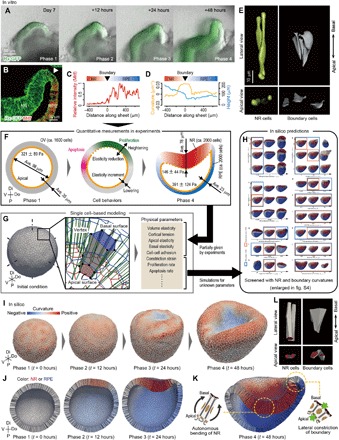
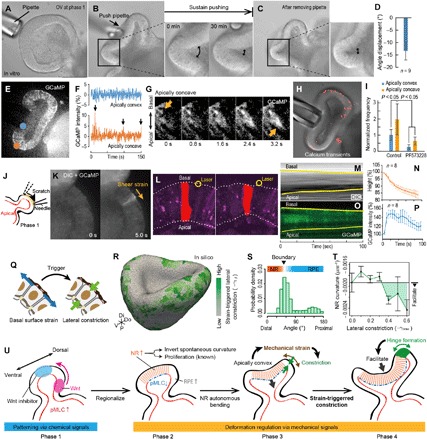
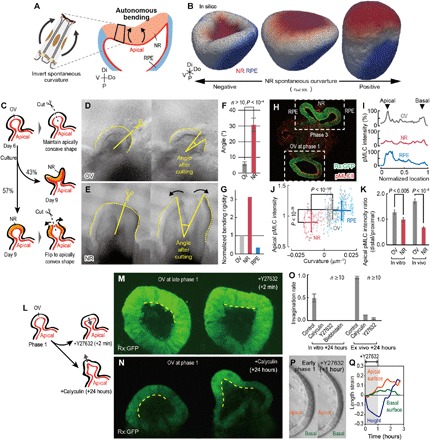
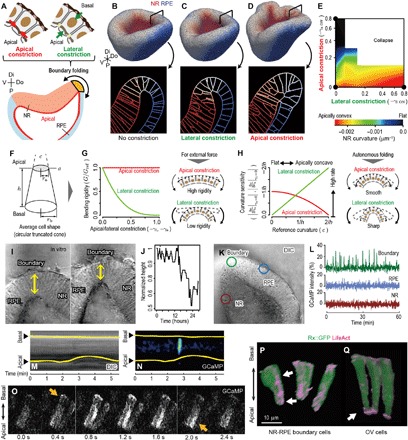
Organogenesis is a self-organizing process of multiple cells in three-dimensional (3D) space, where macroscopic tissue deformations are robustly regulated by multicellular autonomy. It is clear that this robust regulation requires cells to sense and modulate 3D tissue formation across different scales, but its underlying mechanisms are still unclear. To address this question, we developed a versatile computational model of 3D multicellular dynamics at single-cell resolution and combined it with the 3D culture system of pluripotent stem cell-derived optic-cup organoid. The complementary approach enabled quantitative prediction of morphogenesis and its corresponding verification and elucidated that the macroscopic 3D tissue deformation is fed back to individual cellular force generations via mechanosensing. We hereby conclude that mechanical force plays a key role as a feedback regulator to establish the robustness of organogenesis.
器官发生是多细胞在三维(3D)空间中的自组织过程,其中宏观组织变形受到多细胞自主性的强有力调节。很明显,这种强大的调节需要细胞在不同尺度上感知和调节 3D 组织形成,但它的潜在机制尚不清楚。为了解决这个问题,我们开发了一种多功能的单细胞分辨率 3D 多细胞动力学计算模型,并将其与多能干细胞衍生的视杯类器官的 3D 培养系统相结合。这种互补的方法使我们能够定量预测形态发生及其相应的验证,并阐明宏观 3D 组织变形通过机械感知反馈到单个细胞力的产生。因此,我们得出结论,机械力作为反馈调节剂在建立器官发生的稳健性方面起着关键作用。