Paediatric Department, "SS Annunziata" Hospital, 74100 Taranto, Italy.
Department of Paediatrics, Paediatric Hospital Giovanni XXIII, Via Amendola 207, 70126 Bari, Italy.
Nutrients. 2018 Nov 23;10(12):1824. doi: 10.3390/nu10121824.
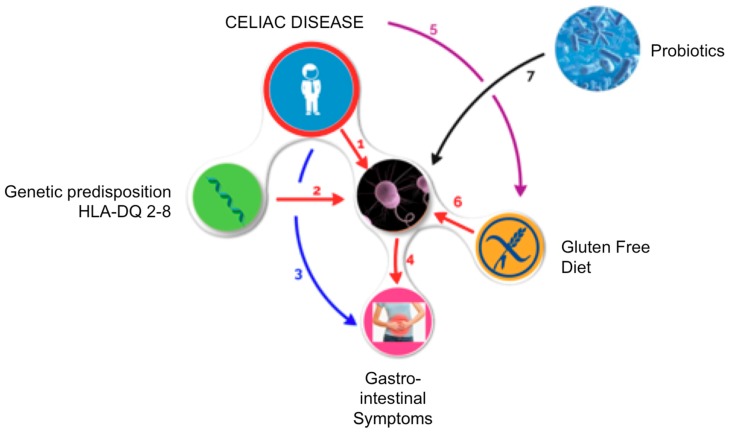
Recently, the interest in the human microbiome and its interplay with the host has exploded and provided new insights on its role in conferring host protection and regulating host physiology, including the correct development of immunity. However, in the presence of microbial imbalance and particular genetic settings, the microbiome may contribute to the dysfunction of host metabolism and physiology, leading to pathogenesis and/or the progression of several diseases. Celiac disease (CD) is a chronic autoimmune enteropathy triggered by dietary gluten exposure in genetically predisposed individuals. Despite ascertaining that gluten is the trigger in CD, evidence has indicated that intestinal microbiota is somehow involved in the pathogenesis, progression, and clinical presentation of CD. Indeed, several studies have reported imbalances in the intestinal microbiota of patients with CD that are mainly characterized by an increased abundance of spp. and a decrease in spp. The evidence that some of these microbial imbalances still persist in spite of a strict gluten-free diet and that celiac patients suffering from persistent gastrointestinal symptoms have a desert gut microbiota composition further support its close link with CD. All of this evidence gives rise to the hypothesis that probiotics might play a role in this condition. In this review, we describe the recent scientific evidences linking the gut microbiota in CD, starting from the possible role of microbes in CD pathogenesis, the attempt to define a microbial signature of disease, the effect of a gluten-free diet and host genetic assets regarding microbial composition to end in the exploration of the proof of concept of probiotic use in animal models to the most recent clinical application of selected probiotic strains.
最近,人们对人类微生物组及其与宿主的相互作用产生了浓厚的兴趣,并从中获得了新的认识,了解了其在赋予宿主保护和调节宿主生理机能(包括正确发育免疫功能)方面的作用。然而,在微生物失衡和特定遗传背景的情况下,微生物组可能会导致宿主代谢和生理机能的功能障碍,从而导致发病机制和/或多种疾病的进展。乳糜泻(CD)是一种由遗传易感个体摄入麸质引发的慢性自身免疫性肠病。尽管已经确定麸质是 CD 的触发因素,但有证据表明肠道微生物群在某种程度上参与了 CD 的发病机制、进展和临床表现。事实上,多项研究报告了 CD 患者肠道微生物群失衡,主要表现为 spp. 的丰度增加和 spp. 的减少。尽管患者坚持无麸质饮食,但仍存在一些微生物失衡的证据,且患有持续性胃肠道症状的 CD 患者的肠道微生物群组成类似于荒漠,这进一步支持了其与 CD 的密切联系。所有这些证据都使人们产生了这样一种假设,即益生菌可能在这种情况下发挥作用。在这篇综述中,我们描述了将肠道微生物群与 CD 联系起来的最新科学证据,从微生物在 CD 发病机制中的可能作用开始,尝试定义疾病的微生物特征,无麸质饮食和宿主遗传资产对微生物组成的影响,最终探索在动物模型中使用益生菌的概念验证,以及最近对选定益生菌菌株的临床应用。