Wernike Kerstin, Holsteg Mark, Szillat Kevin P, Beer Martin
Institute of Diagnostic Virology, Friedrich-Loeffler-Institut, Greifswald - Insel Riems, Germany.
Chamber of Agriculture for North Rhine-Westphalia, Bovine Health Service, Haus Riswick, Kleve, Germany.
BMC Vet Res. 2018 Nov 26;14(1):368. doi: 10.1186/s12917-018-1702-y.
In 2011, the teratogenic, insect-transmitted Schmallenberg virus (SBV) emerged at the German/Dutch border region and subsequently spread rapidly throughout the European continent. In cattle, one of the major target species of SBV, first antibodies are detectable between one and three weeks after infection, but the duration of humoral immunity is unknown. To assess the course of immunity in individual animals and the development of the within-herd seroprevalence, cattle kept in a German farm with a herd size of about 300 lactating animals were annually blood sampled between December 2011 and December 2017 and tested for the presence of SBV-specific antibodies.
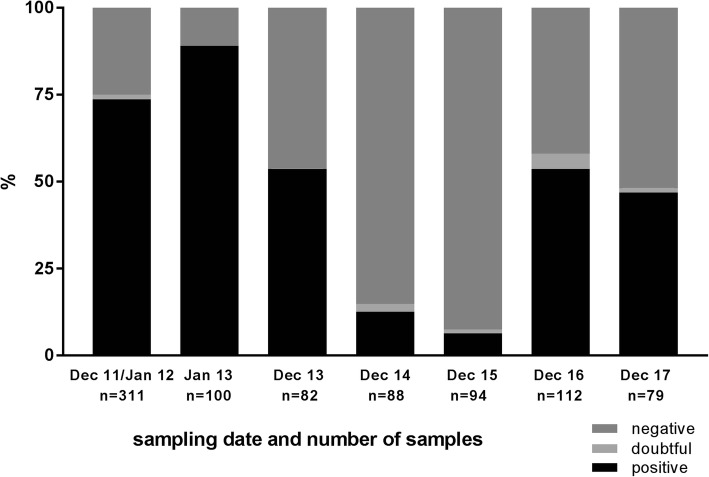
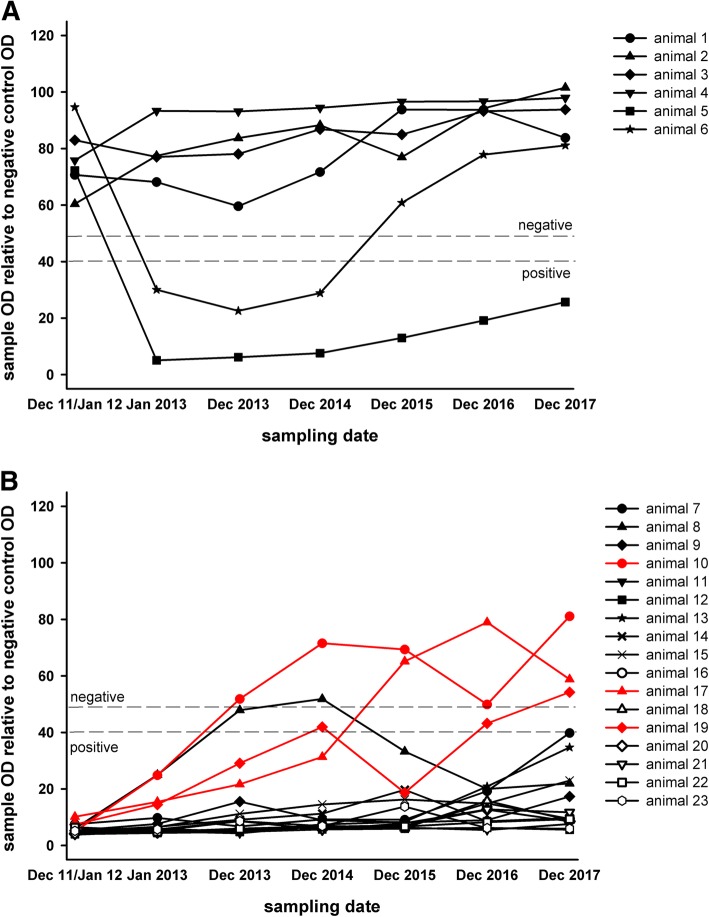
During the monitored period, the within-herd seroprevalence declined from 74.92% in 2011 to 39.93% in 2015 and, thereafter, slightly increased to 49.53% in 2016 and 48.44% in 2017. From the animals that were tested in 2014 and 2015 for the first time (between 24 and 35 months of age) only 14.77% and 7.45%, respectively, scored positive. Thereafter, the seropositivity rate of this age group rose markedly to 58.04% in 2016 and 48.10% in 2017 indicating a circulation of SBV. Twenty-three individual animals were consistently sampled once per year between 2011 and 2017 after the respective insect vector season, 17 of them tested positive at the first sampling. Fourteen animals were still seropositive in December 2017, while three cattle (17.65%) became seronegative.
The regular re-emergence of SBV in Central Europe is a result of decreasing herd immunity caused by the replacement of animals by seronegative youngstock rather than of a drop of antibody levels in previously infected individual animals. The consequences of the overall decline in herd seroprevalence may be increasing virus circulation and more cases of fetal malformation caused by infection of naïve dams during gestation.
2011年,致畸性、昆虫传播的施马伦贝格病毒(SBV)在德国/荷兰边境地区出现,随后迅速蔓延至欧洲大陆。在牛群中,牛是SBV的主要目标物种之一,感染后1至3周可检测到首批抗体,但体液免疫的持续时间尚不清楚。为了评估个体动物的免疫过程以及牛群内血清阳性率的发展情况,对德国一个约有300头泌乳动物的农场中的牛,在2011年12月至2017年12月期间每年进行采血,并检测是否存在SBV特异性抗体。
在监测期间,牛群内血清阳性率从2011年的74.92%下降到2015年的39.93%,此后略有上升,2016年为49.53%,2017年为48.44%。在2014年和2015年首次检测(24至35月龄)的动物中,分别只有14.77%和7.45%呈阳性。此后,该年龄组的血清阳性率在2016年显著上升至58.04%,2017年为48.10%,表明SBV在传播。2011年至2017年期间,每年在相应的昆虫传播季节后对23只个体动物进行一次采血,其中17只在首次采样时呈阳性。14只动物在2017年12月仍为血清阳性,而3头牛(17.65%)血清转阴。
SBV在中欧的定期再次出现是由于血清阴性的幼畜替代动物导致牛群免疫力下降,而非先前感染的个体动物抗体水平下降。牛群血清阳性率总体下降的后果可能是病毒传播增加,以及妊娠期间未感染的母畜感染导致更多胎儿畸形病例。