Mitzner Tracy L, Sanford Jon A, Rogers Wendy A
Center for Assistive Technology and Environmental Access, Georgia Institute of Technology, Atlanta.
Department of Kinesiology & Community Health, University of Illinois Urbana-Champaign.
Innov Aging. 2018 Apr 27;2(1):igy008. doi: 10.1093/geroni/igy008. eCollection 2018 Jan.
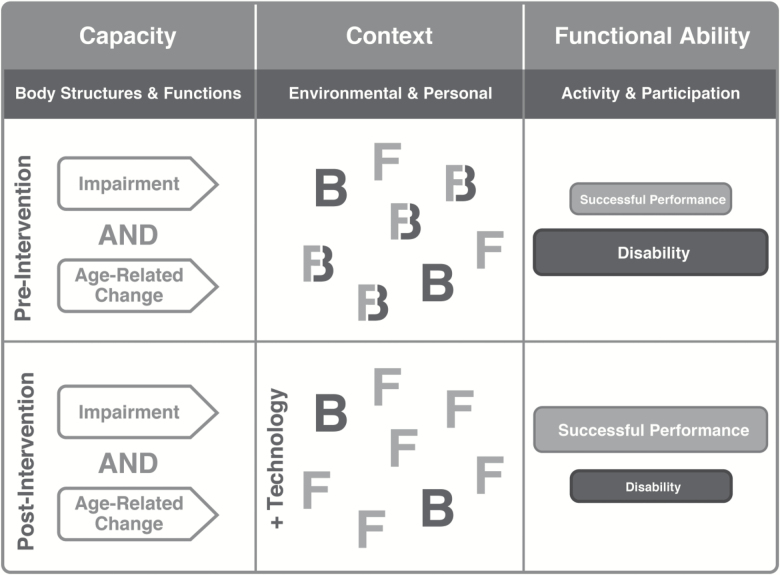
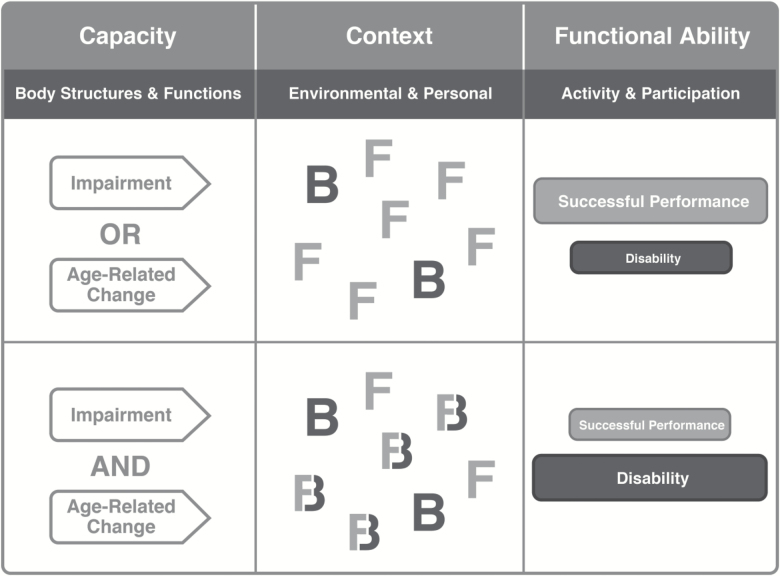
There is a critical need to develop supports for older adults who have a wide range of abilities, including those aging with long-term impairments. Without appropriate support, many individuals will be functioning below optimal levels and will face participation barriers. Technology holds great promise to provide individualized support for a wide range of abilities and for a variety of domains. To ensure technology interventions are designed well and meet research-documented user requirements, we need more specific, actionable models to provide guidance for those developing and designing interventions. In this paper, we present the TechSAge Aging and Disability Model to bridge models from the aging and disability literatures and to disambiguate the population of individuals aging into disability from those aging with disability (i.e., pre-existing impairments). We also present the TechSAge Technology Intervention Model to support aging with pre-existing impairments, which provides direction and touch points for technology interventions. These models reflect the complex and dynamic interaction between age-related changes and an individual's prior capabilities and limitations. We describe the need for these models with respect to filling a gap in the disability and aging literature by highlighting the importance of differentiating between age-related changes and long-term impairments when designing interventions. We also show the need for quantitative and qualitative data to refine the models given complexities of the current state of the literature and survey data. The TechSAge Technology Intervention Model can be used to drive and inform technology redesign and development.
迫切需要为具有广泛能力的老年人提供支持,包括那些因长期损伤而衰老的人。如果没有适当的支持,许多人的功能将低于最佳水平,并将面临参与障碍。技术有望为广泛的能力和各种领域提供个性化支持。为确保技术干预措施设计良好并满足研究记录的用户需求,我们需要更具体、可操作的模型,为开发和设计干预措施的人员提供指导。在本文中,我们提出了“技术促进老龄化与残疾模型”,以弥合老龄化和残疾文献中的模型,并区分逐渐出现残疾的老年人与患有残疾(即先前存在的损伤)的老年人。我们还提出了“技术促进老龄化技术干预模型”,以支持患有先前存在损伤的老年人,该模型为技术干预提供了方向和切入点。这些模型反映了与年龄相关的变化与个人先前的能力和限制之间复杂而动态的相互作用。我们通过强调在设计干预措施时区分与年龄相关的变化和长期损伤的重要性,描述了这些模型在填补残疾和老龄化文献空白方面的必要性。我们还表明,鉴于当前文献和调查数据的复杂性,需要定量和定性数据来完善这些模型。“技术促进老龄化技术干预模型”可用于推动和指导技术重新设计与开发。