
利用长单链 DNA 和 CRISPR Cas9 切口酶在小鼠中实现高效同源重组。
Efficient Homologous Recombination in Mice Using Long Single Stranded DNA and CRISPR Cas9 Nickase.
机构信息
Department of Molecular and Cellular Biology, Harvard University, Cambridge, MA 02138.
Department of Molecular and Cellular Biology, Harvard University, Cambridge, MA 02138
出版信息
G3 (Bethesda). 2019 Jan 9;9(1):281-286. doi: 10.1534/g3.118.200758.
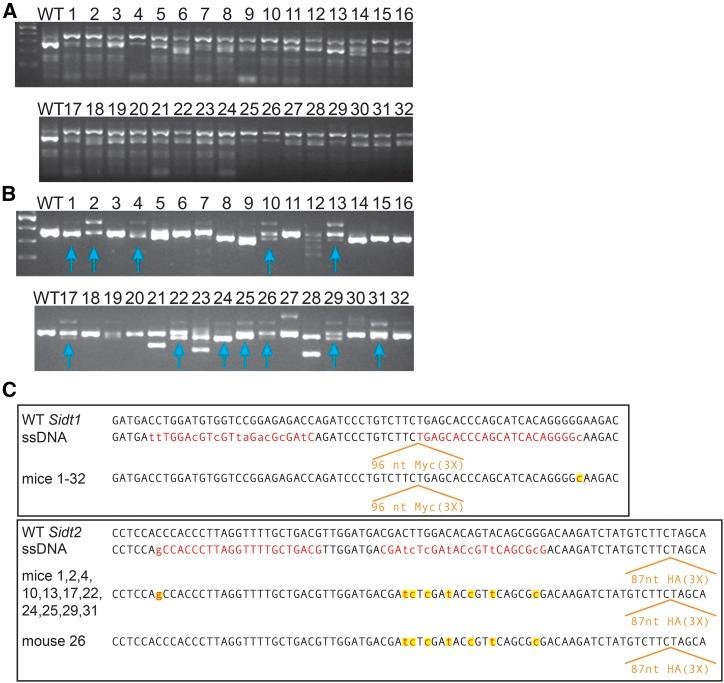
The CRISPR/Cas9 nickase mutant is less prone to off-target double-strand (ds)DNA breaks than wild-type Cas9 because to produce dsDNA cleavage it requires two guide RNAs to target the nickase to nearby opposing strands. Like wild-type Cas9 lesions, these staggered lesions are repaired by either non-homologous end joining or, if a repair template is provided, by homologous recombination (HR). Here, we report very efficient (up to 100%) recovery of heterozygous insertions in produced by long (>300 nt), single-stranded DNA donor template-guided repair of paired-nickase lesions.
CRISPR/Cas9 核酸酶突变体比野生型 Cas9 更不易发生脱靶双链 (ds)DNA 断裂,因为要产生 dsDNA 切割,它需要两个向导 RNA 将核酸酶靶向附近的互补链。与野生型 Cas9 损伤一样,这些交错损伤可通过非同源末端连接修复,或者如果提供修复模板,则通过同源重组 (HR) 修复。在这里,我们报告了通过长 (>300nt)、单链 DNA 供体模板引导的配对核酸酶损伤修复,对产生的杂合插入的非常有效的 (高达 100%) 恢复。


 Zotero 插件