School of Occupational Therapy, College of Medicine, National Taiwan University, Taipei, Taiwan.
Division of Occupational Therapy, Taipei Hospital, Ministry of Health and Welfare, New Taipei, Taiwan.
PLoS One. 2018 Dec 3;13(12):e0207851. doi: 10.1371/journal.pone.0207851. eCollection 2018.
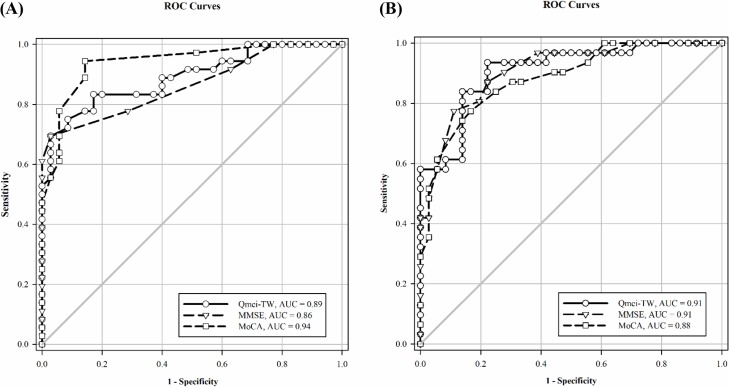
There is a need for a screening tool with capacities of accurate detection of early mild cognitive impairment (MCI) and dementia and is suitable for use in a range of languages and cultural contexts. This research aims to evaluate the psychometric and diagnostic properties of the Taiwan version of Qmci (Qmci-TW) screen and to explore the discriminating ability of the Qmci-TW in differentiating among normal controls (NCs), MCI and dementia. Thirty-one participants with dementia and 36 with MCI and 35 NCs were recruited from a neurology department of regional hospital in Taiwan. Their results on the Qmci-TW, Taiwanese version of the Montreal Cognitive Assessment (MoCA), and Traditional Chinese version of the Mini-Mental State Examination (MMSE) were compared. For analysis, we used Cronbach's α, intraclass correlation coefficient, Spearman's ρ, Kruskal-Wallis test, receiver operating characteristic curve analysis, and multivariate analysis, as appropriate. The Qmci-TW exhibited satisfactory test-retest reliability, internal consistency, and interrater reliability as well as a strong positive correlation with results from the MoCA and MMSE. The optimal cut-off score on the Qmci-TW for differentiating MCI from NC was ≤ 51.5/100 and dementia from MCI was ≤ 31/100. The MoCA exhibited the highest accuracy in differentiating MCI from NC, followed by the Qmci-TW and then MMSE; whereas, the Qmci-TW and MMSE exhibited the same accuracy in differentiating dementia from MCI, followed by the MoCA. The Qmci-TW may be a useful clinical screening tool for a spectrum of cognitive impairments.
需要一种具有准确检测早期轻度认知障碍(MCI)和痴呆能力的筛查工具,且该工具应适用于多种语言和文化背景。本研究旨在评估台湾版简易认知测验(Qmci-TW)的心理计量学和诊断特性,并探讨 Qmci-TW 在区分正常对照(NCs)、MCI 和痴呆方面的区分能力。从台湾地区医院的神经内科招募了 31 名痴呆症患者、36 名 MCI 患者和 35 名 NCs。比较了他们在 Qmci-TW、台湾蒙特利尔认知评估量表(MoCA)和繁体中文版简易精神状态检查(MMSE)上的结果。分析采用 Cronbach's α、组内相关系数、Spearman's ρ、Kruskal-Wallis 检验、受试者工作特征曲线分析和多变量分析。Qmci-TW 表现出令人满意的重测信度、内部一致性和评分者间信度,以及与 MoCA 和 MMSE 结果的强正相关。Qmci-TW 区分 MCI 与 NC 的最佳截断值为≤51.5/100,区分痴呆与 MCI 的最佳截断值为≤31/100。MoCA 在区分 MCI 与 NC 方面的准确性最高,其次是 Qmci-TW,然后是 MMSE;而 Qmci-TW 和 MMSE 在区分痴呆与 MCI 方面的准确性相同,其次是 MoCA。Qmci-TW 可能是一种用于多种认知障碍的有用的临床筛查工具。