Çabuk Burcu, Stone Andrea K, Korber Darren R, Tanaka Takuji, Nickerson Michael T
Department of Food and Bioproduct Sciences, University of Saskatchewan, 51 Campus Drive, Saskatoon, SK, S7N 5A8, Canada.
Food Technol Biotechnol. 2018 Sep;56(3):411-420. doi: 10.17113/ftb.56.03.18.5449.
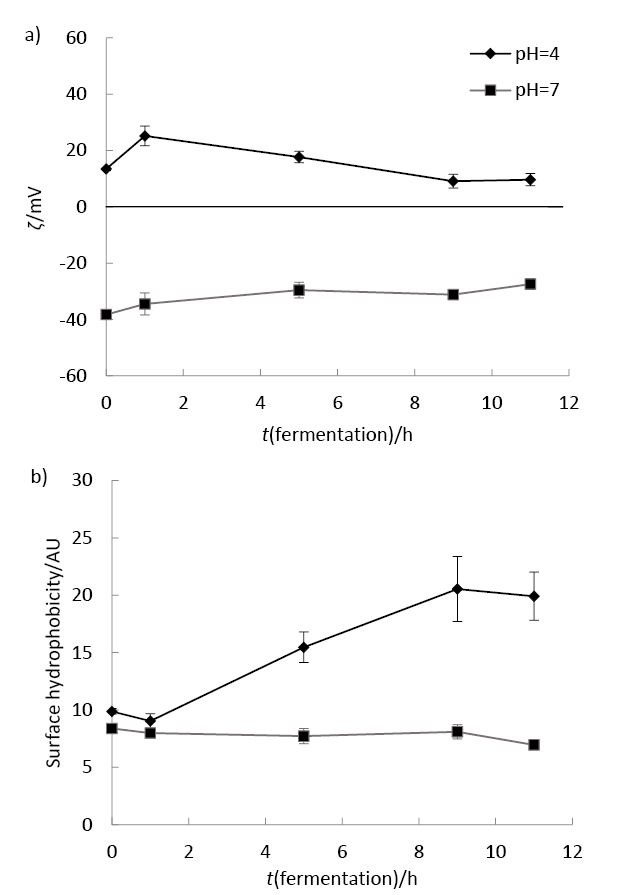
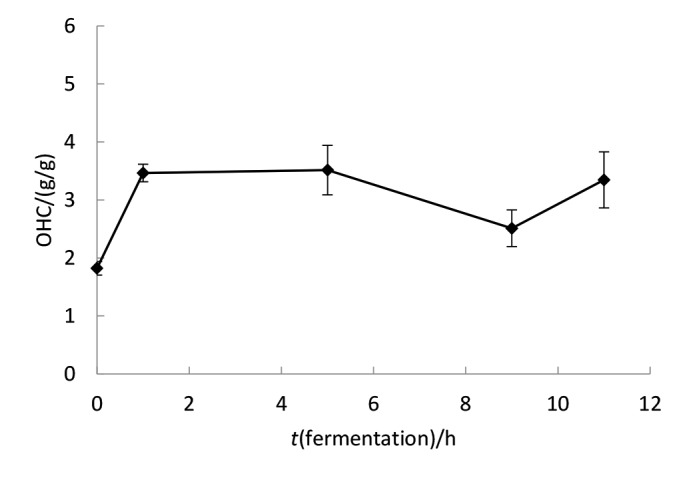
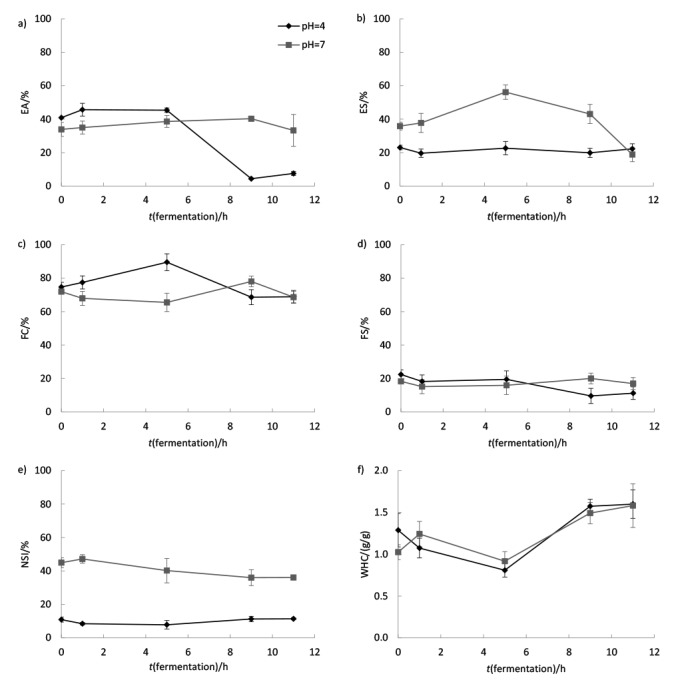
The effect of fermentation on the functional and physicochemical properties of pea protein-enriched flour (PPF) was investigated. Over the course of the fermentation the extent of hydrolysis increased continuously until reaching a maximum degree of hydrolysis of 13.5% after 11 h. The resulting fermented flour was then adjusted to either pH=4 or 7 prior to measuring the surface and functional attributes as a function of fermentation time. At pH=4 surface charge, as measured by zeta potential, initially increased from +14 to +27 mV after 1 h of fermentation, and then decreased to +10 mV after 11 h; whereas at pH=7 the charge gradually increased from -37 to -27 mV over the entire fermentation time. Surface hydrophobicity significantly increased at pH=4 as a function of fermentation time, whereas at pH=7 fermentation induced only a slight decrease in PPF surface hydrophobicity. Foam capacity was highest at pH=4 using PPF fermented for 5 h whereas foam stability was low at both pH values for all samples. Emulsifying activity sharply decreased after 5 h of fermentation at pH=4. Emulsion stability improved at pH=7 after 5 h of fermentation as compared to the control. Oil-holding capacity improved from 1.8 g/g at time 0 to 3.5 g/g by the end of 11 h of fermentation, whereas water hydration capacity decreased after 5 h, then increased after 9 h of fermentation. These results indicate that the fermentation of PPF can modify its properties, which can lead towards its utilization as a functional food ingredient.
研究了发酵对富含豌豆蛋白的面粉(PPF)功能和理化性质的影响。在发酵过程中,水解程度持续增加,直至11小时后达到最大水解度13.5%。然后在测量表面和功能属性作为发酵时间的函数之前,将所得发酵面粉的pH值调节至4或7。在pH = 4时,通过zeta电位测量的表面电荷在发酵1小时后最初从+14 mV增加到+27 mV,然后在11小时后降至+10 mV;而在pH = 7时,电荷在整个发酵时间内从-37 mV逐渐增加到-27 mV。在pH = 4时,表面疏水性随发酵时间显著增加,而在pH = 7时,发酵仅导致PPF表面疏水性略有下降。使用发酵5小时的PPF时,泡沫容量在pH = 4时最高,而所有样品在两个pH值下的泡沫稳定性都较低。在pH = 4时发酵5小时后,乳化活性急剧下降。与对照相比,在pH = 7时发酵5小时后乳液稳定性提高。持油能力从0小时的1.8 g/g提高到发酵11小时结束时的3.5 g/g,而水合能力在5小时后下降,然后在发酵9小时后增加。这些结果表明,PPF的发酵可以改变其性质,这可能使其能够用作功能性食品成分。