CEREB - Center for Empirical Research in Economics and Behavioral Sciences, University of Erfurt, Erfurt, Germany.
Media and Communication Science, University of Erfurt, Erfurt, Germany.
PLoS One. 2018 Dec 7;13(12):e0208601. doi: 10.1371/journal.pone.0208601. eCollection 2018.
Monitoring the reasons why a considerable number of people do not receive recommended vaccinations allows identification of important trends over time, and designing and evaluating strategies to address vaccine hesitancy and increase vaccine uptake. Existing validated measures assessing vaccine hesitancy focus primarily on confidence in vaccines and the system that delivers them. However, empirical and theoretical work has stated that complacency (not perceiving diseases as high risk), constraints (structural and psychological barriers), calculation (engagement in extensive information searching), and aspects pertaining to collective responsibility (willingness to protect others) also play a role in explaining vaccination behavior. The objective was therefore to develop a validated measure of these 5C psychological antecedents of vaccination.
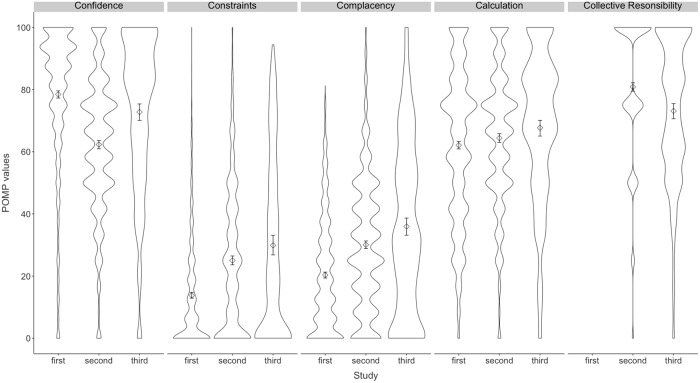
Three cross-sectional studies were conducted. Study 1 uses factor analysis to develop an initial scale and assesses the sub-scales' convergent, discriminant, and concurrent validity (N = 1,445, two German convenience-samples). In Study 2, a sample representative regarding age and gender for the German population (N = 1,003) completed the measure for vaccination in general and for specific vaccinations to assess the potential need for a vaccine-specific wording of items. Study 3 compared the novel scale's performance with six existing measures of vaccine hesitancy (N = 350, US convenience-sample). As an outcome, a long (15-item) and short (5-item) 5C scale were developed as reliable and valid indicators of confidence, complacency, constraints, calculation, and collective responsibility. The 5C sub-scales correlated with relevant psychological concepts, such as attitude (confidence), perceived personal health status and invulnerability (complacency), self-control (constraints), preference for deliberation (calculation), and communal orientation (collective responsibility), among others. The new scale provided similar results when formulated in a general vs. vaccine-specific way (Study 2). In a comparison of seven measures the 5C scale was constantly among the scales that explained the highest amounts of variance in analyses predicting single vaccinations (between 20% and 40%; Study 3). The present studies are limited to the concurrent validity of the scales.
The 5C scale provides a novel tool to monitor psychological antecedents of vaccination and facilitates diagnosis, intervention design and evaluation. Its short version is suitable for field settings and regular global monitoring of relevant antecedents of vaccination.
监测大量人群未接受推荐疫苗接种的原因,可及时发现重要趋势,并设计和评估解决疫苗犹豫和提高疫苗接种率的策略。现有的经过验证的评估疫苗犹豫的措施主要侧重于对疫苗及其接种系统的信心。然而,实证和理论工作已经指出,自满(不认为疾病风险高)、限制(结构性和心理障碍)、计算(广泛搜索信息)以及与集体责任有关的方面(愿意保护他人)也在解释接种疫苗行为方面发挥作用。因此,本研究旨在开发一个经过验证的衡量这 5C 个接种疫苗心理前因的工具。
进行了三项横断面研究。研究 1 使用因子分析开发初始量表,并评估子量表的收敛、区分和同时效度(N=1445,两个德国便利样本)。在研究 2 中,一个针对德国人口年龄和性别具有代表性的样本(N=1003)完成了一般疫苗接种和特定疫苗接种的测量,以评估项目需要特定疫苗措辞的可能性。研究 3 将新量表的性能与六种现有的疫苗犹豫评估工具进行比较(N=350,美国便利样本)。作为结果,开发了一个长(15 项)和短(5 项)的 5C 量表,作为信心、自满、限制、计算和集体责任的可靠和有效指标。5C 子量表与相关心理概念相关,例如态度(信心)、感知个人健康状况和免疫力(自满)、自我控制(限制)、偏好深思熟虑(计算)和公共取向(集体责任)等。当以一般形式与疫苗特异性形式制定时,新量表在研究 2 中提供了相似的结果。在七种量表的比较中,5C 量表始终是预测单一疫苗接种的分析中解释方差最高的量表之一(20% 到 40%之间;研究 3)。本研究仅限于量表的同时效度。
5C 量表提供了一种监测接种疫苗心理前因的新工具,并促进了诊断、干预设计和评估。其简短版本适用于现场环境和对相关疫苗接种前因的定期全球监测。