Basheti Iman A, Obeidat Nathir M, Reddel Helen K
Department of Clinical Pharmacy & Therapeutics, Faculty of Pharmacy, Applied Science Private University, Amman, Jordan.
Department of Internal Medicine, Faculty of Medicine, University of Jordan, Respiratory and Sleep Medicine, Jordan University Hospital, Jordan.
Saudi Pharm J. 2018 Dec;26(8):1127-1136. doi: 10.1016/j.jsps.2018.06.002. Epub 2018 Jul 7.
To investigate the effect of inhaler technique education delivered by a clinical pharmacist to patients hospitalised for asthma, on inhaler technique scores and asthma control at three months post-discharge.
This pre-post interventional study in Jordan enrolled patients who had been admitted for asthma and were using controller medication by Accuhaler [Diskus] (ACC), Turbuhaler (TH) or Pressurized metered dose inhalers (pMDI). Inhaler technique was assessed using published checklists (score 0-9). Asthma symptom control was assessed by Asthma Control Test (ACT, range 5-25). Patients were assessed on admission (baseline), pre-discharge, and 3 months later. All patients received a 'Show-and-Tell' inhaler technique counseling service prior to discharge.
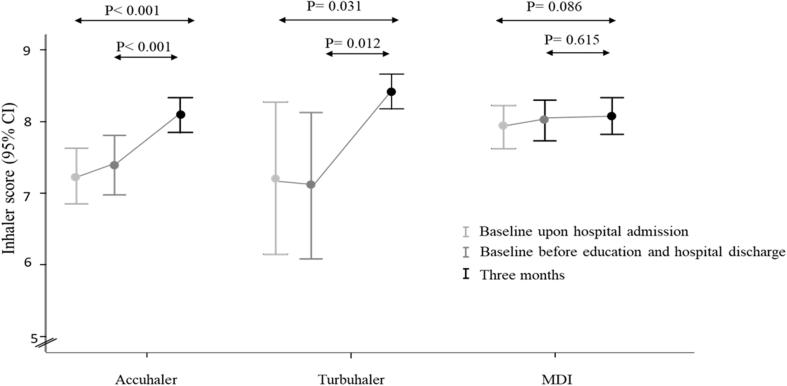
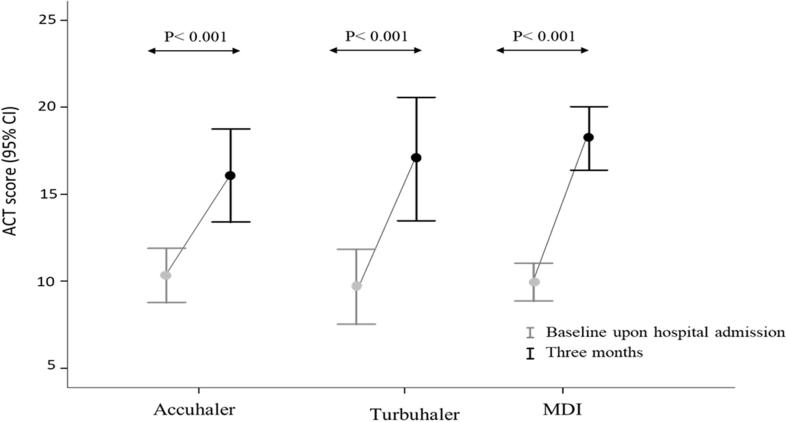
Baseline data were available for 140 patients, 71% females, mean age 52.7 (SD 16.64) years, mean ACT score 10.0 (SD 4.8). Mean inhaler score was 7.5 (SD 1.52) with no significant difference between the inhaler groups (p = 0.174). After pre-discharge training, all patients had correct technique (score 9/9). After 3 months, mean inhaler scores were significantly higher than at baseline (8.14 (SD 0.87, p < 0.001), with mean change significantly higher for TH 1.21 (SD 2.25) and ACC 0.85 (SD 0.97) than pMDI (0.16; SD 0.72), p = 0.001. Symptom control improved significantly for all patients, with a mean increase in ACT score of 7.54 (SD 8.18), with no significant difference between the inhaler device groups (p = 0.326).
Patients hospitalized for asthma achieved correct inhaler technique after training by a pharmacist, and maintained better technique at 3 months than on admission. Significant improvements in ACT scores were documented for all inhaler groups.
探讨临床药师对因哮喘住院患者进行吸入器技术教育,对出院后三个月时吸入器技术评分和哮喘控制情况的影响。
这项在约旦进行的前后对照干预性研究纳入了因哮喘入院且正在使用准纳器(Accuhaler [Diskus],ACC)、都保(Turbuhaler,TH)或压力定量吸入器(pMDI)进行控制治疗的患者。使用已发表的检查表(评分0 - 9分)评估吸入器技术。通过哮喘控制测试(ACT,范围5 - 25)评估哮喘症状控制情况。在入院时(基线)、出院前和3个月后对患者进行评估。所有患者在出院前均接受了“演示与讲解”吸入器技术咨询服务。
140例患者有基线数据,其中71%为女性,平均年龄52.7(标准差16.64)岁,平均ACT评分为10.0(标准差4.8)。平均吸入器评分为7.5(标准差1.52),各吸入器组之间无显著差异(p = 0.174)。出院前培训后,所有患者的技术均正确(评分9/9)。3个月后,平均吸入器评分显著高于基线(8.14(标准差0.87,p < 0.001),TH组平均变化1.21(标准差2.25)和ACC组0.85(标准差0.97)显著高于pMDI组(0.16;标准差0.72),p = 0.001。所有患者的症状控制均显著改善,ACT评分平均增加7.54(标准差8.18),各吸入器装置组之间无显著差异(p = 0.326)。
因哮喘住院的患者经药师培训后掌握了正确的吸入器技术,且在3个月时的技术水平优于入院时。所有吸入器组的ACT评分均有显著改善。