O'Gara Brian, Marcantonio Edward R, Pascual-Leone Alvaro, Shaefi Shahzad, Mueller Ariel, Banner-Goodspeed Valerie, Talmor Daniel, Subramaniam Balachundhar
Department of Anesthesia, Critical Care and Pain Medicine, Beth Israel Deaconess Medical Center, Harvard Medical School, 330 Brookline Ave, Boston, MA, 02215, USA.
Division of General Medicine and Primary Care, Beth Israel Deaconess Medical Center, Harvard Medical School, 330 Brookline Ave, Boston, MA, 02215, USA.
Trials. 2018 Dec 11;19(1):676. doi: 10.1186/s13063-018-3063-z.
Delirium is associated with a significantly increased risk of postoperative morbidity and mortality. Furthermore, delirium has been associated with an increased risk of prolonged cognitive deficits and accelerated long-term cognitive decline. To date, experimental interventions for delirium have mainly focused on alternative pharmacologic and behavioral strategies in the postoperative period. Few studies have examined whether proactive strategies started before surgery can prevent delirium or reduce its sequelae. Neurocognitive training programs such as Lumosity have been shown to be effective in increasing cognitive performance in both elderly healthy volunteers and patients suffering from a myriad of acute and chronic medical conditions. When initiated in the preoperative period, such training programs may serve as interesting and novel patient-led interventions for the prevention of delirium and postoperative cognitive decline (POCD). We hypothesize that perioperative neurocognitive training is feasible in the older cardiac surgical population and are testing this hypothesis using a randomized controlled design.
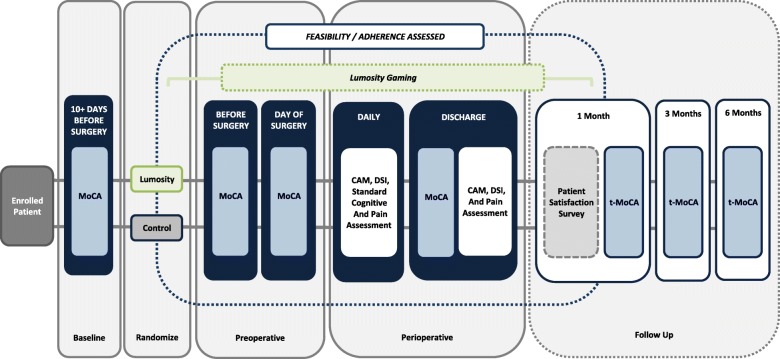
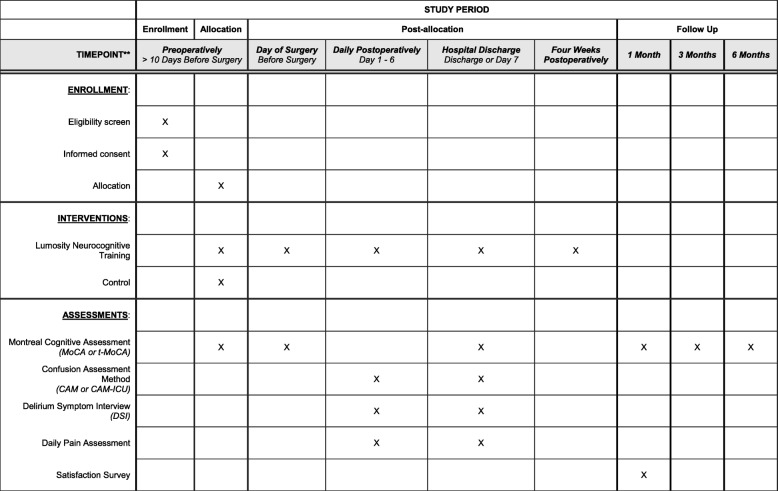
The Prevention of Early Postoperative Decline (PEaPoD) study is a randomized, controlled trial with a target enrollment of 45 elderly cardiac surgical patients. Subjects will be randomized in a 1:1 ratio to undergo either at least 10 days of preoperative neurocognitive training, continued for 4 weeks postoperatively, or usual care control. The primary outcome, feasibility, will be assessed by study recruitment and adherence to protocol. Secondary outcomes will include potential differences in the incidence of postoperative in-hospital delirium and POCD up to 6 months, as determined by the Confusion Assessment Method and the Montreal Cognitive Assessment.
PEaPoD will be the first trial investigating the use of perioperative cognitive training to potentially reduce delirium and POCD in the cardiac surgical population. Information gleaned from this feasibility study will prove valuable in designing future efficacy studies aimed at determining whether this low-risk, patient-led intervention can reduce serious postoperative morbidity.
ClinicalTrials.gov, NCT02908464 . Registered on 21 September 2016.
谵妄与术后发病率和死亡率显著增加相关。此外,谵妄还与长期认知缺陷风险增加及长期认知衰退加速有关。迄今为止,针对谵妄的实验性干预主要集中在术后的替代药物和行为策略上。很少有研究探讨术前启动的主动策略是否能预防谵妄或减少其后遗症。诸如Lumosity等神经认知训练项目已被证明在提高老年健康志愿者以及患有各种急慢性疾病患者的认知表现方面是有效的。在术前阶段启动此类训练项目,可能成为预防谵妄和术后认知衰退(POCD)的有趣且新颖的患者主导干预措施。我们假设围手术期神经认知训练在老年心脏手术人群中是可行的,并正在使用随机对照设计来验证这一假设。
预防术后早期衰退(PEaPoD)研究是一项随机对照试验,目标招募45名老年心脏手术患者。受试者将按1:1比例随机分组,分别接受至少10天的术前神经认知训练,并在术后持续4周,或接受常规护理对照。主要结局指标——可行性,将通过研究招募情况和对方案的依从性来评估。次要结局指标将包括术后住院期间谵妄和长达6个月的POCD发生率的潜在差异,由混乱评估法和蒙特利尔认知评估确定。
PEaPoD将是首个研究围手术期认知训练对心脏手术人群潜在减少谵妄和POCD作用的试验。从这项可行性研究中收集的信息对于设计未来的疗效研究将具有重要价值,这些研究旨在确定这种低风险、患者主导的干预措施是否能降低严重的术后发病率。
ClinicalTrials.gov,NCT02908464。于2016年9月21日注册。