Giang Nguyen Truong, Van Nam Nguyen, Trung Nguyen Ngoc, Anh Le Viet, Cuong Nguyen Manh, Van Dinh Ngo, Pho Dinh Cong, Geiger Phillip, Kien Nguyen Trung
Department of Cardiothoracic Surgery, Military Hospital 103, Vietnam Military Medical University, Hanoi, Vietnam.
Department of Anesthesia and Pain Medicine, Military Hospital 103, Vietnam Military Medical University, Hanoi, Vietnam,
Local Reg Anesth. 2018 Nov 22;11:115-121. doi: 10.2147/LRA.S184589. eCollection 2018.
Paravertebral block has been proven to be an efficient method to provide post-thoracotomy pain management. This study aimed to compare patient-controlled paravertebral analgesia (PCPA) and intravenous patient-controlled analgesia (IVPCA) in terms of analgesic efficiency, respiratory function, and adverse effects after video-assisted thoracoscopic surgery (VATS) lobectomy.
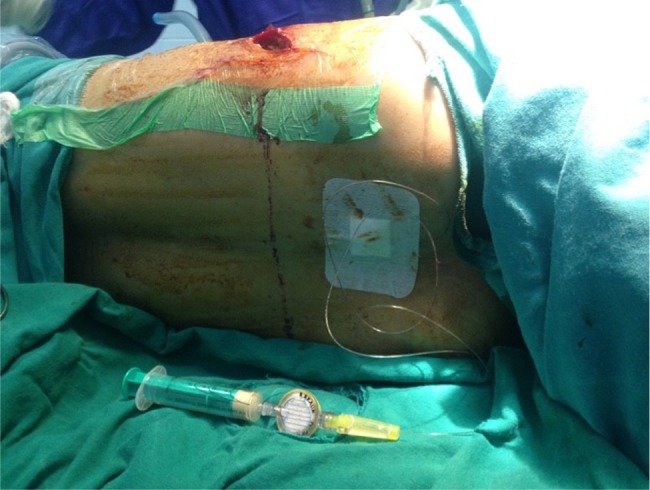
The prospective randomized trial study was carried out on 60 patients who underwent VATS lobectomy (randomly allocated 30 patients in each group). In the PCPA group, an initial dose of 0.3 mL/kg of 0.125% bupivacaine with fentanyl 2 µg/mL was administered, followed by a 3 mL/h continuous infusion with patient-controlled analgesia (2 mL bolus, 10-minute lockout interval, 25 mL/4 h limit). In the IVPCA group with morphine 1 mg/mL solution, an infusion device was programmed to deliver a 1.0 mL demand bolus with no basal infusion rate, with a 10-minute lockout interval and a maximum of 20 mL/4 h period. Postoperative pain was assessed by visual analog scale at rest and on coughing. Arterial blood gas and spirometry were monitored and recorded for the first 3 postoperative days. Side effects to include were also recorded.
The PCPA group had statistically significant lower pain scores (<0.0001) at rest at all times. Lower pain scores on coughing were statistically significant in PCPA group in the first 4 hours. Postoperative spirometry showed that both the groups had comparable recovery trajectories for their pulmonary function. Arterial blood gas analysis showed pH and PaCO were in a normal range in both the groups. The incidence of headache was higher in the IVPCA group (13.3% vs 0%; =0.038).
PCPA effectively managed pain after VATS lobectomy, with lower pain scores, similar respiratory function, and fewer side effects than standard IVPCA treatment.
椎旁阻滞已被证明是一种有效的开胸术后疼痛管理方法。本研究旨在比较电视辅助胸腔镜手术(VATS)肺叶切除术后患者自控椎旁镇痛(PCPA)和静脉自控镇痛(IVPCA)在镇痛效果、呼吸功能及不良反应方面的差异。
对60例行VATS肺叶切除术的患者进行前瞻性随机试验研究(每组随机分配30例患者)。PCPA组给予初始剂量为0.3 mL/kg的0.125%布比卡因与2 μg/mL芬太尼混合液,随后以3 mL/h的速度持续输注并采用患者自控镇痛(2 mL推注量,锁定时间间隔10分钟,4小时限量25 mL)。IVPCA组使用1 mg/mL吗啡溶液,输液装置设置为给予1.0 mL按需推注量,无基础输注速率,锁定时间间隔10分钟,4小时最大限量20 mL。术后通过视觉模拟评分法评估静息和咳嗽时的疼痛程度。术后前3天监测并记录动脉血气和肺功能测定结果。同时记录包括的不良反应。
PCPA组在所有时间点静息时的疼痛评分均有统计学显著降低(<0.0001)。PCPA组在术后前4小时咳嗽时的疼痛评分较低,具有统计学显著性。术后肺功能测定显示两组肺功能恢复轨迹相似。动脉血气分析显示两组的pH值和PaCO均在正常范围内。IVPCA组头痛发生率较高(13.3%对0%;P=0.038)。
PCPA能有效管理VATS肺叶切除术后的疼痛,与标准IVPCA治疗相比,疼痛评分更低,呼吸功能相似,不良反应更少。