Obstetrics and Gynecology Hospital, Fudan University, Shanghai, 200011, China.
Department of Obstetrics and Gynecology of Shanghai Medical College, Fudan University, Shanghai, 200032, China.
BMC Cancer. 2018 Dec 17;18(1):1256. doi: 10.1186/s12885-018-5170-3.
Exhibiting high consistence in sequence and structure, S100 family members are interchangeable in function and they show a wide spectrum of biological processes, including proliferation, apoptosis, migration, inflammation and differentiation and the like. While the prognostic value of each individual S100 in ovarian cancer is still elusive. In current study, we investigated the prognostic value of S100 family members in the ovarian cancer.
We used the Kaplan Meier plotter (KM plotter) database, in which updated gene expression data and survival information are from 1657 ovarian cancer patients, to assess the relevance of individual S100 family mRNA expression to overall survival in various ovarian cancer subtypes and different clinicopathological features.
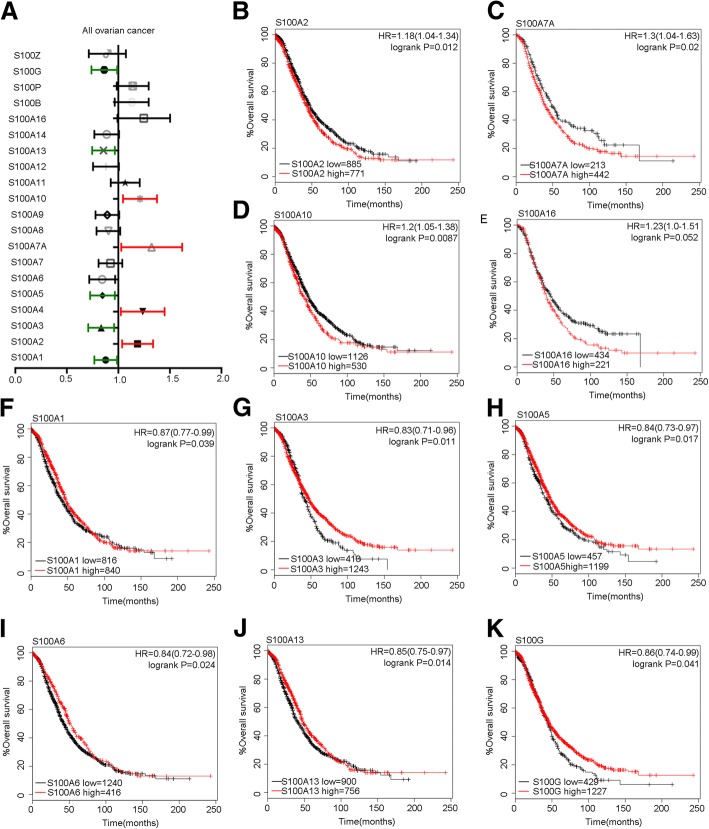
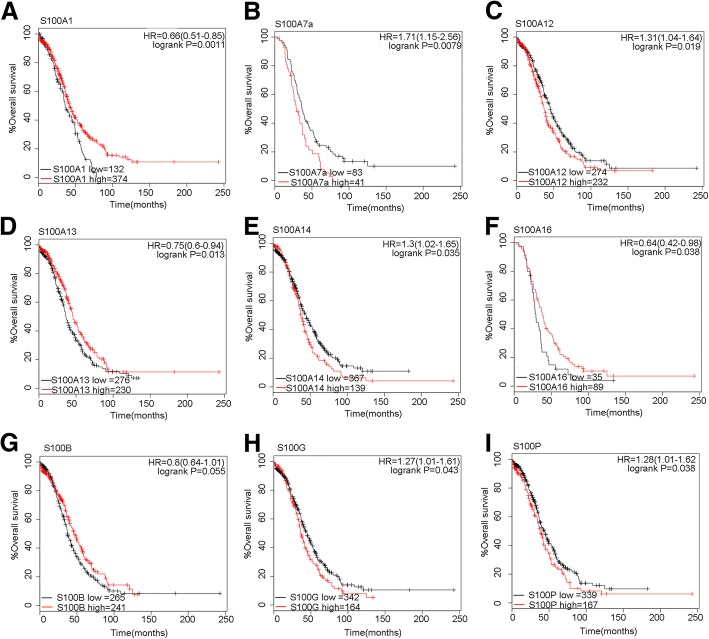
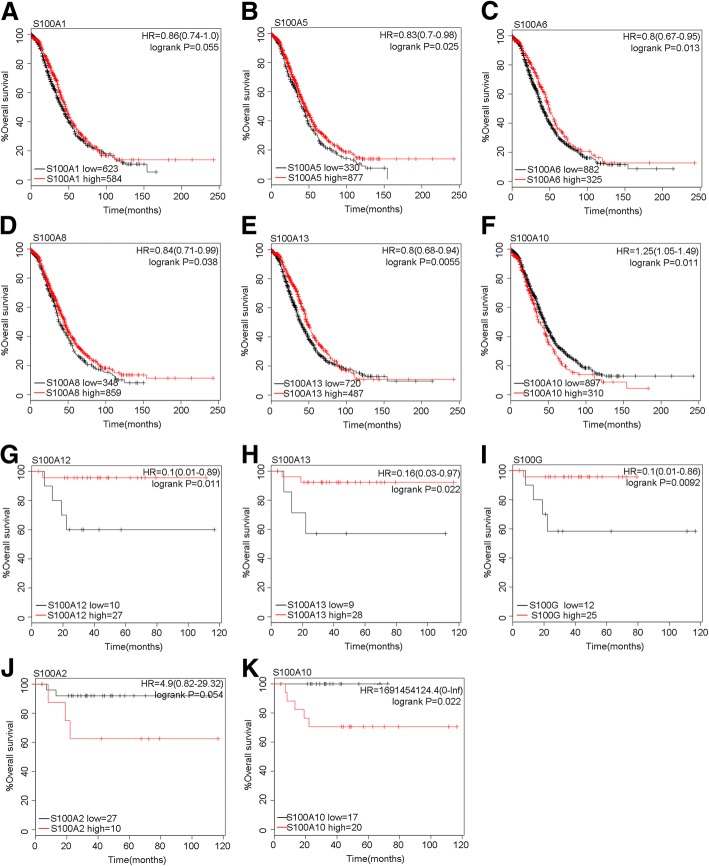
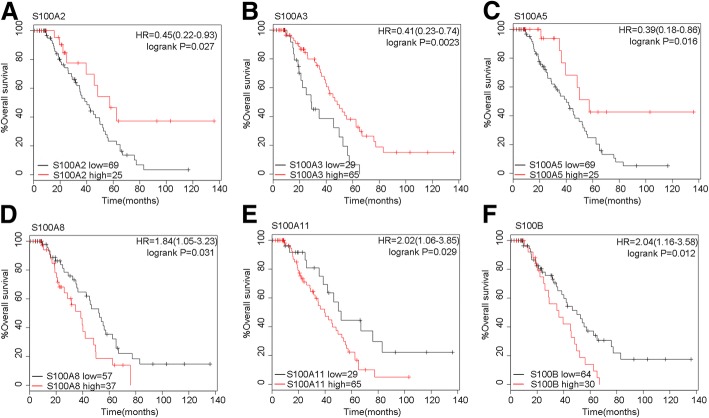
It was found that high expression of S100A2 (HR = 1.18, 95%CI: 1.04-1.34, P = 0.012), S100A7A (HR = 1.3, 95%CI: 1.04-1.63, P = 0.02),S100A10 (HR = 1.2, 95%CI: 1.05-1.38, P = 0.0087),and S100A16 (HR = 1.23, 95%CI: 1-1.51, P = 0.052) were significantly correlated with worse OS in all ovarian cancer patients, while the expression of S100A1 (HR = 0.87, 95%CI: 0.77-0.99, P = 0.039), S100A3 (HR = 0.83, 95%CI: 0.71-0.96, P = 0.0011), S100A5 (HR = 0.84, 95%CI: 0.73-0.97, P = 0.017), S100A6 (HR = 0.84, 95%CI: 0.72-0.98, P = 0.024), S100A13 (HR = 0.85, 95%CI:0.75-0.97, P = 0.014) and S100G (HR = 0.86, 95%CI: 0.74-0.99, P = 0.041) were associated with better prognosis. Furthermore, we assessed the prognostic value of S100 expression in different subtypes and the clinicopathological features, including pathological grades, clinical stages and TP53 mutation status, of ovarian cancer patients.
Comprehensive understanding of the S100 family members may have guiding significance for the diagnosis and outcome of ovarian cancer patients.
S100 家族成员在序列和结构上具有高度一致性,它们在功能上是可互换的,表现出广泛的生物学过程,包括增殖、凋亡、迁移、炎症和分化等。然而,每个 S100 蛋白在卵巢癌中的预后价值仍然难以捉摸。在本研究中,我们研究了 S100 家族成员在卵巢癌中的预后价值。
我们使用 Kaplan Meier plotter(KM plotter)数据库,其中更新的基因表达数据和生存信息来自 1657 名卵巢癌患者,评估个体 S100 家族 mRNA 表达与各种卵巢癌亚型和不同临床病理特征的总生存率之间的相关性。
我们发现 S100A2(HR=1.18,95%CI:1.04-1.34,P=0.012)、S100A7A(HR=1.3,95%CI:1.04-1.63,P=0.02)、S100A10(HR=1.2,95%CI:1.05-1.38,P=0.0087)和 S100A16(HR=1.23,95%CI:1-1.51,P=0.052)的高表达与所有卵巢癌患者的 OS 较差显著相关,而 S100A1(HR=0.87,95%CI:0.77-0.99,P=0.039)、S100A3(HR=0.83,95%CI:0.71-0.96,P=0.0011)、S100A5(HR=0.84,95%CI:0.73-0.97,P=0.017)、S100A6(HR=0.84,95%CI:0.72-0.98,P=0.024)、S100A13(HR=0.85,95%CI:0.75-0.97,P=0.014)和 S100G(HR=0.86,95%CI:0.74-0.99,P=0.041)的表达与较好的预后相关。此外,我们评估了 S100 表达在不同亚型和临床病理特征(包括病理分级、临床分期和 TP53 突变状态)中的预后价值。
全面了解 S100 家族成员可能对卵巢癌患者的诊断和预后具有指导意义。