Department of Disease Control, London School of Hygiene & Tropical Medicine, London, UK.
Department of Population Medicine, College of Medicine, Qatar University, Doha, Qatar.
Malar J. 2018 Dec 18;17(1):479. doi: 10.1186/s12936-018-2632-7.
The proportion of mosquito blood-meals that are of human origin, referred to as the 'human blood index' or HBI, is a key determinant of malaria transmission.
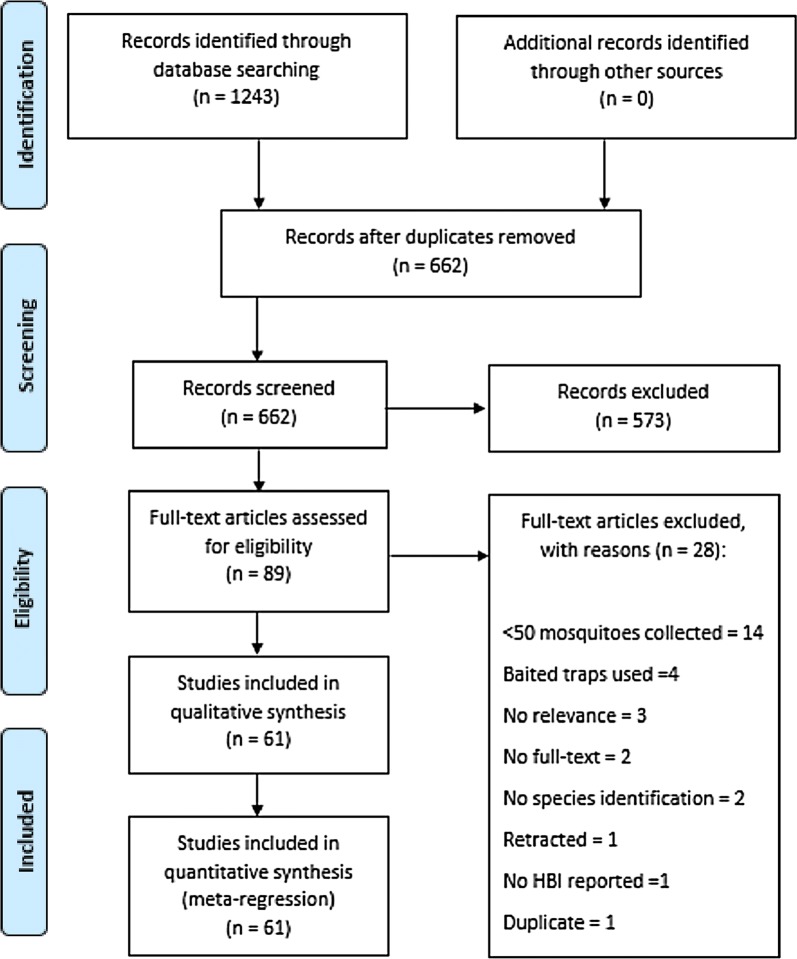
A systematic review was conducted followed by meta-regression of the HBI for the major African malaria vectors.
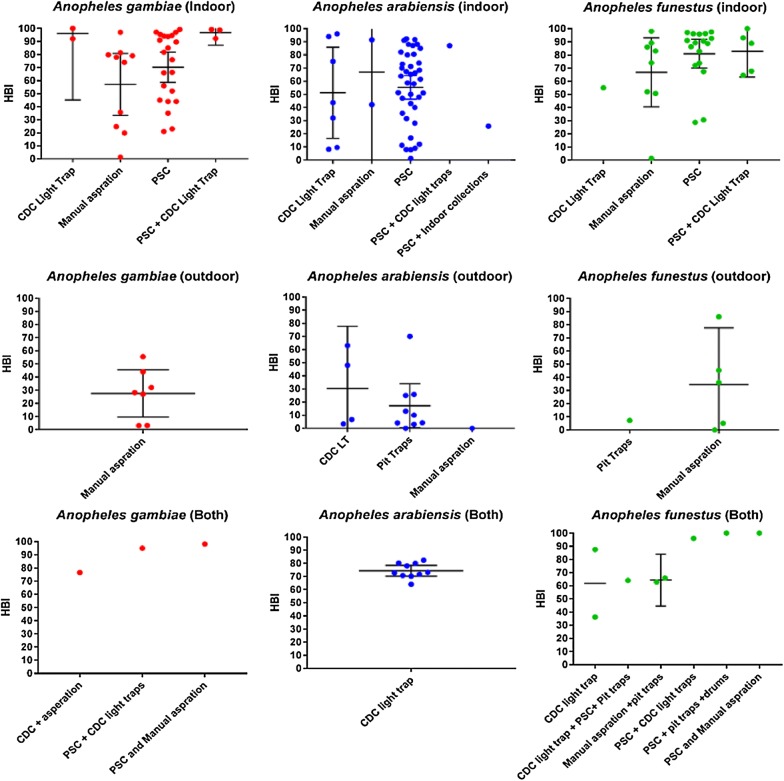
Evidence is presented for higher HBI among Anopheles gambiae (M/S forms and Anopheles coluzzii/An. gambiae sensu stricto are not distinguished for most studies and, therefore, combined) as well as Anopheles funestus when compared with Anopheles arabiensis (prevalence odds ratio adjusted for collection location [i.e. indoor or outdoor]: 1.62; 95% CI 1.09-2.42; 1.84; 95% CI 1.35-2.52, respectively). This finding is in keeping with the entomological literature which describes An. arabiensis to be more zoophagic than the other major African vectors. However, analysis also revealed that HBI was more associated with location of mosquito captures (R = 0.29) than with mosquito (sibling) species (R = 0.11).
These findings call into question the appropriateness of current methods of assessing host preferences among disease vectors and have important implications for strategizing vector control.
以蚊血中源自人类的比例,即“人血指数”或 HBI 来衡量,是疟疾传播的关键决定因素。
对主要的非洲疟疾传播媒介的 HBI 进行了系统评价和荟萃回归分析。
与 Anopheles arabiensis 相比,证据表明 Anopheles gambiae(M/S 形式和 Anopheles coluzzii/An. gambiae sensu stricto 在大多数研究中没有区分,因此合并在一起)以及 Anopheles funestus 的 HBI 更高(经采集地点(室内或室外)调整的流行优势比:1.62;95%CI 1.09-2.42;1.84;95%CI 1.35-2.52)。这一发现与昆虫学文献一致,该文献描述 An. arabiensis 比其他主要的非洲媒介更偏向于捕食动物。然而,分析还表明,HBI 与蚊子捕获地点的相关性(R=0.29)大于与蚊子(亲缘)种的相关性(R=0.11)。
这些发现对当前评估疾病传播媒介宿主偏好的方法的适当性提出了质疑,并对制定蚊虫控制策略具有重要意义。