Erasmus Choice Modelling Centre, Erasmus University, Rotterdam, The Netherlands.
Duke Clinical Research Institute, Duke University, Durham, North Carolina.
Health Econ. 2019 Mar;28(3):350-363. doi: 10.1002/hec.3846. Epub 2018 Dec 18.
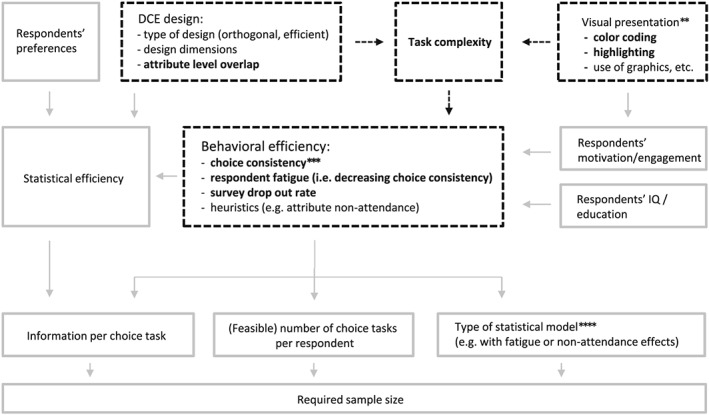
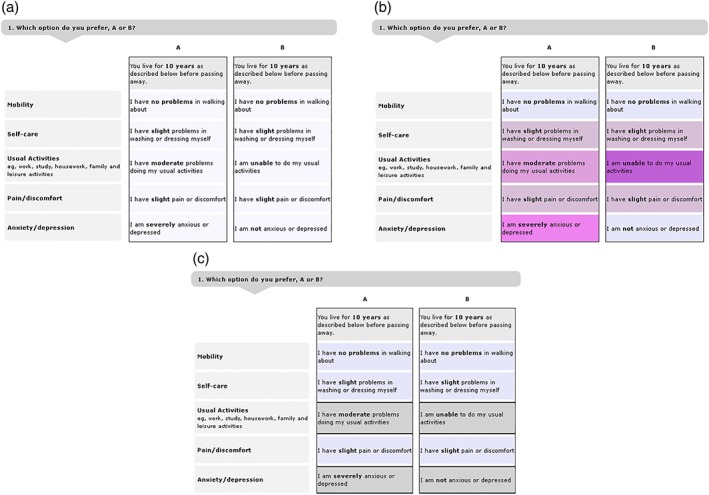
A randomized controlled discrete choice experiment (DCE) with 3,320 participating respondents was used to investigate the individual and combined impact of level overlap and color coding on task complexity, choice consistency, survey satisfaction scores, and dropout rates. The systematic differences between the study arms allowed for a direct comparison of dropout rates and cognitive debriefing scores and accommodated the quantitative comparison of respondents' choice consistency using a heteroskedastic mixed logit model. Our results indicate that the introduction of level overlap made it significantly easier for respondents to identify the differences and choose between the choice options. As a stand-alone design strategy, attribute level overlap reduced the dropout rate by 30%, increased the level of choice consistency by 30%, and avoided learning effects in the initial choice tasks of the DCE. The combination of level overlap and color coding was even more effective: It reduced the dropout rate by 40% to 50% and increased the level of choice consistency by more than 60%. Hence, we can recommend attribute level overlap, with color coding to amplify its impact, as a standard design strategy in DCEs.
采用了一项有 3320 名参与者的随机对照离散选择实验(DCE),以调查水平重叠和颜色编码对任务复杂性、选择一致性、调查满意度评分和退出率的单独和综合影响。研究臂之间的系统差异允许直接比较退出率和认知剖析评分,并使用异方差混合对数模型对受访者的选择一致性进行定量比较。我们的结果表明,引入水平重叠使得受访者更容易识别差异并在选择选项之间进行选择。作为一种独立的设计策略,属性水平重叠将退出率降低了 30%,将选择一致性提高了 30%,并避免了 DCE 初始选择任务中的学习效应。水平重叠和颜色编码的组合甚至更有效:它将退出率降低了 40%至 50%,并将选择一致性提高了 60%以上。因此,我们可以推荐属性水平重叠,并使用颜色编码来增强其影响,作为 DCE 中的标准设计策略。