Department of Clinical Science, Lund University, Skåne University Hospital, Malmö, Sweden.
Department of Endocrinology, Skåne University Hospital, Malmö, Sweden.
J Clin Endocrinol Metab. 2019 Jun 1;104(6):1917-1925. doi: 10.1210/jc.2018-02195.
Because elevated copeptin, a marker of vasopressin, is linked to low water intake and high diabetes risk, we tested the effect of water supplementation on copeptin and fasting glucose.
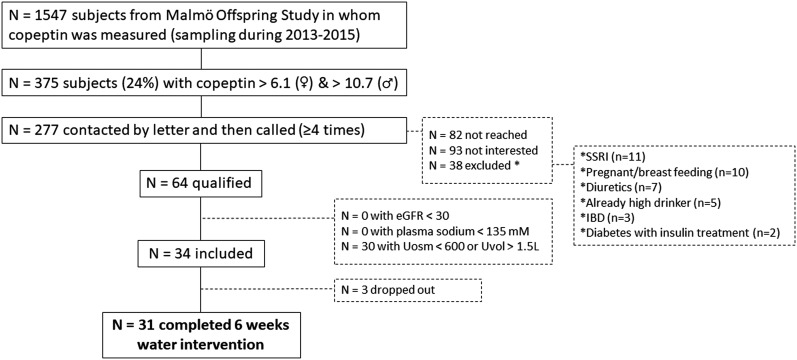
DESIGN, SETTING, AND PARTICIPANTS: Thirty-one healthy adults with high copeptin (>10.7 pmol · L-1 in men and >6.1 pmol·L-1 in women) identified in a population-based survey from 2013 to 2015 and with a current 24-hour urine osmolality of >600 mOsm · kg-1 were included.
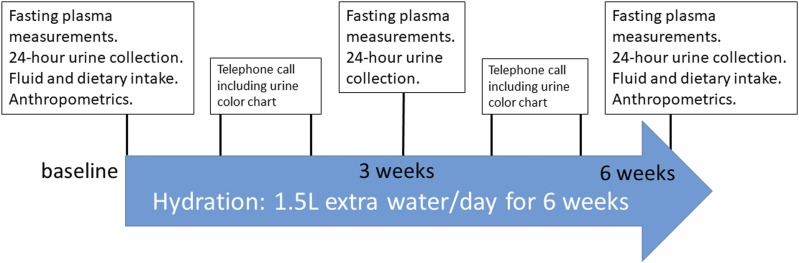
Addition of 1.5 L water daily on top of habitual fluid intake for 6 weeks.
Pre- and postintervention fasting plasma copeptin concentrations.
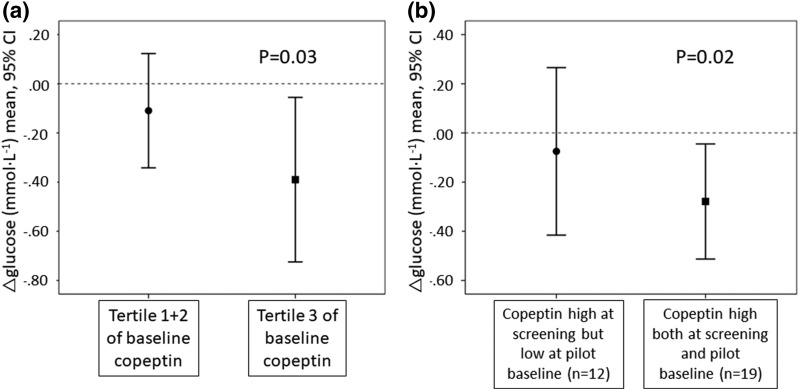
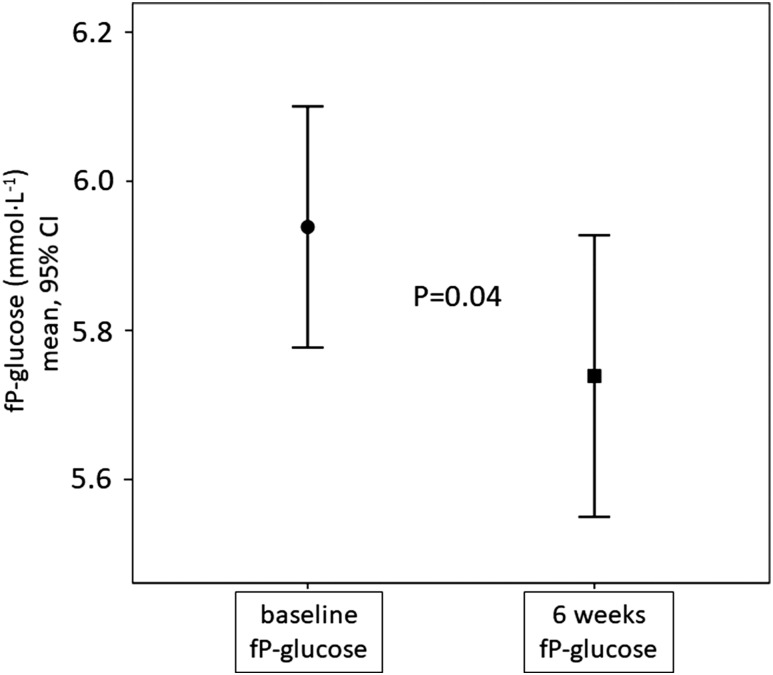
Reported mean water intake increased from 0.43 to 1.35 L · d-1 (P < 0.001), with no other observed changes in diet. Median (interquartile range) urine osmolality was reduced from 879 (705, 996) to 384 (319, 502) mOsm · kg-1 (P < 0.001); urine volume increased from 1.06 (0.90, 1.20) to 2.27 (1.52, 2.67) L · d-1 (P < 0.001); and baseline copeptin decreased from 12.9 (7.4, 21.9) pmol · L-1 to 7.8 (4.6;11.3) pmol · L-1 (P < 0.001). Water supplementation reduced fasting plasma glucose from a mean (SD) of 5.94 (0.44) to 5.74 (0.51) (P = 0.04). The water-associated reduction of both fasting copeptin and glucose concentration in plasma was most pronounced in participants in the top tertile of baseline copeptin.
Water supplementation in persons with habitually low water consumption and high copeptin levels is effective in lowering copeptin. It appears a safe and promising intervention with the potential of lowering fasting plasma glucose and thus reducing diabetes risk. Further investigations are warranted to support these findings.
由于加压素的标志物 copeptin 升高与水摄入不足和高糖尿病风险有关,我们测试了水补充对 copeptin 和空腹血糖的影响。
设计、地点和参与者:我们纳入了 2013 年至 2015 年在一项基于人群的调查中确定的 copeptin 较高(男性 >10.7 pmol·L-1,女性 >6.1 pmol·L-1)且当前 24 小时尿液渗透压 >600 mOsm·kg-1 的 31 名健康成年人,并进行了当前的研究。
在习惯性液体摄入的基础上每天额外添加 1.5 L 水,持续 6 周。
干预前后空腹血浆 copeptin 浓度。
报告的平均水摄入量从 0.43 增加到 1.35 L·d-1(P<0.001),而饮食无其他变化。中位数(四分位距)尿渗透压从 879(705,996)降低到 384(319,502)mOsm·kg-1(P<0.001);尿量从 1.06(0.90,1.20)增加到 2.27(1.52,2.67)L·d-1(P<0.001);基线 copeptin 从 12.9(7.4,21.9)pmol·L-1降低到 7.8(4.6;11.3)pmol·L-1(P<0.001)。水补充使空腹血糖从平均(标准差)5.94(0.44)降至 5.74(0.51)(P=0.04)。在基线 copeptin 处于最高三分位数的参与者中,血浆中空腹 copeptin 和葡萄糖浓度的降低与水的相关性最为明显。
在习惯性低水摄入和高 copeptin 水平的人群中,水补充可有效降低 copeptin。它似乎是一种安全且有前途的干预措施,具有降低空腹血浆葡萄糖从而降低糖尿病风险的潜力。需要进一步的研究来支持这些发现。