New York University School of Medicine, Center for Healthful Behavior Change, New York, New York.
New York University School of Medicine, Center for Healthful Behavior Change, New York, New York.
J Ren Nutr. 2019 Jul;29(4):328-332. doi: 10.1053/j.jrn.2018.10.006. Epub 2018 Dec 19.
This study was to assess the impact of baseline dietary self-efficacy on the effect of a dietary intervention to reduce sodium intake in patients undergoing hemodialysis (HD) and to identify determinants of low dietary self-efficacy.
This is a post hoc analysis of the BalanceWise study, a randomized controlled trial that aimed to reduce dietary sodium intake in HD patients recruited from 17 dialysis centers in Pennsylvania. The main outcome measures include dietary self-efficacy and reported dietary sodium density. Analysis of variance with post hoc group-wise comparison was used to examine the effect of baseline dietary self-efficacy on changes in reported sodium density in the intervention and control groups at 8 and 16 weeks. Chi-square test, independent t tests, or Wilcoxon rank-sum tests were used to identify determinants of low dietary self-efficacy.
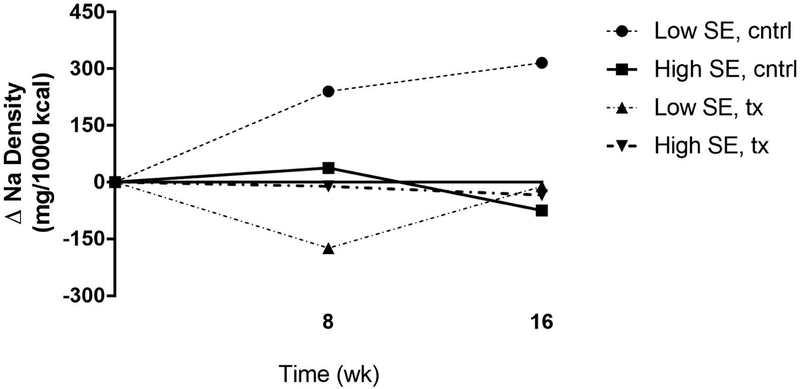
The interaction between dietary self-efficacy and the impact of the intervention on changes in reported dietary sodium density approached significance at 8 and 16 weeks (P interaction = 0.051 and 0.06, respectively). Younger age and perceived income inadequacy were significantly associated with low self-efficacy in patients undergoing HD.
The benefits of dietary interventions designed to improve self-efficacy may differ by the baseline self-efficacy status. This may be particularly important for HD patients who are younger and report inadequate income as they had lower dietary self-efficacy.
本研究旨在评估基线饮食自我效能对降低接受血液透析(HD)患者钠摄入量的饮食干预效果的影响,并确定低饮食自我效能的决定因素。
这是 BalanceWise 研究的事后分析,该研究是一项随机对照试验,旨在降低宾夕法尼亚州 17 个透析中心招募的 HD 患者的饮食钠摄入量。主要结局指标包括饮食自我效能和报告的饮食钠密度。采用方差分析和事后组间比较,检验基线饮食自我效能对干预组和对照组在 8 周和 16 周时报告的钠密度变化的影响。采用卡方检验、独立 t 检验或 Wilcoxon 秩和检验来确定低饮食自我效能的决定因素。
饮食自我效能与干预对报告的饮食钠密度变化的影响之间的交互作用在 8 周和 16 周时接近显著(P 交互=0.051 和 0.06,分别)。年轻和感知收入不足与 HD 患者的低自我效能显著相关。
旨在提高自我效能的饮食干预措施的益处可能因基线自我效能状况而异。对于年轻和报告收入不足的 HD 患者,这可能尤为重要,因为他们的饮食自我效能较低。