Suppr超能文献

从肉类中分离出的肠外氟喹诺酮耐药大肠杆菌菌株。

Extra-Intestinal Fluoroquinolone-Resistant Escherichia coli Strains Isolated from Meat.

机构信息

Department of Sciences for Health Promotion and Mother & Child Care, University of Palermo, Italy.

Institute for Experimental Veterinary Medicine of Sicily, Palermo, Italy.

出版信息

Biomed Res Int. 2018 Nov 18;2018:8714975. doi: 10.1155/2018/8714975. eCollection 2018.

Abstract

Extra-intestinal are emerging as a global threat due to their diffusion as opportunistic pathogens and, above all, to their wide set of antibiotic resistance determinants. There are still many gaps in our knowledge of their origin and spread pathways, although food animals have been adjudicated vehicles for passing mult-drug resistant bacteria to humans. This study analyzed 46 samples of meat purchased from retail stores in Palermo in order to obtain quinolone-resistant isolates. Strains were screened for their phylogenetic groups, ST131-associated single nucleotide polymorphisms (SNPs), and then typed by ERIC-PCR. Their set of virulence factors, namely, , and genes, were investigated and their fluoroquinolone-resistance determinants evaluated. The data obtained show a dramatically high prevalence of multidrug resistance patterns in the Palermo area, with 28% of the isolates having virulence factor genes typical of ExPEC strains. No B2 group or ST131 strains were detected. Moreover, 20% of our isolates showed positivity to all the plasmid-mediated quinolone resistance (PMQR) determinants, showing a potential to transfer these genes among other bacteria. Therefore, these data underline the possibility that food animals and, specifically, poultry in particular may be a significant source of resistant bacterial strains, posing a potential zoonotic risk.

摘要

肠外 由于其作为机会性病原体的扩散,以及其广泛的抗生素耐药决定因素,正在成为全球威胁。尽管食用动物已被判定为将多药耐药细菌传播给人类的媒介,但我们对它们的起源和传播途径仍知之甚少。本研究分析了从巴勒莫零售店购买的 46 份肉样,以获得对喹诺酮类药物耐药的 分离株。对菌株进行了其系统发育群、与 ST131 相关的单核苷酸多态性(SNP)的筛选,然后通过 ERIC-PCR 进行分型。研究了它们的一组毒力因子,即 、 和 基因,并评估了它们的氟喹诺酮类药物耐药决定因素。所得数据显示,巴勒莫地区多药耐药模式的流行率极高,28%的分离株具有 ExPEC 菌株的典型毒力因子基因。未检测到 B2 组或 ST131 菌株。此外,我们的 20%的分离株对所有质粒介导的喹诺酮类耐药(PMQR)决定因素呈阳性,表明这些基因在其他细菌之间转移的潜力。因此,这些数据强调了食用动物,特别是家禽可能是耐药菌菌株的重要来源,从而构成了潜在的人畜共患病风险。
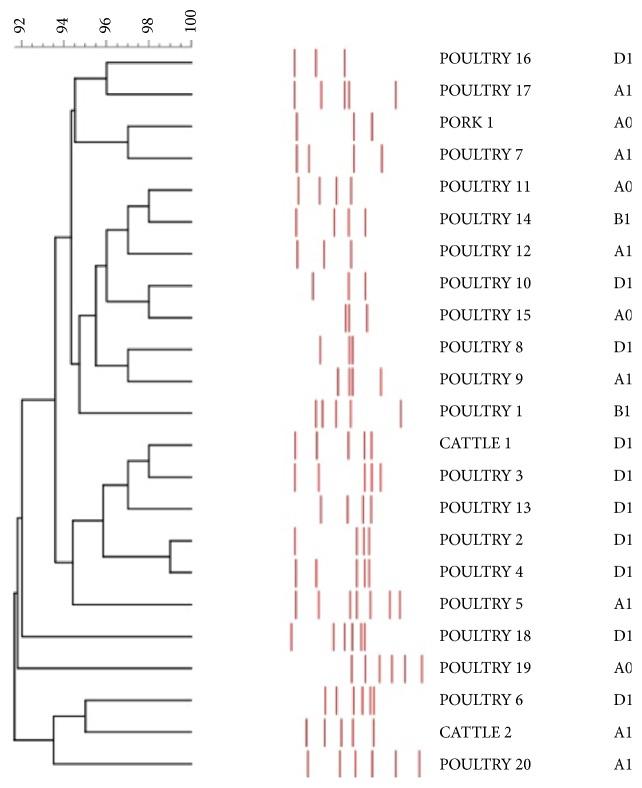
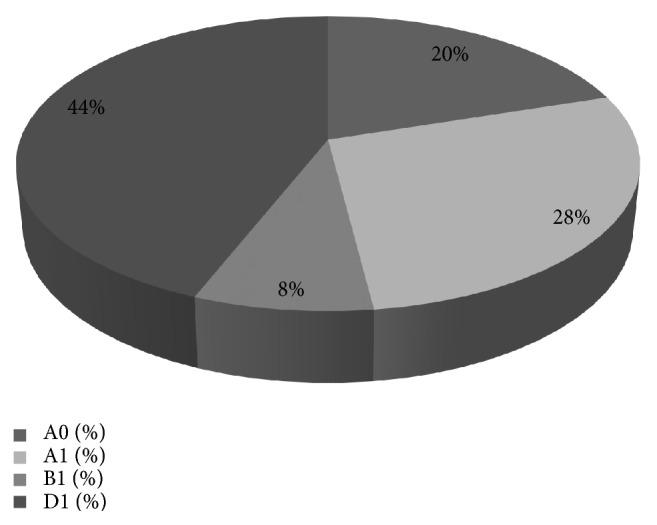
https://cdn.ncbi.nlm.nih.gov/pmc/blobs/709b/6276482/bb3021bb3b06/BMRI2018-8714975.001.jpg

相似文献

1
Extra-Intestinal Fluoroquinolone-Resistant Escherichia coli Strains Isolated from Meat.
Biomed Res Int. 2018 Nov 18;2018:8714975. doi: 10.1155/2018/8714975. eCollection 2018.
2
Extended-Spectrum ß-Lactamase, AmpC-Producing, and Fluoroquinolone-Resistant Escherichia coli in Retail Broiler Chicken Meat, Italy.
Foodborne Pathog Dis. 2015 Jul;12(7):619-25. doi: 10.1089/fpd.2015.1936. Epub 2015 May 28.
4
Virulence factors in urinary Escherichia coli strains: phylogenetic background and quinolone and fluoroquinolone resistance.
J Clin Microbiol. 2008 Feb;46(2):480-7. doi: 10.1128/JCM.01488-07. Epub 2007 Dec 5.
6
Extraintestinal pathogenic Escherichia coli in poultry meat products on the Finnish retail market.
Acta Vet Scand. 2012 Nov 16;54(1):64. doi: 10.1186/1751-0147-54-64.
8
Characterization of Extraintestinal Pathogenic Escherichia coli isolated from retail poultry meats from Alberta, Canada.
Int J Food Microbiol. 2014 May 2;177:49-56. doi: 10.1016/j.ijfoodmicro.2014.02.006. Epub 2014 Feb 21.
10
Extraintestinal pathogenic Escherichia coli sequence type 131 H30-R and H30-Rx subclones in retail chicken meat, Italy.
Int J Food Microbiol. 2016 Jul 2;228:10-3. doi: 10.1016/j.ijfoodmicro.2016.04.004. Epub 2016 Apr 6.

引用本文的文献

2
Resistance and Virulence Surveillance in Isolated from Commercial Meat Samples: A One Health Approach.
Microorganisms. 2023 Nov 6;11(11):2712. doi: 10.3390/microorganisms11112712.
3
Prevalence and characterization of quinolone-resistant isolated from retail raw beef and poultry meat in Egypt.
J Adv Vet Anim Res. 2023 Sep 30;10(3):490-499. doi: 10.5455/javar.2023.j702. eCollection 2023 Sep.
5
Faecal carriage of ESBL producing and colistin resistant in avian species over a 2-year period (2017-2019) in Zimbabwe.
Front Cell Infect Microbiol. 2022 Dec 23;12:1035145. doi: 10.3389/fcimb.2022.1035145. eCollection 2022.
7
Unearthing Antibiotic Resistance Associated with Disturbance-Induced Permafrost Thaw in Interior Alaska.
Microorganisms. 2021 Jan 6;9(1):116. doi: 10.3390/microorganisms9010116.
10
Detection of OXA-48 Gene in Carbapenem-Resistant and from Urine Samples.
Infect Drug Resist. 2020 Jul 14;13:2311-2321. doi: 10.2147/IDR.S259967. eCollection 2020.

本文引用的文献

2
Antibiotic resistance: What is so special about multidrug-resistant Gram-negative bacteria?
GMS Hyg Infect Control. 2017 Apr 10;12:Doc05. doi: 10.3205/dgkh000290. eCollection 2017.
3
Mechanisms of drug resistance: quinolone resistance.
Ann N Y Acad Sci. 2015 Sep;1354(1):12-31. doi: 10.1111/nyas.12830. Epub 2015 Jul 17.
4
Extended-Spectrum ß-Lactamase, AmpC-Producing, and Fluoroquinolone-Resistant Escherichia coli in Retail Broiler Chicken Meat, Italy.
Foodborne Pathog Dis. 2015 Jul;12(7):619-25. doi: 10.1089/fpd.2015.1936. Epub 2015 May 28.
5
Resistance and virulence factors of Escherichia coli isolated from chicken.
J Environ Sci Health B. 2015;50(6):417-21. doi: 10.1080/03601234.2015.1011959.
6
Plasmid-mediated quinolone resistance.
Microbiol Spectr. 2014 Oct;2(5). doi: 10.1128/microbiolspec.PLAS-0006-2013.
7
Escherichia coli ST131, an intriguing clonal group.
Clin Microbiol Rev. 2014 Jul;27(3):543-74. doi: 10.1128/CMR.00125-13.
8
A new clone sweeps clean: the enigmatic emergence of Escherichia coli sequence type 131.
Antimicrob Agents Chemother. 2014 Sep;58(9):4997-5004. doi: 10.1128/AAC.02824-14. Epub 2014 May 27.
10
Microbiological quality of ready-to-eat salads: an underestimated vehicle of bacteria and clinically relevant antibiotic resistance genes.
Int J Food Microbiol. 2013 Sep 16;166(3):464-70. doi: 10.1016/j.ijfoodmicro.2013.08.005. Epub 2013 Aug 17.

文献AI研究员

20分钟写一篇综述,助力文献阅读效率提升50倍。

立即体验

用中文搜PubMed

大模型驱动的PubMed中文搜索引擎

马上搜索

文档翻译

学术文献翻译模型,支持多种主流文档格式。

立即体验