Estrich C G, Araujo M W B, Lipman R D
Science Institute, American Dental Association, Chicago, IL, USA.
JDR Clin Trans Res. 2019 Jan;4(1):76-85. doi: 10.1177/2380084418798818. Epub 2018 Sep 6.
Early recognition of prediabetes may prevent progression to diabetes, yet not all adults are aware of their prediabetes risk. To reach all adults unaware of their risk, additional risk assessment strategies are warranted.
The objective of this study was to evaluate the potential scope of benefit from prediabetes risk assessment in the dental care setting and to identify characteristics of dental patients likely to unknowingly have prediabetes or diabetes.
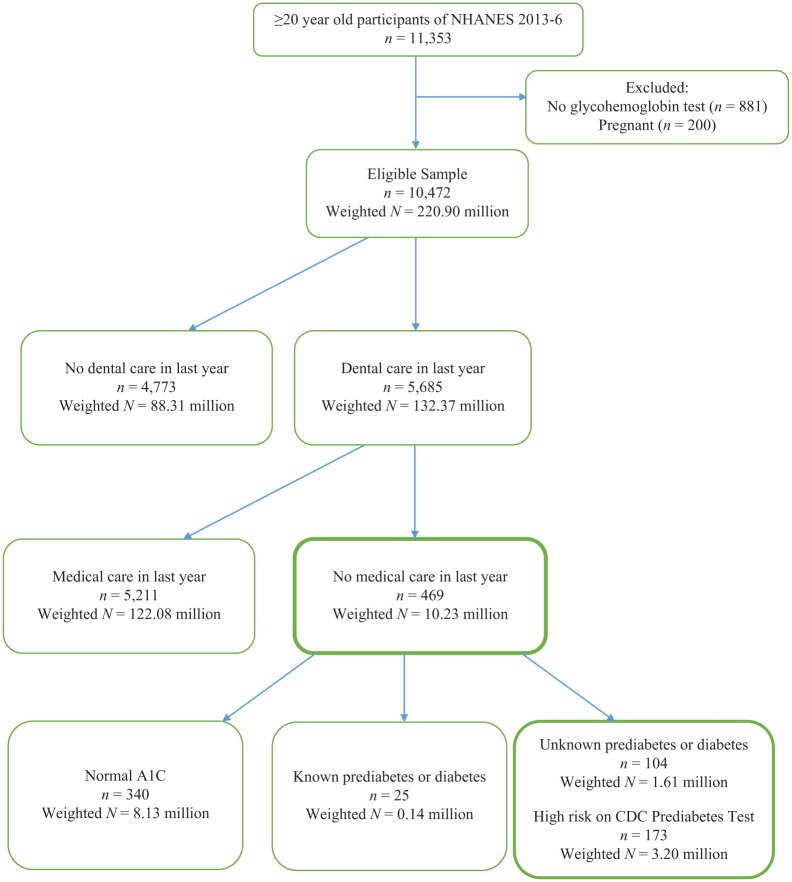
Data from 10,472 adults in the National Health and Nutrition Examination Survey from 2013 to 2014 and 2015 to 2016 were analyzed for associations among prediabetes/diabetes risk factors, health care use, and hemoglobin A1C levels according to chi-square tests and multivariate logistic regression.
A total of 7.73% of US adults had seen a dentist but not a medical provider in the past 12 mo. The composition of this subpopulation was significantly different from that who saw a medical provider, in ways that might affect their diabetes risk. In addition, 31.27% of this subpopulation would be identified as being at high risk for prediabetes according to the CDC Prediabetes Screening Test (Centers for Disease Control and Prevention), and 15.83% had hemoglobin A1C levels indicative of undiagnosed prediabetes or diabetes. Screening in a dental setting would have the highest odds of identifying someone unaware of his or her diabetes risk among those who were non-White, obese, or ≥45 y old.
Extrapolation from this analysis indicates that screening for prediabetes at dental visits has the potential to alert an estimated 22.36 million adults of their risk for prediabetes or diabetes. Incorporating prediabetes or diabetes risk assessment into routine dental visits may enable 1) those with prediabetes to take action to decrease their risk of developing diabetes and 2) those with diabetes to engage in treatment to decrease their risk of diabetes-related complications.
Screening for prediabetes and diabetes during dental visits has the potential to raise patients' awareness of diabetes risk and prevent prediabetes from progressing to diabetes. For some patients, the dental visit may be the only point of contact with the health care system, which heightens the importance of including diabetes risk assessment for patient well-being.
早期识别糖尿病前期可能会预防其发展为糖尿病,但并非所有成年人都意识到自己患糖尿病前期的风险。为了让所有未意识到自身风险的成年人了解情况,有必要采取额外的风险评估策略。
本研究的目的是评估在牙科护理环境中进行糖尿病前期风险评估可能带来的潜在益处范围,并确定可能在不知情情况下患有糖尿病前期或糖尿病的牙科患者的特征。
根据卡方检验和多因素逻辑回归分析了2013年至2014年以及2015年至2016年美国国家健康和营养检查调查中10472名成年人的数据,以研究糖尿病前期/糖尿病风险因素、医疗保健利用情况和糖化血红蛋白水平之间的关联。
在过去12个月中,共有7.73%的美国成年人看过牙医但未看过医疗服务提供者。这一亚人群的构成与看过医疗服务提供者的人群有显著差异,这些差异可能会影响他们患糖尿病的风险。此外,根据美国疾病控制与预防中心的糖尿病前期筛查测试,该亚人群中有31.27%被确定为糖尿病前期高风险人群,15.83%的糖化血红蛋白水平表明其患有未被诊断的糖尿病前期或糖尿病。在牙科环境中进行筛查,在非白人、肥胖或年龄≥45岁的人群中,识别出未意识到自己糖尿病风险的人的几率最高。
从该分析推断,在牙科就诊时筛查糖尿病前期有可能提醒约2236万成年人注意他们患糖尿病前期或糖尿病的风险。将糖尿病前期或糖尿病风险评估纳入常规牙科就诊可能会使1)患有糖尿病前期的人采取行动降低患糖尿病的风险,以及2)患有糖尿病的人接受治疗以降低糖尿病相关并发症的风险。
在牙科就诊时筛查糖尿病前期和糖尿病有可能提高患者对糖尿病风险的认识,并预防糖尿病前期发展为糖尿病。对于一些患者来说,牙科就诊可能是他们与医疗保健系统的唯一接触点,这凸显了将糖尿病风险评估纳入其中以保障患者健康的重要性。