The National Clinical Research Center for Mental Disorders & Beijing key Laboratory of Mental Disorders, Beijing Anding Hospital, Capital Medical University, No. 5 Ankang Lane, Dewai Avenue, Xicheng District, Beijing, 100088, China.
Advanced Innovation Center for Human Brain Protection, Capital Medical University, Beijing, China.
BMC Public Health. 2019 Jan 3;19(1):11. doi: 10.1186/s12889-018-6313-9.
The post-disaster mental health crisis intervention (MHCI) system in China remains immature and unsystematic. We aim to report the perceptions of a large sample of MHCI workers and government administrators and provide recommendations for developing a national mental health disaster response management plan in China.
An in-depth qualitative study was conducted, collecting data from 20 focus-group discussions and 25 key stakeholder interviews. These recruited participants who had been involved in different types of disaster rescue across 7 provinces/cities where disasters have recently occurred. We used thematic analysis to analyze the data and relevant findings were extracted for policy recommendation.
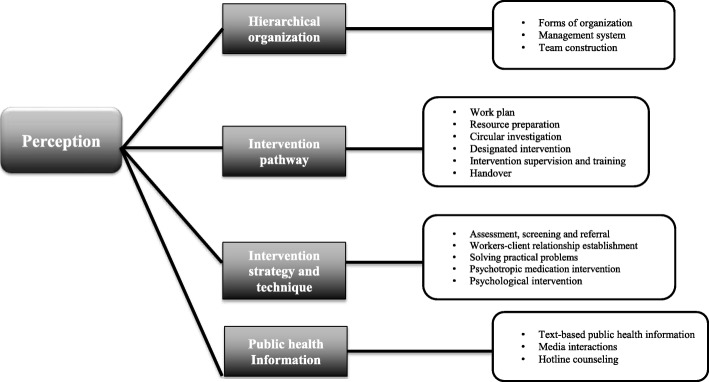
Mental health workers' perspectives were examined in detailed according to four core themes: forms of organization, intervention pathway, intervention strategy and technique, and public health information. Post-disaster MHCI should be approached in teams that are integrated with emergency medicine systems, and be led by unified command management. All levels of local health and family planning commission should prepare post-disaster MHCI work plans and build response teams/emergency centres. Future training for MHCI workers should focus on: building a sense of trust within the team; clarifying each member's role; strengthening the screening, assessment and referrals training for psychological professionals; and providing psychological intervention training for Chinese psychiatrists. It is necessary to set up guiding principles for disaster research ethics, mental health rehabilitation and media interaction.
Through exploring and analyzing the perceptions of current disaster response mental health workers and government administrators, our findings provide essential recommendations for developing a national to county level post-disaster MHCI emergency management plan and can guide the formulation of relevant laws and regulation in China.
中国的灾后心理健康危机干预(MHCI)系统仍不成熟且缺乏系统性。我们旨在报告大量 MHCI 工作人员和政府管理人员的看法,并为中国制定国家心理健康灾害应对管理计划提供建议。
我们进行了深入的定性研究,从 7 个受灾省份/城市的 20 个焦点小组讨论和 25 个主要利益相关者访谈中收集数据。这些参与者参与了不同类型的灾害救援。我们使用主题分析对数据进行分析,并提取相关发现以提出政策建议。
根据四个核心主题详细考察了心理健康工作者的观点:组织形式、干预途径、干预策略和技术以及公共卫生信息。灾后 MHCI 应采用与急诊医学系统相结合的团队形式,并由统一指挥管理领导。各级地方卫生和计划生育委员会应制定灾后 MHCI 工作计划,并建立应急小组/应急中心。未来 MHCI 工作人员的培训应侧重于:在团队中建立信任感;明确每个成员的角色;加强对心理专业人员的筛查、评估和转介培训;为中国精神科医生提供心理干预培训。有必要为灾难研究伦理、心理健康康复和媒体互动制定指导原则。
通过探索和分析当前灾害应对心理健康工作者和政府管理人员的看法,我们的发现为制定国家到县级灾后 MHCI 应急管理计划提供了重要建议,并可以指导中国相关法律法规的制定。