Collado A, Sanmarti R, Bielsa I, Castel T, Kanterewicz E, Cañete J D, Brancós M A, Rotes-Querol J
Department of Rheumatology, Hospital Clinic i Provincial de Barcelona, Spain.
Ann Rheum Dis. 1988 Dec;47(12):1004-7. doi: 10.1136/ard.47.12.1004.
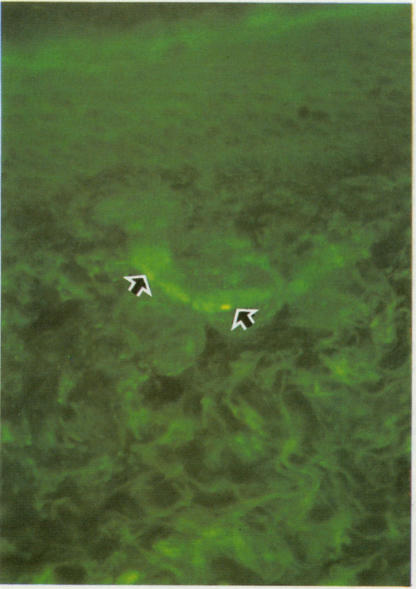
Cutaneous immunofluorescence studies were carried out in 21 patients with ankylosing spondylitis (AS) and the results compared with those for 18 healthy subjects. The most prominent finding was the presence of IgA in dermal vessels of patients with AS (71% compared with 17% of the control group). IgG and IgM cutaneous deposits were also observed in patients with AS, but these results did not differ from those of the control group. A renal biopsy was performed in three of the patients presenting with unexplained microscopic haematuria. One of them had an IgA nephropathy, but no correlation was found between kidney and skin deposits of IgA. These findings suggest that IgA cutaneous deposits in AS are not a marker of IgA nephropathy but stress the role of immunoglobulin A in the pathogenesis of this disease.
对21例强直性脊柱炎(AS)患者进行了皮肤免疫荧光研究,并将结果与18名健康受试者的结果进行了比较。最显著的发现是AS患者真皮血管中存在IgA(71%,而对照组为17%)。在AS患者中也观察到IgG和IgM皮肤沉积物,但这些结果与对照组无差异。对3例出现不明原因镜下血尿的患者进行了肾活检。其中1例患有IgA肾病,但未发现肾脏和皮肤IgA沉积物之间存在相关性。这些发现表明,AS中的IgA皮肤沉积物不是IgA肾病的标志物,但强调了免疫球蛋白A在该疾病发病机制中的作用。