Rubenstein School of Environment and Natural Resources, University of Vermont, 81 Carrigan Drive, Burlington, VT 05405, U.S.A.
Gund Institute for Environment, University of Vermont, 617 Main Street, Burlington, VT 05405, U.S.A.
Conserv Biol. 2019 Aug;33(4):942-952. doi: 10.1111/cobi.13276. Epub 2019 Feb 27.
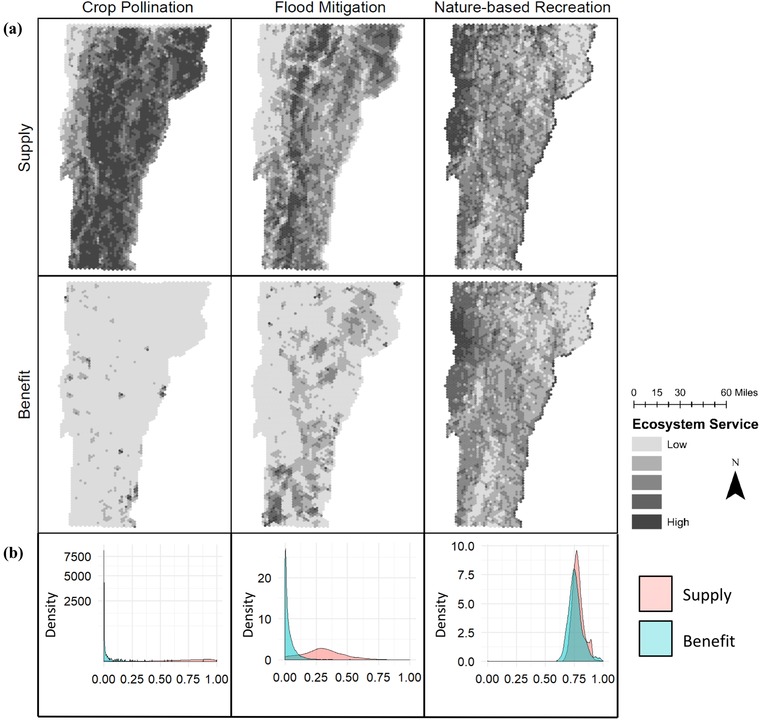
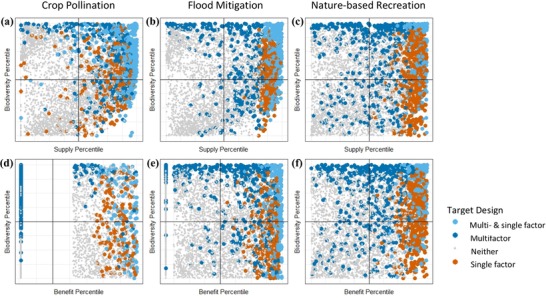
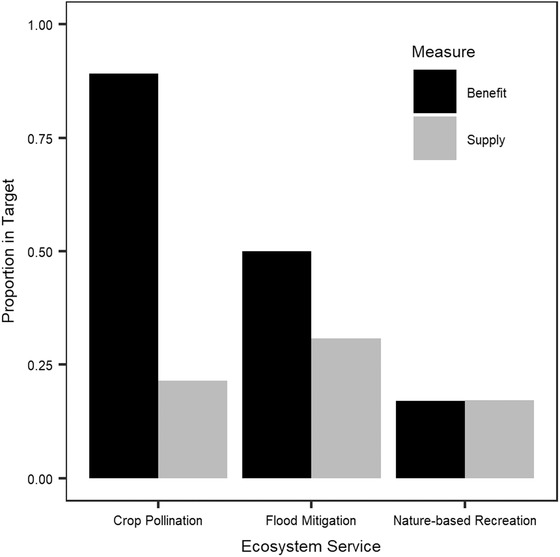
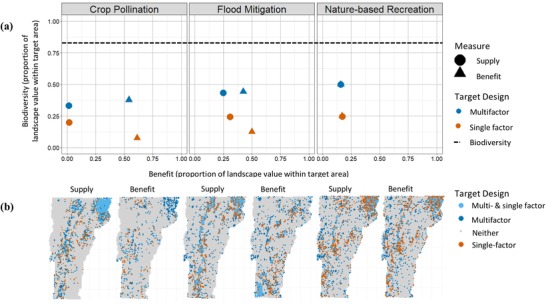
Safeguarding ecosystem services and biodiversity is critical to achieving sustainable development. To date, ecosystem services quantification has focused on the biophysical supply of services with less emphasis on human beneficiaries (i.e., demand). Only when both occur do ecosystems benefit people, but demand may shift ecosystem service priorities toward human-dominated landscapes that support less biodiversity. We quantified how accounting for demand affects the efficiency of conservation in capturing both human benefits and biodiversity by comparing conservation priorities identified with and without accounting for demand. We mapped supply and benefit for 3 ecosystem services (flood mitigation, crop pollination, and nature-based recreation) by adapting existing ecosystem service models to include and exclude factors representing human demand. We then identified conservation priorities for each with the conservation planning program Marxan. Particularly for flood mitigation and crop pollination, supply served as a poor proxy for benefit because demand changed the spatial distribution of ecosystem service provision. Including demand when jointly targeting biodiversity and ecosystem service increased the efficiency of conservation efforts targeting ecosystem services without reducing biodiversity outcomes. Our results highlight the importance of incorporating demand when quantifying ecosystem services for conservation planning.
保护生态系统服务和生物多样性对于实现可持续发展至关重要。迄今为止,生态系统服务量化主要关注服务的生物物理供应,而较少关注人类受益者(即需求)。只有当两者同时发生时,生态系统才会使人类受益,但需求可能会将生态系统服务的优先事项转向以人类为主导、支持生物多样性较少的景观。我们通过比较考虑和不考虑需求时确定的保护优先事项,量化了考虑需求如何影响保护在捕捉人类利益和生物多样性方面的效率。我们通过调整现有的生态系统服务模型,纳入和排除代表人类需求的因素,为 3 种生态系统服务(洪水缓解、作物授粉和自然为基础的娱乐)绘制了供应和效益图。然后,我们使用保护规划程序 Marxan 为每一种服务确定了保护优先事项。特别是对于洪水缓解和作物授粉,供应是效益的糟糕替代品,因为需求改变了生态系统服务提供的空间分布。在共同针对生物多样性和生态系统服务时,包括需求会提高不降低生物多样性结果的情况下针对生态系统服务的保护努力的效率。我们的研究结果强调了在进行保护规划时,量化生态系统服务时纳入需求的重要性。