Chamanzar Maysamreza, Garfield David J, Iafrati Jillian, Chan Emory M, Sohal Vikaas, Cohen Bruce E, Schuck P James, Maharbiz Michel M
Electrical and Computer Engineering Department, Carnegie Mellon University, Pittsburgh, PA 15213, USA.
Department of Electrical Engineering and Computer Sciences, University of California Berkeley, Berkeley, CA 94720, USA.
Biomed Opt Express. 2018 Aug 20;9(9):4359-4371. doi: 10.1364/BOE.9.004359. eCollection 2018 Sep 1.
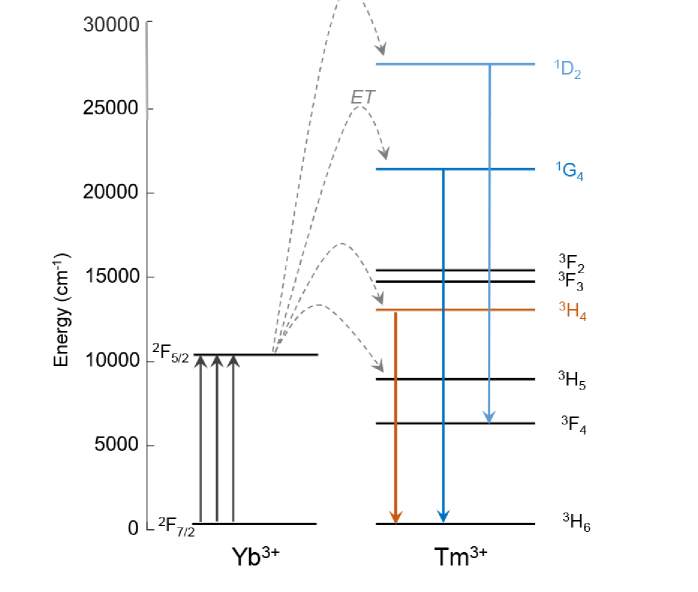
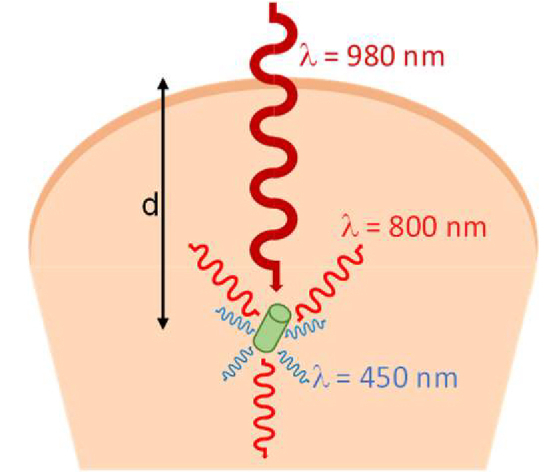
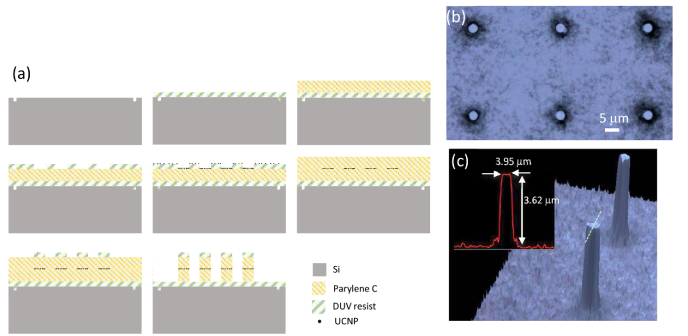
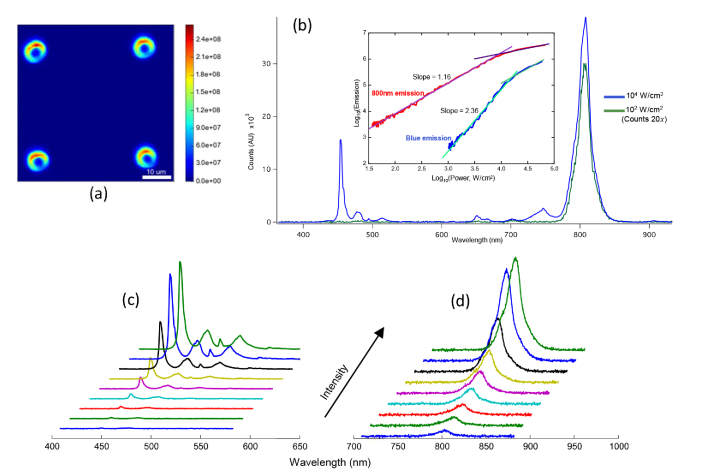
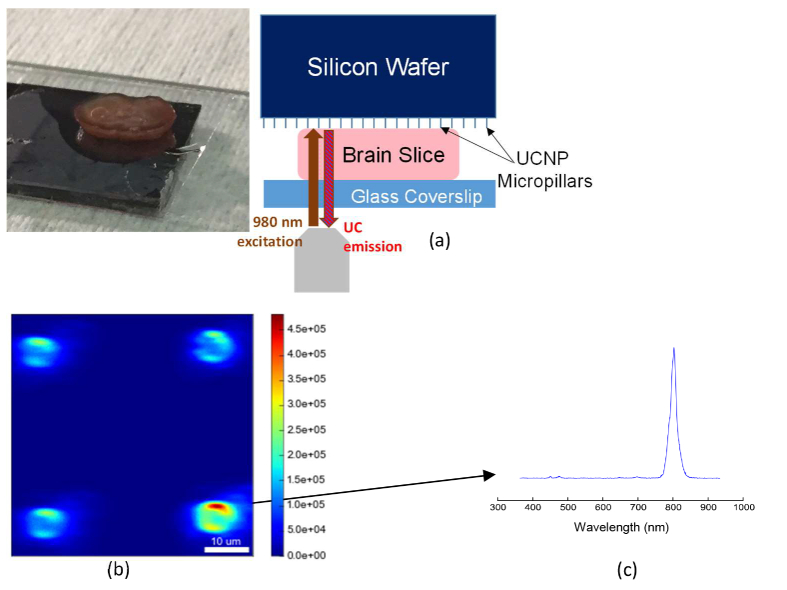
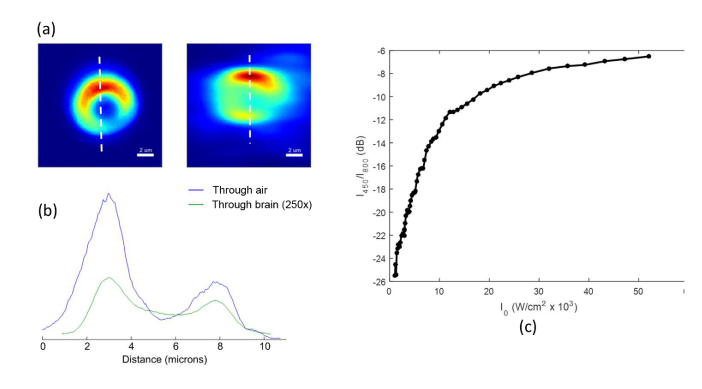
Optical methods for imaging and stimulation of biological events based on the use of visible light are limited to the superficial layers of tissue due to the significant absorption and scattering of light. Here, we demonstrate the design and implementation of passive micro-structured lightbulbs (MLBs) containing bright-emitting lanthanide-doped upconverting nanoparticles (UCNPs) for light delivery deep into the tissue. The MLBs are realized as cylindrical pillars made of Parylene C polymer that can be implanted deep into the tissue. The encapsulated UCNPs absorb near-infrared (NIR) light at λ = 980 nm, which undergoes much less absorption than the blue light in the brain tissue, and then locally emit blue light (G→H and D→F transitions) that can be used for optogenetic excitation of neurons in the brain. The H→H transition will result in the emission of higher energy NIR photons at λ = 800 nm that can be used for imaging and tracking MLBs through thick tissue.
基于可见光利用的用于生物事件成像和刺激的光学方法,由于光的显著吸收和散射,仅限于组织的表层。在此,我们展示了包含发光镧系掺杂上转换纳米颗粒(UCNPs)的无源微结构灯泡(MLBs)的设计与实现,用于将光深入传递到组织中。MLBs被实现为由聚对二甲苯C聚合物制成的圆柱形支柱,可植入到组织深处。封装的UCNPs吸收波长为λ = 980 nm的近红外(NIR)光,其在脑组织中的吸收比蓝光少得多,然后局部发射蓝光(G→H和D→F跃迁),可用于对大脑中的神经元进行光遗传学激发。H→H跃迁将导致在λ = 800 nm处发射更高能量的近红外光子,可用于通过厚组织对MLBs进行成像和跟踪。