Department of Biochemistry and Molecular Biology, The Pennsylvania State University College of Medicine, Hershey, PA, United States.
Front Immunol. 2018 Dec 19;9:3006. doi: 10.3389/fimmu.2018.03006. eCollection 2018.
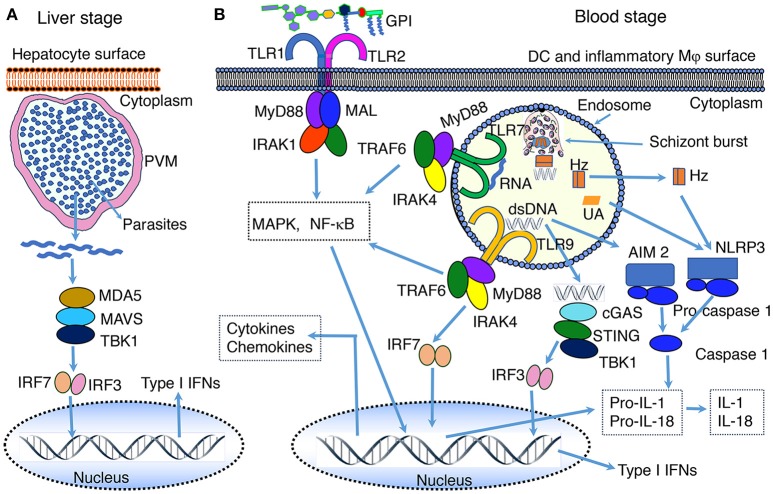
Malaria caused by the family of parasites, especially . and , is a major health problem in many countries in the tropical and subtropical regions of the world. The disease presents a wide array of systemic clinical conditions and several life-threatening organ pathologies, including the dreaded cerebral malaria. Like many other infectious diseases, malaria is an inflammatory response-driven disease, and positive outcomes to infection depend on finely tuned regulation of immune responses that efficiently clear parasites and allow protective immunity to develop. Immune responses initiated by the innate immune system in response to parasites play key roles both in protective immunity development and pathogenesis. Initial pro-inflammatory responses are essential for clearing infection by promoting appropriate cell-mediated and humoral immunity. However, elevated and prolonged pro-inflammatory responses owing to inappropriate cellular programming contribute to disease conditions. A comprehensive knowledge of the molecular and cellular mechanisms that initiate immune responses and how these responses contribute to protective immunity development or pathogenesis is important for developing effective therapeutics and/or a vaccine. Historically, in efforts to develop a vaccine, immunity to malaria was extensively studied in the context of identifying protective humoral responses, targeting proteins involved in parasite invasion or clearance. The innate immune response was thought to be non-specific. However, during the past two decades, there has been a significant progress in understanding the molecular and cellular mechanisms of host-parasite interactions and the associated signaling in immune responses to malaria. Malaria infection occurs at two stages, initially in the liver through the bite of a mosquito, carrying sporozoites, and subsequently, in the blood through the invasion of red blood cells by merozoites released from the infected hepatocytes. Soon after infection, both the liver and blood stage parasites are sensed by various receptors of the host innate immune system resulting in the activation of signaling pathways and production of cytokines and chemokines. These immune responses play crucial roles in clearing parasites and regulating adaptive immunity. Here, we summarize the knowledge on molecular mechanisms that underlie the innate immune responses to malaria infection.
疟疾是由寄生虫家族引起的,特别是 和 ,是世界上许多热带和亚热带国家的主要卫生问题。这种疾病表现出广泛的全身临床症状和几种危及生命的器官病理学,包括可怕的脑疟疾。像许多其他传染病一样,疟疾是一种炎症反应驱动的疾病,感染的良好结果取决于对免疫反应的精细调节,这些免疫反应能够有效地清除寄生虫并允许保护性免疫的发展。寄生虫引发的固有免疫系统的免疫反应在保护性免疫的发展和发病机制中起着关键作用。初始的促炎反应对于通过促进适当的细胞和体液免疫来清除感染是必不可少的。然而,由于细胞编程不当而导致的升高和延长的促炎反应导致疾病状况。全面了解启动免疫反应的分子和细胞机制以及这些反应如何有助于保护性免疫的发展或发病机制,对于开发有效的治疗方法和/或疫苗非常重要。从历史上看,在努力开发疫苗时,在识别保护性体液反应、针对参与寄生虫入侵或清除的蛋白质方面,疟疾的免疫受到了广泛研究。固有免疫反应被认为是非特异性的。然而,在过去的二十年中,人们对宿主-寄生虫相互作用的分子和细胞机制以及疟疾免疫反应相关信号转导有了显著的认识。疟疾感染发生在两个阶段,最初是在蚊子叮咬时通过携带子孢子在肝脏中发生,随后是通过从受感染的肝细胞中释放的裂殖子入侵红细胞。感染后不久,宿主固有免疫系统的各种受体就会感知到肝脏和血液阶段的寄生虫,从而激活信号通路并产生细胞因子和趋化因子。这些免疫反应在清除寄生虫和调节适应性免疫方面起着至关重要的作用。在这里,我们总结了对疟疾感染固有免疫反应的分子机制的认识。