Department of Biochemistry and Molecular Biology, Medical University of South Carolina, Charleston, SC, USA.
Oxid Med Cell Longev. 2018 Dec 2;2018:4138560. doi: 10.1155/2018/4138560. eCollection 2018.
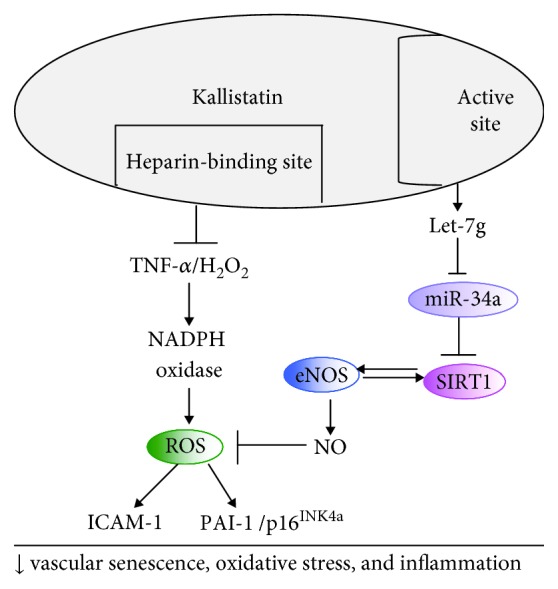
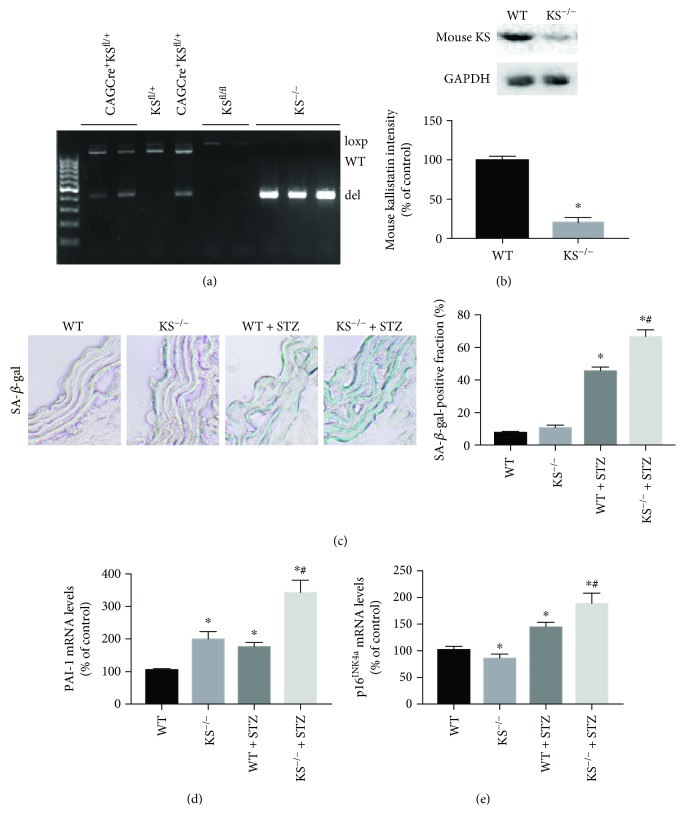
Kallistatin was identified in human plasma as a tissue kallikrein-binding protein and a serine proteinase inhibitor. Kallistatin exerts pleiotropic effects on angiogenesis, oxidative stress, inflammation, apoptosis, fibrosis, and tumor growth. Kallistatin levels are markedly reduced in patients with coronary artery disease, sepsis, diabetic retinopathy, inflammatory bowel disease, pneumonia, and cancer. Moreover, plasma kallistatin levels are positively associated with leukocyte telomere length in young African Americans, indicating the involvement of kallistatin in aging. In addition, kallistatin treatment promotes vascular repair by increasing the migration and function of endothelial progenitor cells (EPCs). Kallistatin via its heparin-binding site antagonizes TNF--induced senescence and superoxide formation, while kallistatin's active site is essential for inhibiting miR-34a synthesis, thus elevating sirtuin 1 (SIRT1)/eNOS synthesis in EPCs. Kallistatin inhibits oxidative stress-induced cellular senescence by upregulating Let-7g synthesis, leading to modulate Let-7g-mediated miR-34a-SIRT1-eNOS signaling pathway in human endothelial cells. Exogenous kallistatin administration attenuates vascular injury and senescence in association with increased SIRT1 and eNOS levels and reduced miR-34a synthesis and NADPH oxidase activity, as well as TNF- and ICAM-1 expression in the aortas of streptozotocin- (STZ-) induced diabetic mice. Conversely, endothelial-specific depletion of kallistatin aggravates vascular senescence, oxidative stress, and inflammation, with further reduction of Let-7g, SIRT1, and eNOS and elevation of miR-34a in mouse lung endothelial cells. Furthermore, systemic depletion of kallistatin exacerbates aortic injury, senescence, NADPH oxidase activity, and inflammatory gene expression in STZ-induced diabetic mice. These findings indicate that endogenous kallistatin displays a novel role in protection against vascular injury and senescence by inhibiting oxidative stress and inflammation.
激肽释放酶抑制剂(Kallistatin)在人血浆中被鉴定为组织激肽释放酶结合蛋白和丝氨酸蛋白酶抑制剂。Kallistatin 对血管生成、氧化应激、炎症、细胞凋亡、纤维化和肿瘤生长具有多种作用。在患有冠状动脉疾病、败血症、糖尿病视网膜病变、炎症性肠病、肺炎和癌症的患者中,Kallistatin 的水平明显降低。此外,血浆 Kallistatin 水平与年轻非裔美国人的白细胞端粒长度呈正相关,表明 Kallistatin 参与了衰老过程。此外,Kallistatin 通过增加内皮祖细胞(EPC)的迁移和功能促进血管修复。Kallistatin 通过其肝素结合位点拮抗 TNF-诱导的衰老和超氧化物形成,而 Kallistatin 的活性位点对于抑制 miR-34a 的合成是必需的,从而提高 EPC 中的 SIRT1/eNOS 合成。Kallistatin 通过上调 Let-7g 的合成抑制氧化应激诱导的细胞衰老,从而调节人内皮细胞中 Let-7g 介导的 miR-34a-SIRT1-eNOS 信号通路。外源性 Kallistatin 给药可减轻血管损伤和衰老,同时增加 SIRT1 和 eNOS 水平,降低 miR-34a 合成和 NADPH 氧化酶活性,以及降低 STZ 诱导的糖尿病小鼠主动脉中 TNF-α和 ICAM-1 的表达。相反,内皮细胞特异性 Kallistatin 耗竭会加剧血管衰老、氧化应激和炎症,导致小鼠肺内皮细胞中 Let-7g、SIRT1 和 eNOS 的进一步减少和 miR-34a 的增加。此外,Kallistatin 的全身性耗竭会加剧 STZ 诱导的糖尿病小鼠主动脉损伤、衰老、NADPH 氧化酶活性和炎症基因表达。这些发现表明,内源性 Kallistatin 通过抑制氧化应激和炎症,在保护血管免受损伤和衰老方面发挥新的作用。