Unit of Orthodontics and Paediatric Dentistry, Section of Dentistry, Department of Clinical, Surgical, Diagnostic and Paediatric Sciences, University of Pavia, Italy.
Orthodontics Unit, Dental School, Department of Surgical Sciences, University of Torino, Italy.
Biomed Res Int. 2018 Nov 29;2018:9341821. doi: 10.1155/2018/9341821. eCollection 2018.
The upper incisors torque expression is essential for the orthodontic treatment accuracy. Various orthodontic devices are claimed to have different inclination control capacity. The purpose of this retrospective study was to compare the radiographic buccolingual inclination of upper incisors in patients treated with three different orthodontic techniques.
Conventional brackets (Victory, 3M), self-ligating appliances (Damon Q, Ormco), and aligners (Invisalign, Align Technology) were tested. Cephalometric data of 25 patients with similar skeletal and dental pretreatment parameters were collected for each technique. Position changes of upper central incisors were assessed with radiographic evaluation before and after therapy. Three different parameters were considered: 11SnaSnp, 11Ocl and I+ TVL. All variables were measured before (T0) and after (T1) treatment and their variation over treatment was assessed.
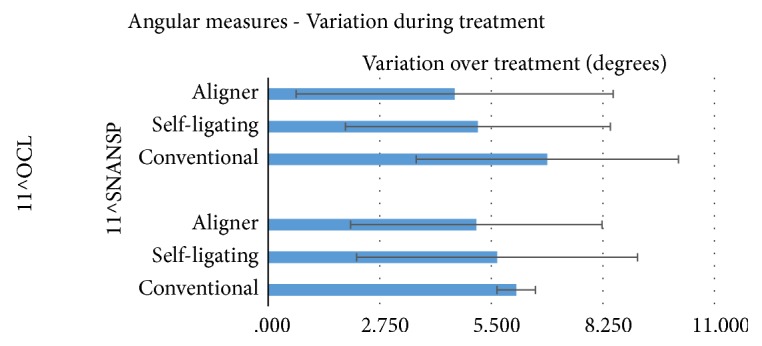
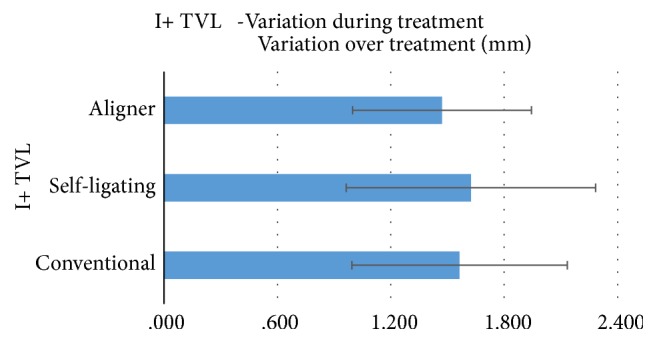
When evaluating angular measurements, 11SnaSnp and 11Ocl angles showed the highest numeric variation with conventional brackets. Lowest values were reported with aligners. However, the differences among various techniques were not significant for both angles (P>0.05). Also I+ TVL linear value variation did not show significant differences among the different groups tested (P>0.05).
Conventional multibrackets appliance showed the highest incisal position variations over treatment, but the differences among various groups were not significantly different.
上颌切牙转矩表达对于正畸治疗的准确性至关重要。各种正畸装置据称具有不同的倾斜控制能力。本回顾性研究的目的是比较三种不同正畸技术治疗的患者上颌切牙的放射影像学颊舌倾斜度。
测试了传统托槽(Victory,3M)、自锁矫治器(Damon Q,Ormco)和隐形矫治器(Invisalign,Align Technology)。对于每种技术,均收集了 25 名具有相似骨骼和牙齿预处理参数的患者的头影测量数据。通过治疗前后的放射影像学评估,评估上颌中切牙位置的变化。考虑了三个不同的参数:11SnaSnp、11Ocl 和 I+ TVL。所有变量均在治疗前(T0)和治疗后(T1)进行测量,并评估其在治疗过程中的变化。
在评估角度测量时,传统托槽组的 11SnaSnp 和 11Ocl 角度显示出最高的数值变化。隐形矫治器组报告的数值最低。然而,对于这两个角度,不同技术之间的差异没有统计学意义(P>0.05)。I+ TVL 线性值变化在不同测试组之间也没有显示出显著差异(P>0.05)。
传统多托槽矫治器在治疗过程中显示出最高的切牙位置变化,但不同组之间的差异没有显著差异。