Thorup Anne A E, Hemager Nicoline, Søndergaard Anne, Gregersen Maja, Prøsch Åsa Kremer, Krantz Mette F, Brandt Julie M, Carmichael Line, Melau Marianne, Ellersgaard Ditte V, Burton Birgitte K, Greve Aja N, Uddin Md Jamal, Ohland Jessica, Nejad Ayna B, Johnsen Line K, Ver Loren van Themaat Anna Hester, Andreassen Anna K, Vedum Lotte, Knudsen Christina B, Stadsgaard Henriette, M Jepsen Jens Richardt, Siebner Hartwig Roman, Østergaard Leif, Bliksted Vibeke F, Plessen Kerstin J, Mors Ole, Nordentoft Merete
The Lundbeck Foundation Intiative for Integrative Psychiatric Research (iPSYCH), Aarhus, Denmark.
Research Unit, Child and Adolescent Mental Health Center, University of Copenhagen, Copenhagen, Denmark.
Front Psychiatry. 2018 Dec 12;9:661. doi: 10.3389/fpsyt.2018.00661. eCollection 2018.
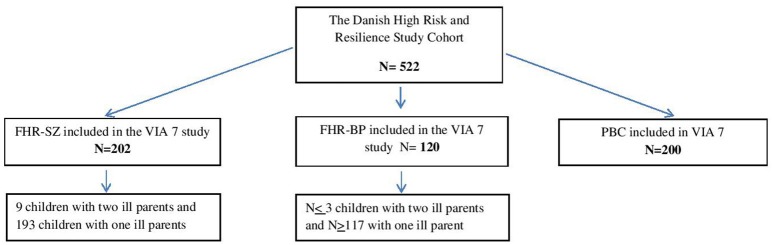
Offspring of parents with severe mental illness have an increased risk of developing mental illnesses themselves. Familial high risk cohorts give a unique opportunity for studying the development over time, both the illness that the individual is predisposed for and any other diagnoses. These studies can also increase our knowledge of etiology of severe mental illness and provide knowledge about the underlying mechanisms before illness develops. Interventions targeting this group are often proposed due to the potential possibility of prevention, but evidence about timing and content is lacking. A large, representative cohort of 522 7-year old children born to parents with schizophrenia, bipolar disorder or controls was established based on Danish registers. A comprehensive baseline assessment including neurocognition, motor functioning, psychopathology, home environment, sociodemographic data, and genetic information was conducted from January 1, 2013 to January 31, 2016. This study is the first follow-up of the cohort, carried out when the children turn 11 years of age. By assessing the cohort at this age, we will evaluate the children twice before puberty. All instruments have been selected with a longitudinal perspective and most of them are identical to those used at inclusion into the study at age 7. A diagnostic interview, motor tests, and a large cognitive battery are conducted along with home visits and information from teachers. This time we examine the children's brains by magnetic resonance scans and electroencephalograms. Measures of physical activity and sleep are captured by a chip placed on the body, while we obtain biological assays by collecting blood samples from the children. Findings from the VIA 7 study revealed large variations across domains between children born to parents with schizophrenia, bipolar and controls, respectively. This study will further determine whether the children at familial risk reveal delayed developmental courses, but catch up at age 11, or whether the discrepancies between the groups have grown even larger. We will compare subgroups within each of the familial high risk groups in order to investigate aspects of resilience. Data on brain structure and physical parameters will add a neurobiological dimension to the study.
患有严重精神疾病的父母的后代自身患精神疾病的风险会增加。家族性高风险队列提供了一个独特的机会来研究随时间的发展情况,包括个体易患的疾病以及任何其他诊断。这些研究还可以增加我们对严重精神疾病病因的了解,并在疾病发生前提供有关潜在机制的知识。由于存在预防的可能性,针对这一群体的干预措施经常被提出,但缺乏关于时机和内容的证据。基于丹麦的登记记录,建立了一个由522名7岁儿童组成的大型代表性队列,这些儿童的父母患有精神分裂症、双相情感障碍或为对照组。从2013年1月1日至2016年1月31日进行了全面的基线评估,包括神经认知、运动功能、精神病理学、家庭环境、社会人口统计学数据和遗传信息。本研究是该队列的首次随访,在儿童11岁时进行。通过在这个年龄评估队列,我们将在青春期前对儿童进行两次评估。所有工具都是从纵向角度选择的,其中大多数与7岁纳入研究时使用的工具相同。进行诊断访谈、运动测试和大型认知测试,同时进行家访并收集教师提供的信息。这次我们通过磁共振扫描和脑电图检查儿童的大脑。通过放置在身体上的芯片获取身体活动和睡眠的测量数据,同时通过采集儿童的血样获得生物学检测结果。VIA 7研究的结果显示,分别患有精神分裂症、双相情感障碍的父母的孩子与对照组孩子在各个领域存在很大差异。本研究将进一步确定处于家族风险中的儿童是否显示出发育进程延迟,但在11岁时赶上,或者各群体之间的差异是否变得更大。我们将比较每个家族性高风险组内的亚组,以调查恢复力的各个方面。大脑结构和身体参数的数据将为该研究增添神经生物学维度。