Smith-Woolley Emily, Pingault Jean-Baptiste, Selzam Saskia, Rimfeld Kaili, Krapohl Eva, von Stumm Sophie, Asbury Kathryn, Dale Philip S, Young Toby, Allen Rebecca, Kovas Yulia, Plomin Robert
King's College London, MRC Social, Genetic and Developmental Psychiatry Centre, Institute of Psychiatry, Psychology & Neuroscience, London, SE5 8AF UK.
2Clinical, Educational & Health Psychology, Division of Psychology & Language Sciences, Faculty of Brain Sciences, University College London, 26 Bedford Way, London, WC1H 0DS UK.
NPJ Sci Learn. 2018 Mar 23;3:3. doi: 10.1038/s41539-018-0019-8. eCollection 2018.
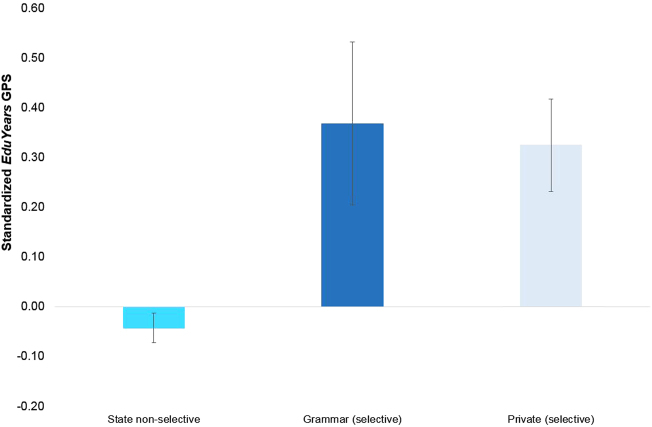
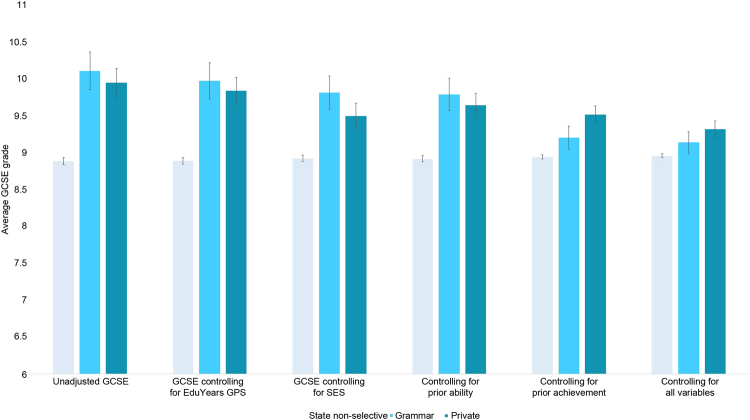
On average, students attending selective schools outperform their non-selective counterparts in national exams. These differences are often attributed to value added by the school, as well as factors schools use to select pupils, including ability, achievement and, in cases where schools charge tuition fees or are located in affluent areas, socioeconomic status. However, the possible role of DNA differences between students of different schools types has not yet been considered. We used a UK-representative sample of 4814 genotyped students to investigate exam performance at age 16 and genetic differences between students in three school types: state-funded, non-selective schools ('non-selective'), state-funded, selective schools ('grammar') and private schools, which are selective ('private'). We created a genome-wide polygenic score (GPS) derived from a genome-wide association study of years of education (). We found substantial mean genetic differences between students of different school types: students in non-selective schools had lower GPS compared to those in grammar ( = 0.41) and private schools ( = 0.37). Three times as many students in the top GPS decile went to a selective school compared to the bottom decile. These results were mirrored in the exam differences between school types. However, once we controlled for factors involved in pupil selection, there were no significant genetic differences between school types, and the variance in exam scores at age 16 explained by school type dropped from 7% to <1%. These results show that genetic and exam differences between school types are primarily due to the heritable characteristics involved in pupil admission.
平均而言,就读于择优录取学校的学生在全国性考试中的表现优于非择优录取学校的学生。这些差异通常归因于学校的增值作用,以及学校用于选拔学生的因素,包括能力、成绩,还有在学校收取学费或位于富裕地区的情况下的社会经济地位。然而,不同类型学校的学生之间DNA差异可能起到的作用尚未得到考虑。我们使用了一个具有英国代表性的样本,其中包括4814名进行了基因分型的学生,以调查16岁时的考试成绩以及三种学校类型学生之间的基因差异:由国家资助的非择优录取学校(“非择优录取”)、由国家资助的择优录取学校(“文法”)和择优录取的私立学校。我们创建了一个全基因组多基因分数(GPS),该分数源自一项关于受教育年限的全基因组关联研究。我们发现不同类型学校的学生之间存在显著的平均基因差异:非择优录取学校的学生的GPS低于文法学校的学生(差异 = 0.41)和私立学校的学生(差异 = 0.37)。处于GPS十分位数前10%的学生进入择优录取学校的人数是处于后10%的学生的三倍。这些结果在不同学校类型的考试差异中也有体现。然而,一旦我们控制了学生选拔所涉及的因素,不同学校类型之间就不存在显著的基因差异了,并且由学校类型解释的16岁考试成绩方差从7%降至<1%。这些结果表明,不同学校类型之间的基因和考试差异主要是由于学生录取过程中涉及的可遗传特征。