Jou Cristina, Ortigoza-Escobar Juan D, O'Callaghan Maria M, Nascimento Andres, Darling Alejandra, Pias-Peleteiro Leticia, Perez-Dueñas Belén, Pineda Mercedes, Codina Anna, Arjona César, Armstrong Judith, Palau Francesc, Ribes Antonia, Gort Laura, Tort Frederic, Navas Placido, Ruiz-Pesini Eduardo, Emperador Sonia, Lopez-Gallardo Ester, Bayona-Bafaluy Pilar, Montero Raquel, Jimenez-Mallebrera Cecilia, Garcia-Cazorla Angels, Montoya Julio, Yubero Delia, Artuch Rafael
Clinical Biochemistry, Pathology, Paediatric Neurology and Molecular Medicine Departments and Biobank, Institut de Recerca Sant Joan de Déu and CIBERER-ISCIII, 08950 Esplugues, Spain.
Secció d'Errors Congènits del Metabolisme-IBC, Servei de Bioquímica i Genètica Molecular, Hospital Clínic, IDIBAPS, CIBERER-ISCIII, 08028 Barcelona, Spain.
J Clin Med. 2019 Jan 10;8(1):68. doi: 10.3390/jcm8010068.
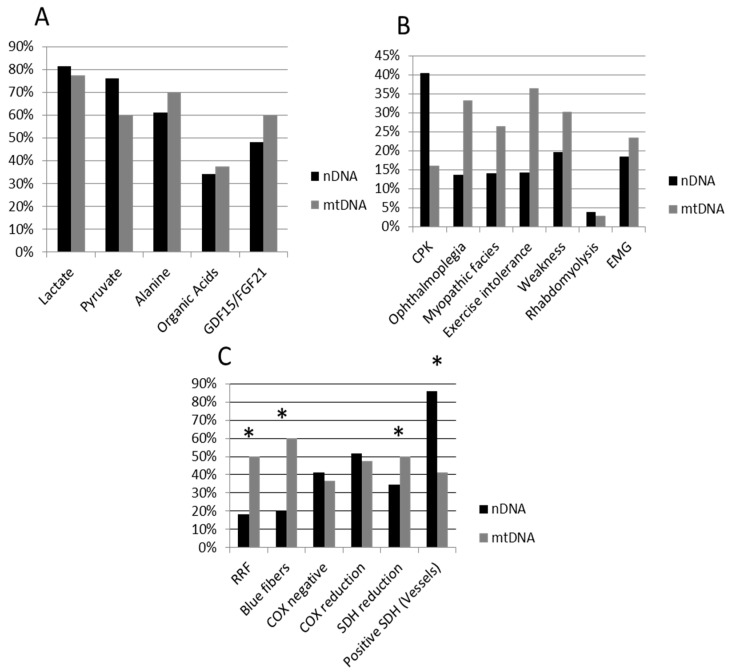
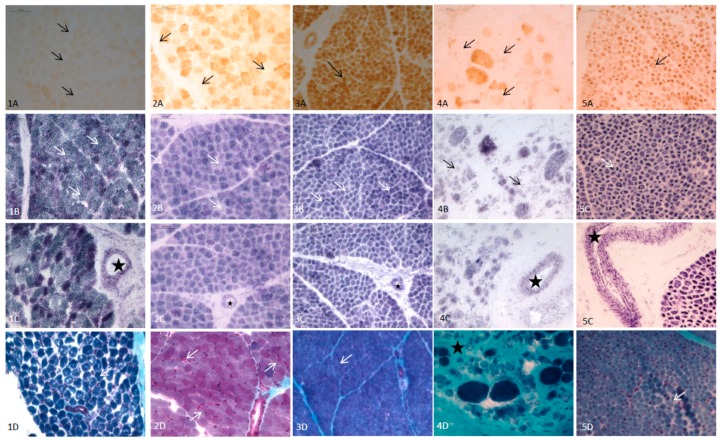
Mitochondrial diseases (MD) are a group of genetic and acquired disorders which present significant diagnostic challenges. Here we report the disease characteristics of a large cohort of pediatric MD patients ( = 95) with a definitive genetic diagnosis, giving special emphasis on clinical muscle involvement, biochemical and histopathological features. Of the whole cohort, 51 patients harbored mutations in nuclear DNA (nDNA) genes and 44 patients had mutations in mitochondrial DNA (mtDNA) genes. The nDNA patients were more likely to have a reduction in muscle fiber succinate dehydrogenase (SDH) stains and in SDH-positive blood vessels, while a higher frequency of mtDNA patients had ragged red (RRF) and blue fibers. The presence of positive histopathological features was associated with ophthalmoplegia, myopathic facies, weakness and exercise intolerance. In 17 patients younger than two years of age, RRF and blue fibers were observed only in one case, six cases presented cytochrome c oxidase (COX) reduction/COX-fibers, SDH reduction was observed in five and all except one presented SDH-positive blood vessels. In conclusion, muscle involvement was a frequent finding in our series of MD patients, especially in those harboring mutations in mtDNA genes.
线粒体疾病(MD)是一组遗传性和后天性疾病,在诊断上面临重大挑战。在此,我们报告了一大群经明确基因诊断的儿科MD患者(n = 95)的疾病特征,特别强调了临床肌肉受累情况、生化和组织病理学特征。在整个队列中,51例患者的核DNA(nDNA)基因发生突变,44例患者的线粒体DNA(mtDNA)基因发生突变。nDNA患者更有可能出现肌纤维琥珀酸脱氢酶(SDH)染色减少以及SDH阳性血管减少的情况,而mtDNA患者出现破碎红(RRF)纤维和蓝色纤维的频率更高。组织病理学阳性特征的出现与眼肌麻痹、肌病面容、肌无力和运动不耐受相关。在17例两岁以下的患者中,仅1例观察到RRF和蓝色纤维,6例出现细胞色素c氧化酶(COX)减少/COX纤维,5例观察到SDH减少,除1例之外所有患者均出现SDH阳性血管。总之,在我们的MD患者系列中,肌肉受累是常见表现,尤其是在那些mtDNA基因突变的患者中。