Center for Prevention and Diagnosis of Celiac Disease, Gastroenterology and Endoscopy Unit, Fondazione IRCCS Ca' Granda Ospedale Maggiore Policlinico, 20135 Milan, Italy.
Department of Biomedical, Surgical and Dental Sciences, University of Milan, 20133 Milan, Italy.
Nutrients. 2019 Jan 10;11(1):136. doi: 10.3390/nu11010136.
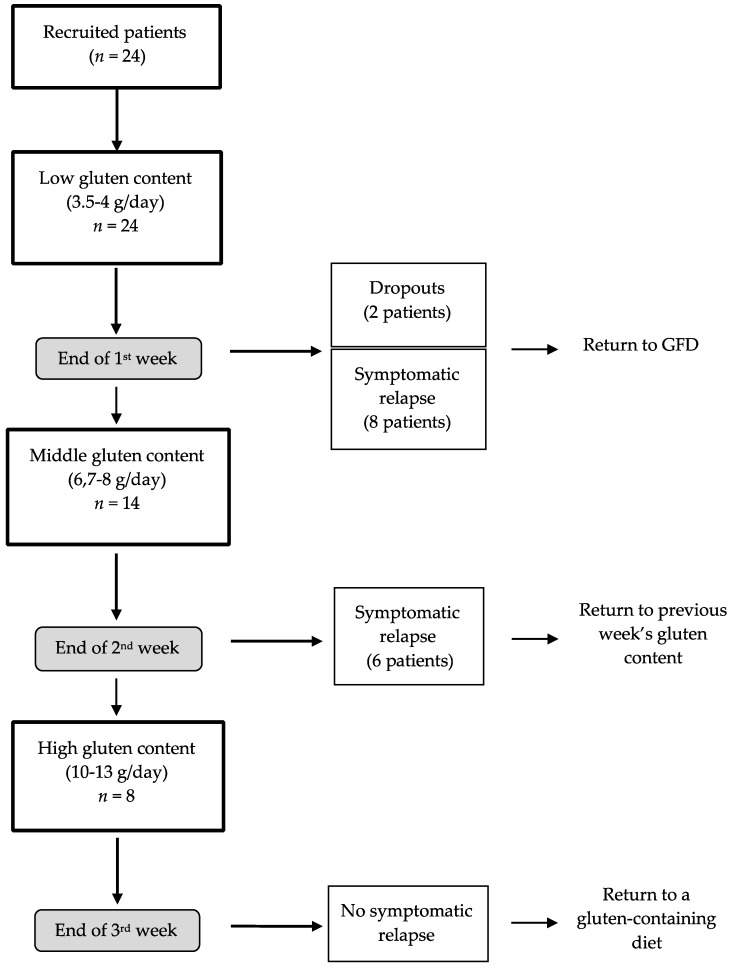
It is unclear whether patients with non-celiac gluten sensitivity (NCGS) can tolerate gluten. We have evaluated the changes of both gastrointestinal symptoms and quality of life for NCGS patients after the re-introduction of dietary gluten. Twenty-two NCGS patients reporting functional gastroenterological symptoms and on gluten-free diet (GFD) for the previous three weeks were exposed to incremental gluten-containing diets. Three groups were compared at baseline (immediately after 3-weeks on GFD) and immediately after the return of symptomatology: (i) a group tolerating a low-gluten diet (3.5 g gluten/day, week 1, = 8), (ii) a group tolerating a mid-gluten diet (8 g gluten/day, week 2, = 6), and (iii) a group tolerating a high-gluten diet (13 g gluten/day, week 3, = 8). Their gastrointestinal symptoms and quality of life were assessed at baseline and post-intervention. The most common symptoms were: constipation (46%), abdominal pain (50%) and dyspepsia (38%). A decrease in several short form health survey (SF-36) sub-scores (all < 0.03) after gluten re-introduction was only observed in the group tolerating the low-gluten diet; the same group showed a lower post-intervention role-emotional SF-36 score ( = 0.01). Most gastrointestinal symptoms remained similar after gluten re-introduction. However, a decrease in the general perception of well-being was only found after gluten re-introduction in the group tolerating a low-gluten diet ( = 0.01); the same was true when comparing the post-intervention general well-being perception among the three groups ( = 0.050). In conclusion, dissimilar responses from patients with NCGS were observed after the re-introduction of gluten, with gluten at a low dosage affecting the quality of life and general well-being of a group of patients, whereas others tolerate even higher doses of dietary gluten.
目前尚不清楚非乳糜泻麸质敏感性(NCGS)患者是否能够耐受麸质。我们评估了在重新引入饮食麸质后,NCGS 患者的胃肠道症状和生活质量的变化。22 名报告有功能性胃肠病症状并在过去三周内接受无麸质饮食(GFD)的 NCGS 患者接受了递增的含麸质饮食。在基线(GFD 后 3 周时立即)和症状恢复后,将三组进行了比较:(i)一组能耐受低麸质饮食(3.5 g 麸质/天,第 1 周, = 8),(ii)一组能耐受中麸质饮食(8 g 麸质/天,第 2 周, = 6),和(iii)一组能耐受高麸质饮食(13 g 麸质/天,第 3 周, = 8)。他们的胃肠道症状和生活质量在基线和干预后进行了评估。最常见的症状是:便秘(46%)、腹痛(50%)和消化不良(38%)。仅在能耐受低麸质饮食的组中,在重新引入麸质后,几个简短健康调查(SF-36)子评分(均<0.03)下降;同一组的 SF-36 角色情感评分在干预后较低( = 0.01)。在重新引入麸质后,大多数胃肠道症状仍然相似。然而,只有在能耐受低麸质饮食的组中,在重新引入麸质后,整体幸福感的感知才会下降( = 0.01);当比较三组在干预后的整体幸福感感知时,情况也是如此( = 0.050)。总之,在重新引入麸质后,NCGS 患者的反应不同,低剂量的麸质会影响一组患者的生活质量和整体幸福感,而其他患者则能耐受更高剂量的饮食麸质。