State Key Laboratory for Conservation and Utilization of Bio-Resources in Yunnan & School of Life Sciences, Yunnan University, Kunming 650091, China.
College of Mathematics and Computer, Dali University, Dali 671003, China.
Int J Mol Sci. 2019 Jan 10;20(2):260. doi: 10.3390/ijms20020260.
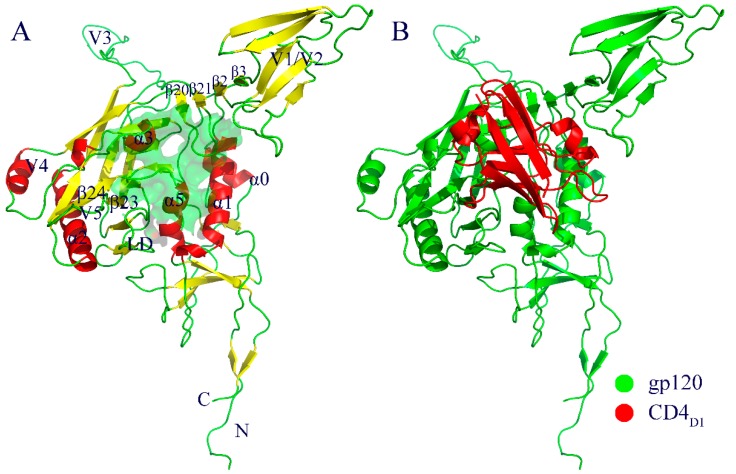
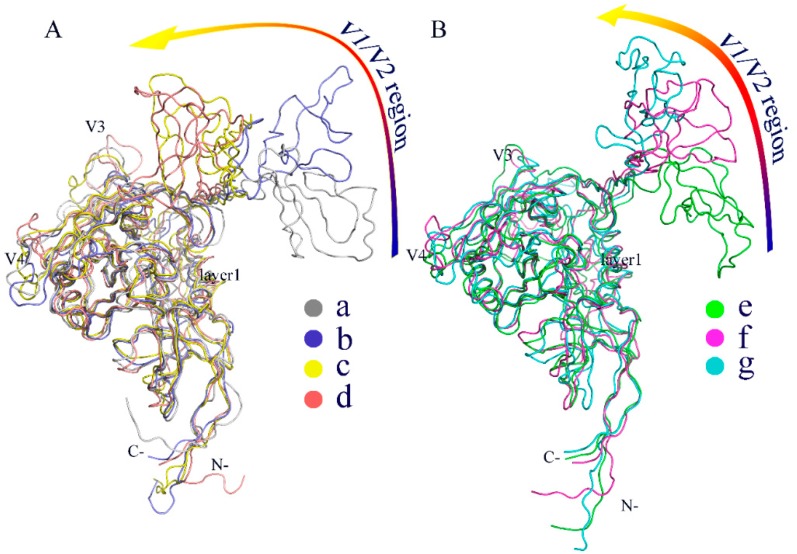
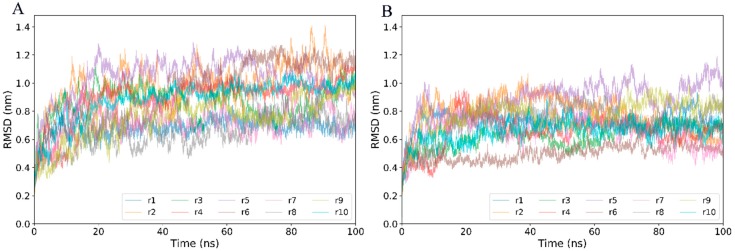
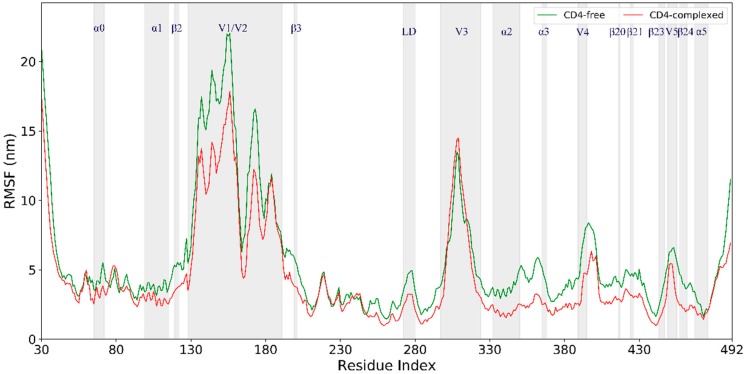
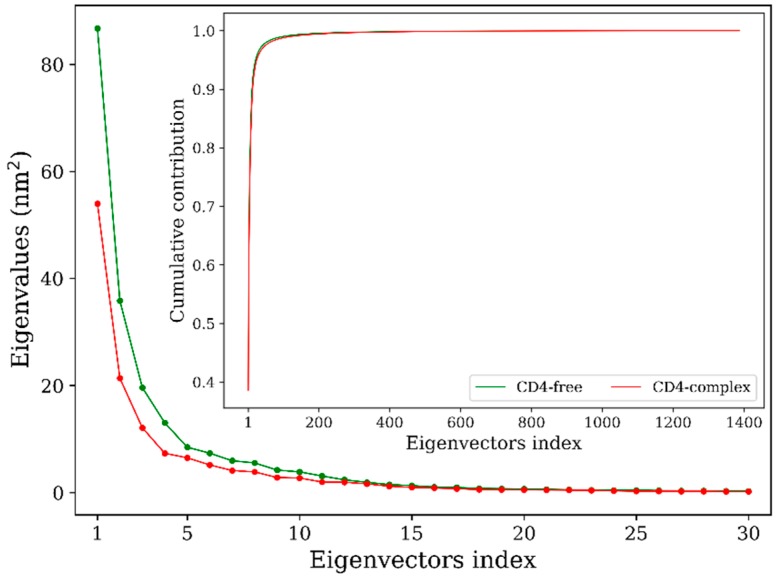
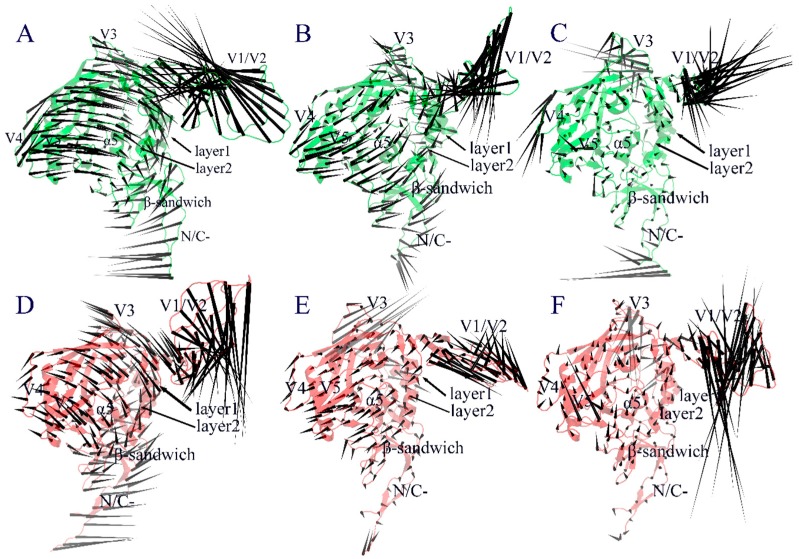
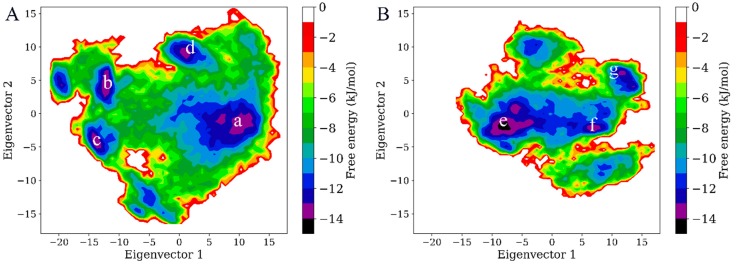
Human immunodeficiency virus type-1 (HIV-1) infection is triggered by its envelope (Env) glycoprotein gp120 binding to the host-cell receptor CD4. Although structures of Env/gp120 in the liganded state are known, detailed information about dynamics of the liganded gp120 has remained elusive. Two structural models, the CD4-free gp120 and the gp120-CD4 complex, were subjected to µs-scale multiple-replica molecular dynamics (MD) simulations to probe the effects of CD4 binding on the conformational dynamics, molecular motions, and thermodynamics of gp120. Comparative analyses of MD trajectories in terms of structural deviation and conformational flexibility reveal that CD4 binding effectively suppresses the overall conformational fluctuations of gp120. Despite the largest fluctuation amplitude of the V1/V2 region in both forms of gp120, the presence of CD4 prevents it from approaching the gp120 core. Comparison of the constructed free energy landscapes (FELs) shows that CD4 binding reduces the conformational entropy and conformational diversity while enhancing the stability of gp120. Further comparison of the representative structures extracted from free energy basins/minima of FELs reveals that CD4 binding weakens the reorientation ability of V1/V2 and hence hinders gp120 from transitioning out of the liganded state to the unliganded state. Therefore, locking gp120 conformation via restraining V1/V2 reorientation with small molecules seems to be a promising strategy to control HIV-1 infection. Our computer simulation results support the conformational selection mechanism for CD4 binding to gp120 and facilitate the understanding of HIV-1 immune evasion mechanisms.
人类免疫缺陷病毒 1 型(HIV-1)感染是由其包膜(Env)糖蛋白 gp120与宿主细胞受体 CD4 结合引发的。尽管已知配体状态下的 Env/gp120 结构,但配体 gp120 的详细动力学信息仍然难以捉摸。对无 CD4 的 gp120 和 gp120-CD4 复合物这两种结构模型进行了微秒级的多副本分子动力学(MD)模拟,以探究 CD4 结合对 gp120 的构象动力学、分子运动和热力学的影响。根据结构偏差和构象灵活性对 MD 轨迹进行的比较分析表明,CD4 结合有效地抑制了 gp120 的整体构象波动。尽管在这两种形式的 gp120 中 V1/V2 区域的波动幅度最大,但 CD4 的存在阻止了它接近 gp120 核心。构建的自由能景观(FEL)的比较表明,CD4 结合降低了 gp120 的构象熵和构象多样性,同时增强了 gp120 的稳定性。从 FEL 的自由能盆地/最小值中提取的代表性结构的进一步比较表明,CD4 结合削弱了 V1/V2 的重定向能力,从而阻碍了 gp120 从配体状态转变为非配体状态。因此,通过限制 V1/V2 的重定向来锁定 gp120 构象,用小分子似乎是控制 HIV-1 感染的一种有前途的策略。我们的计算机模拟结果支持了 CD4 与 gp120 结合的构象选择机制,并有助于理解 HIV-1 的免疫逃逸机制。