Li Yi, Deng Lei, Ai Shi-Meng, Sang Peng, Yang Jing, Xia Yuan-Lin, Zhang Zhi-Bi, Fu Yun-Xin, Liu Shu-Qun
State Key Laboratory for Conservation and Utilization of Bio-Resources in Yunnan, Yunnan University Kunming P. R. China
Department of Applied Mathematics, Yunnan Agricultural University Kunming P. R. China.
RSC Adv. 2018 Apr 17;8(26):14355-14368. doi: 10.1039/c8ra00425k.
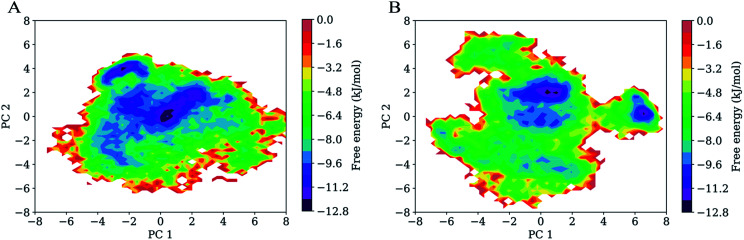
The envelope (Env) of HIV-1 plays critical roles in viral infection and immune evasion. Although structures of prefusion Env have been determined and phenotypes relevant to the CD4 dependency and the neutralization sensitivity for various HIV-1 isolates have been identified, the detailed structural dynamics and energetics underlying these two phenotypes have remained elusive. In this study, two unliganded structural models of gp120, one from the CD4-dependent, neutralization-resistant isolate H061.14 and the other from the CD4-independent, neutralization-sensitive R2 strain, were constructed, and subsequently were subjected to multiple-replica molecular dynamics (MD) simulations followed by free energy landscape (FEL) construction. Comparative analyses of MD trajectories reveal that during simulations R2-gp120 demonstrated larger structural fluctuations/deviations and higher global conformational flexibility than H061.14-gp120. Close comparison of local conformational flexibility shows that some of the structural regions involving direct interactions with gp41 and adjacent gp120 subunits in the context of the closed trimeric Env exhibit significantly higher flexibility in R2-gp120 than in H061.14-gp120, thus likely increasing the probability for R2-Env to open the trimer crown and prime gp41 fusogenic properties without induction by CD4. Collective motions derived from principal component analysis (PCA) reveal that R2-gp120 is prone to spontaneous transition to the neutralization-sensitive CD4-bound state while H061.14-gp120 tends to maintain the neutralization-resistant unliganded state. Finally, comparison between FELs reveals that R2-gp120 has larger conformational entropy, richer conformational diversity, and lower thermostability than H061.14-gp120, thus explaining why R2-gp120 is more structurally unstable and conformationally flexible, and has a higher propensity to transition to the CD4-bound state than H061.14-gp120. The present results reveal that the differences in dynamics and energetics between R2-gp120 and H061.14-gp120 impart Env trimers with distinct capacities to sample different states (, R2-Env samples more readily the open state while H061.14-Env is more inclined to maintain the closed state), thus shedding light on the molecular mechanism underlying the HIV-1 phenotype associated with CD4 dependency/neutralization sensitivity.
HIV-1的包膜糖蛋白(Env)在病毒感染和免疫逃逸中起着关键作用。尽管已确定了融合前Env的结构,并鉴定了与各种HIV-1分离株的CD4依赖性和中和敏感性相关的表型,但这两种表型背后详细的结构动力学和能量学仍不清楚。在本研究中,构建了两种未结合配体的gp120结构模型,一种来自CD4依赖性、中和抗性分离株H061.14,另一种来自CD4非依赖性、中和敏感性R2株,随后对其进行多重复制分子动力学(MD)模拟,接着构建自由能景观(FEL)。MD轨迹的比较分析表明,在模拟过程中,R2-gp120比H061.14-gp120表现出更大的结构波动/偏差和更高的全局构象灵活性。局部构象灵活性的仔细比较表明,在封闭三聚体Env背景下,一些与gp41和相邻gp120亚基直接相互作用的结构区域在R2-gp120中比在H061.14-gp120中表现出明显更高的灵活性,因此可能增加R2-Env打开三聚体冠并引发gp41融合特性而无需CD4诱导的概率。主成分分析(PCA)得出的集体运动表明,R2-gp120易于自发转变为中和敏感的CD4结合状态,而H061.14-gp120倾向于维持中和抗性的未结合配体状态。最后,FELs之间的比较表明,R2-gp120比H061.14-gp120具有更大的构象熵、更丰富的构象多样性和更低的热稳定性,从而解释了为什么R2-gp120在结构上更不稳定且构象更灵活,并且比H061.14-gp120具有更高的转变为CD4结合状态的倾向。目前的结果表明,R2-gp120和H061.14-gp120之间动力学和能量学的差异赋予Env三聚体不同的能力来采样不同状态(即,R2-Env更容易采样开放状态,而H061.14-Env更倾向于维持封闭状态),从而揭示了与CD4依赖性/中和敏感性相关的HIV-1表型背后的分子机制。