Department of Quality Management, Administration Center, Chang Gung Medical Foundation, Taoyuan, Taiwan.
Department of Nursing, Chang Gung University of Science & Technology, Taoyuan, Taiwan.
PLoS One. 2019 Jan 15;14(1):e0210606. doi: 10.1371/journal.pone.0210606. eCollection 2019.
Evidence-based nursing (EBN) has been an important training mechanism for improving the quality of clinical care. At present, the pedagogy focuses on the application of e-learning and team-based learning to enhance learners' engagement and learning effectiveness.
This study applied the flipped classroom approach to conduct evidence-based nursing (EBN) teaching. The aim of this study is to elevate the learning effectiveness of the flipped classroom group to the traditional teaching group in terms of knowledge and self-efficacy in practice.
A pretest-posttest nonequivalent control group with a quasi-experimental quantitative design.
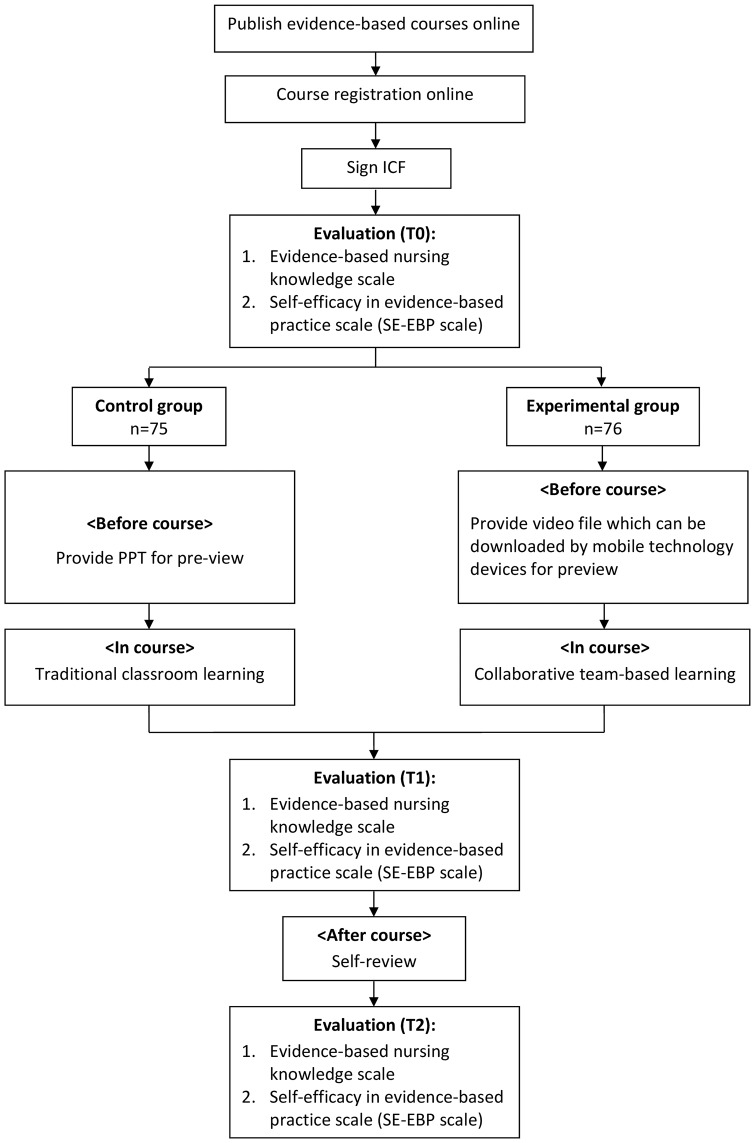
The study recruited 151 nurses, of whom 75 were in the control group and 76 were in the experimental group. During the EBN course, the control group received training via traditional pedagogy while the experimental group engaged the flipped classroom approach. The learning effectiveness of EBN knowledge and self-efficacy in practice were evaluated across the three time points: pre-course, post-course, and one month after the course.
In both group the scores of the EBN knowledge and self-efficacy in practice improved after training. The scores of the experimental group increased significantly than in the control group. However, the scores declined in both groups one month after the course. Even so, the experimental group's score of self-efficacy in practice was still higher than that of the control group.
The implementation of the flipped classroom approach and team-based learning effectively enhanced the learners EBN knowledge accumulation and self-efficacy in practice. The research results can be used as an important reference for improving clinical nursing teaching quality.
循证护理(EBN)一直是提高临床护理质量的重要培训机制。目前,教学法侧重于电子学习和团队学习的应用,以提高学习者的参与度和学习效果。
本研究采用翻转课堂方法进行循证护理(EBN)教学。本研究的目的是提高翻转课堂组的学习效果,使其在知识和实践自我效能方面达到传统教学组的水平。
采用预测试-后测试非等同对照组的准实验定量设计。
该研究招募了 151 名护士,其中 75 名在对照组,76 名在实验组。在 EBN 课程中,对照组接受传统教学法培训,而实验组采用翻转课堂方法。在三个时间点(课程前、课程后和课程结束一个月后)评估 EBN 知识和实践自我效能的学习效果。
两组的 EBN 知识和实践自我效能得分在培训后均有所提高。实验组的得分显著高于对照组。然而,两组的得分在课程结束一个月后均有所下降。即便如此,实验组的实践自我效能得分仍高于对照组。
翻转课堂方法和团队学习的实施有效增强了学习者的 EBN 知识积累和实践自我效能。研究结果可作为提高临床护理教学质量的重要参考。