Department of Infectious and Parasitic Diseases, School of Medicine, University of São Paulo (Universidade de São Paulo - USP), São Paulo, SP, Brazil.
Laboratory of Viral Medical Research in Hepatology (Laboratório de Investigação Médica em Hepatologia por vírus - LIM-47), Clinics Hospital, School of Medicine, USP, São Paulo, SP, Brazil.
Infect Dis Poverty. 2019 Jan 16;8(1):3. doi: 10.1186/s40249-018-0514-4.
Hepatitis E virus (HEV) is a member of the Hepeviridae family; it has four main genotypes and one serotype. While genotypes 1 and 2 cause epidemic hepatitis and are transmitted via water and the fecal-oral route, genotypes 3 and 4 are zoonotic. In the various seroprevalence studies of hepatitis E in Brazil, the numbers reported vary widely and are difficult to interpret. The aim of this study was to analyze existing seroprevalence studies of hepatitis E in adults in Brazil.
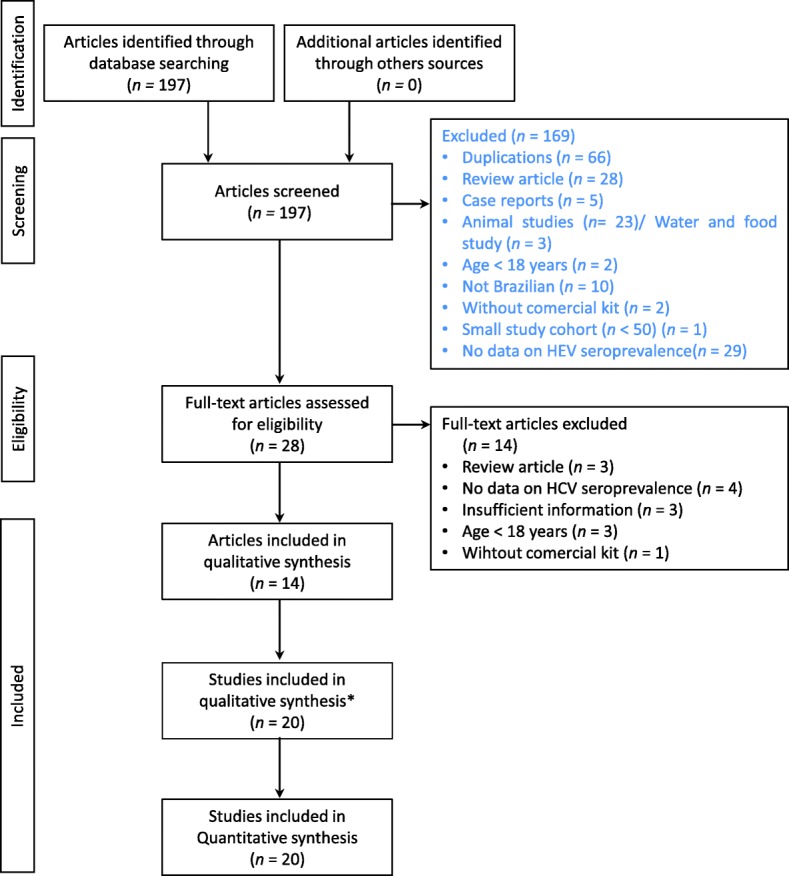
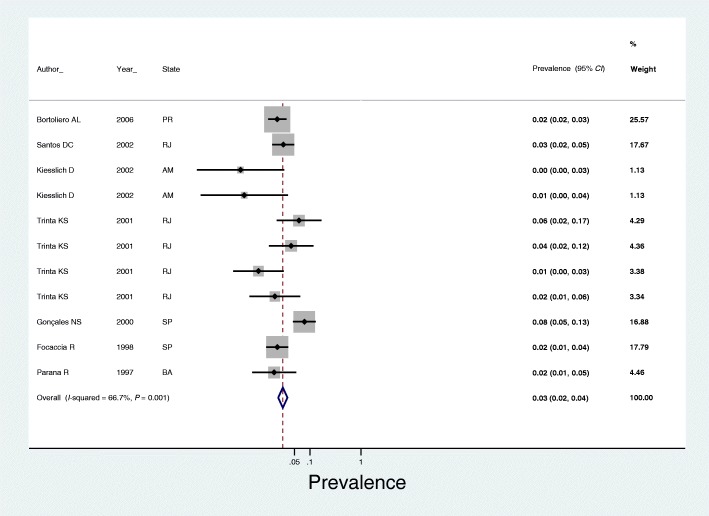
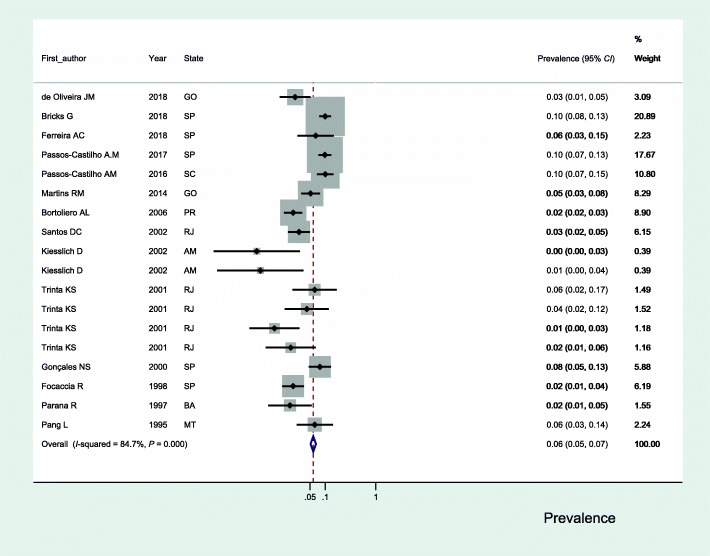
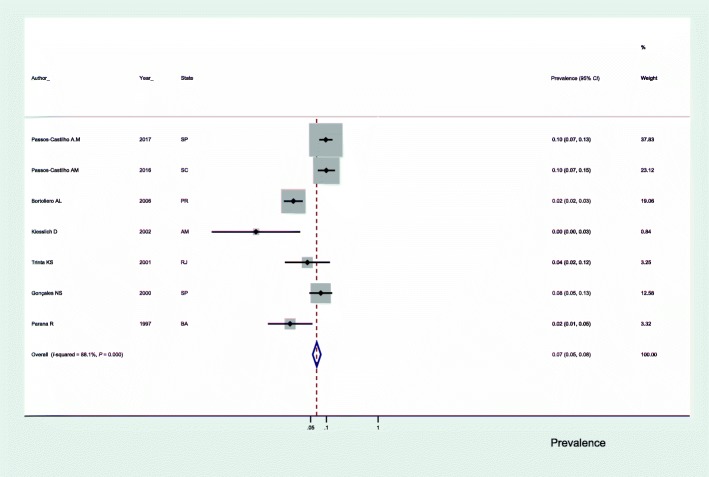
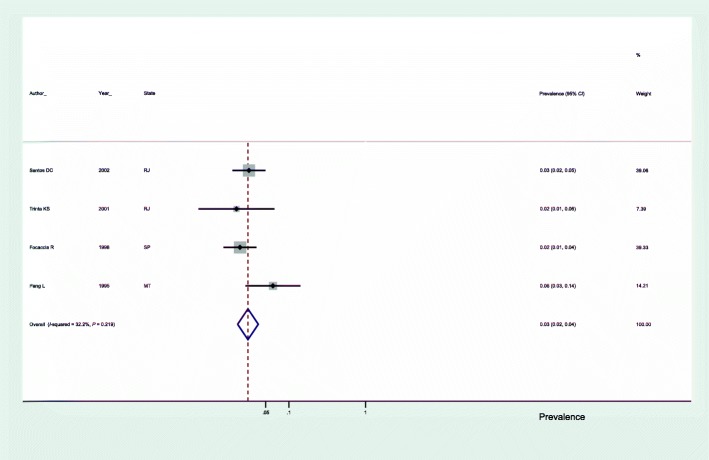
We searched the PubMed, Latin American and Caribbean Health Sciences and Embase databases for studies published from inception to May 12, 2018 concerning infection by HEV in Brazil without time period or language restrictions. We included studies that presented data concerning hepatitis E seroprevalence in adults in Brazil, had a sample size ≥50 patients and whose method used for the detection of anti-HEV was standardized and commercialized. We also evaluated the quality of the articles using a list of criteria that totalized 9 items. Of the 20 studies ultimately analyzed, 10 (50%) were from the southeast region of Brazil, 3 (15%) were from the central-west region, 3 (15%) were from the northern region, 2 (10%) were from the northeast region and 2 (10%) were from the southern region. Regarding the quality evaluation of the studies, the mean score was 5.6 (range: 4-8). The estimated overall seroprevalence of HEV infection in the adult population was 6.0% (95% CI: 5.0-7.0); in subgroup analyses, we observed that the prevalence of anti-HEV antibodies in blood donors was 7.0% (95% CI: 5.0-8.0), whereas in the general population, it was 3.0% (95% CI: 2.0-4.0).
The results of this systematic review indicate that there should be national investment in the prevention of hepatitis E virus infection in Brazil, including the implementation of improvements in basic sanitation and guidance regarding the appropriate handling of animal waste and the optimal cooking of vegetables, meat and their derivatives.
戊型肝炎病毒(HEV)是肝炎病毒科的一个成员;它有四个主要基因型和一个血清型。基因型 1 和 2 引起的是大流行型肝炎,通过水和粪-口途径传播,而基因型 3 和 4 则是动物源性的。在巴西进行的各种戊型肝炎血清学流行率研究中,报告的数字差异很大,难以解释。本研究旨在分析巴西成年人中现有的戊型肝炎血清学流行率研究。
我们在 PubMed、拉丁美洲和加勒比健康科学以及 Embase 数据库中搜索了从开始到 2018 年 5 月 12 日发表的关于巴西 HEV 感染的研究,没有时间限制或语言限制。我们纳入了在巴西成年人中报告了戊型肝炎血清流行率数据、样本量≥50 例且用于检测抗-HEV 的方法标准化和商业化的研究。我们还使用一个总计 9 项标准的清单评估了文章的质量。在最终分析的 20 项研究中,10 项(50%)来自巴西东南部,3 项(15%)来自中西部,3 项(15%)来自北部,2 项(10%)来自东北部,2 项(10%)来自南部。关于研究的质量评估,平均得分为 5.6(范围:4-8)。估计戊型肝炎病毒感染在成年人群中的总流行率为 6.0%(95%可信区间:5.0-7.0);在亚组分析中,我们观察到血液供者中抗-HEV 抗体的流行率为 7.0%(95%可信区间:5.0-8.0),而在一般人群中为 3.0%(95%可信区间:2.0-4.0)。
这项系统评价的结果表明,巴西应该在预防戊型肝炎病毒感染方面进行国家投资,包括改善基本卫生设施以及关于动物废物的适当处理和蔬菜、肉类及其衍生物的最佳烹饪的指导。