Laboratoire de Physique de l'Ecole Normale Supérieure, ENS, Université PSL, CNRS, Sorbonne Université, Université Paris-Diderot, Sorbonne Paris Cité, Paris, France.
University of Cambridge Metabolic Research Laboratories, Wellcome Trust-Medical Research Council Institute of Metabolic Science, Cambridge CB2 0QQ, United Kingdom.
Mol Biol Cell. 2019 Mar 1;30(5):703-716. doi: 10.1091/mbc.E18-08-0534. Epub 2019 Jan 16.
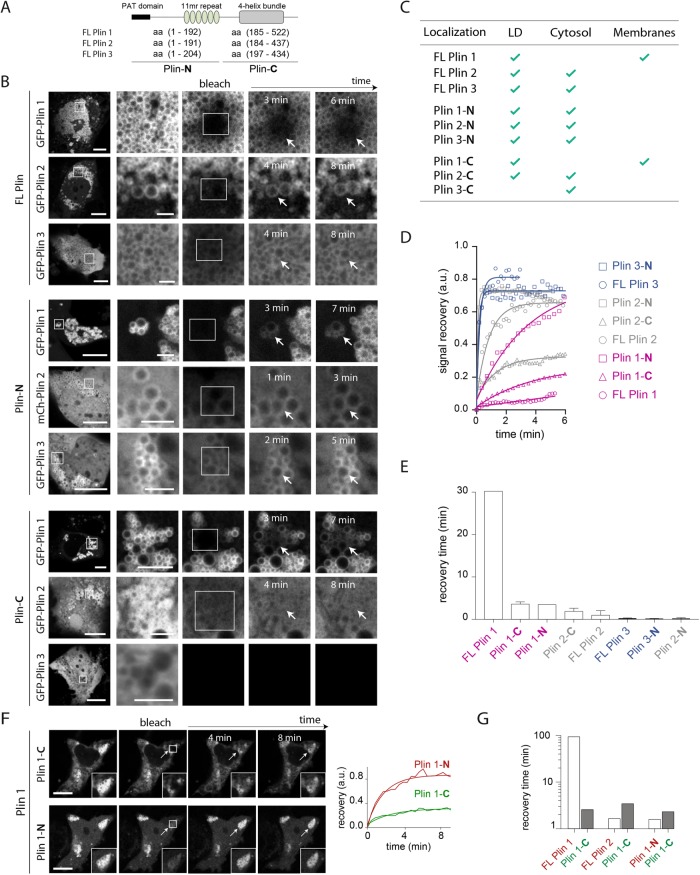
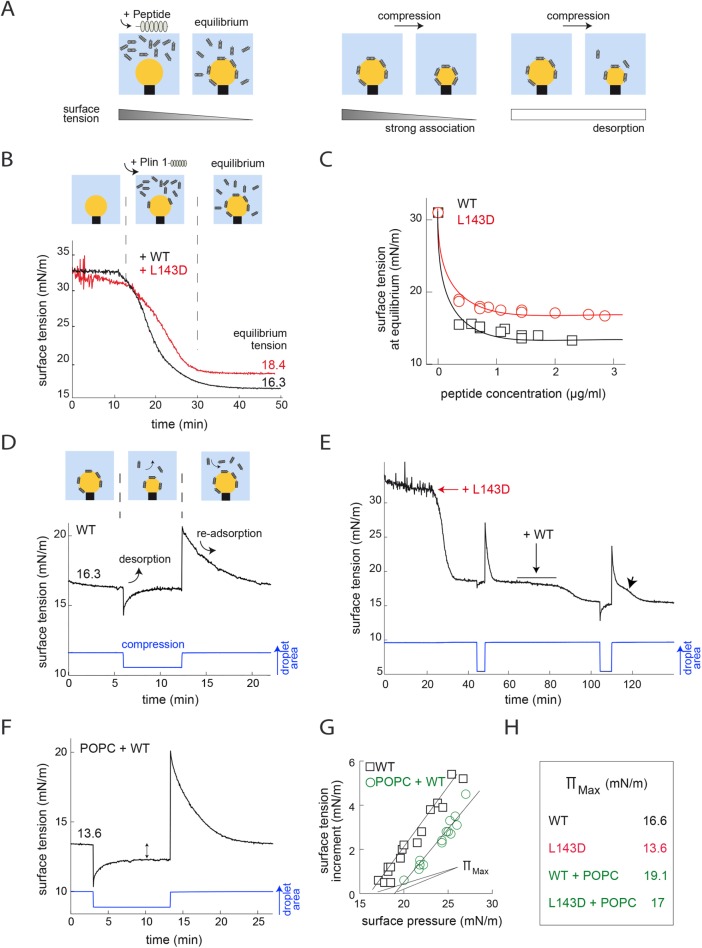
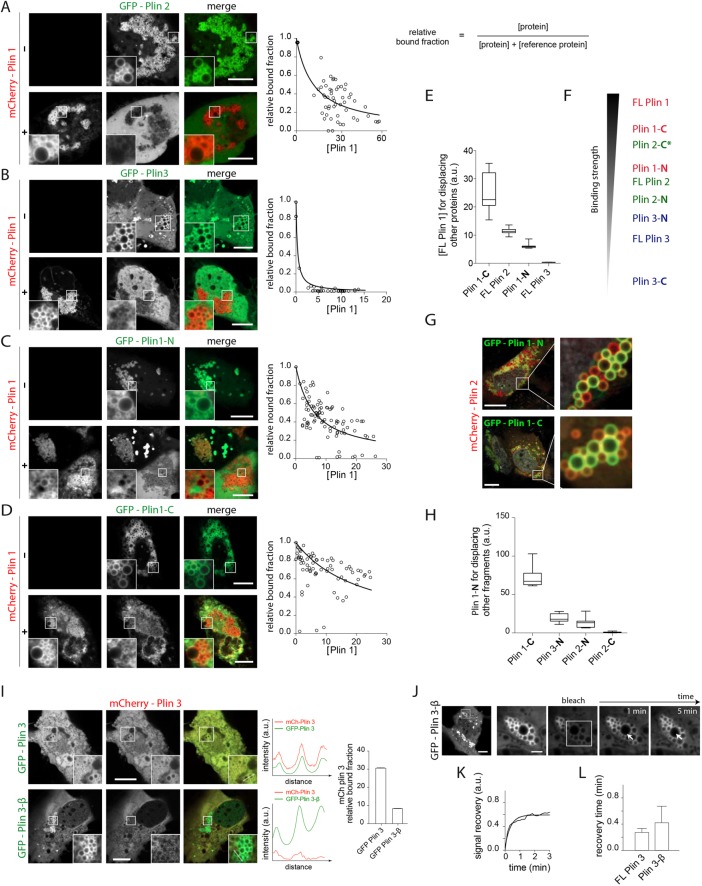
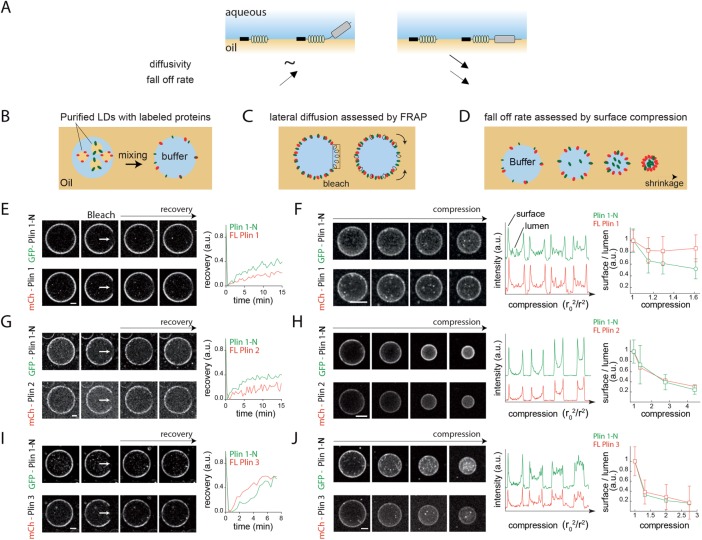
Lipid droplets (LDs) in all eukaryotic cells are coated with at least one of the perilipin (Plin) family of proteins. They all regulate key intracellular lipases but do so to significantly different extents. Where more than one Plin is expressed in a cell, they associate with LDs in a hierarchical manner. In vivo, this means that lipid flux control in a particular cell or tissue type is heavily influenced by the specific Plins present on its LDs. Despite their early discovery, exactly how Plins target LDs and why they displace each other in a "hierarchical" manner remains unclear. They all share an amino-terminal 11-mer repeat (11mr) amphipathic region suggested to be involved in LD targeting. Here, we show that, in vivo, this domain functions as a primary highly reversible LD targeting motif in Plin1-3, and, in vitro, we document reversible and competitive binding between a wild-type purified Plin1 11mr peptide and a mutant with reduced binding affinity to both "naked" and phospholipid-coated oil-water interfaces. We also present data suggesting that a second carboxy-terminal 4-helix bundle domain stabilizes LD binding in Plin1 more effectively than in Plin2, whereas it weakens binding in Plin3. These findings suggest that dual amphipathic helical regions mediate LD targeting and underpin the hierarchical binding of Plin1-3 to LDs.
所有真核细胞的脂滴(LDs)都至少被一种 perilipin(Plin)家族蛋白所覆盖。它们都调控关键的细胞内脂肪酶,但调控程度却大不相同。在一个细胞中表达不止一种 Plin 时,它们以层级方式与 LDs 相关联。在体内,这意味着特定细胞或组织类型中的脂质通量控制受到其 LDs 上存在的特定 Plin 的强烈影响。尽管它们很早就被发现,但 Plin 如何靶向 LDs 以及它们为何以“层级”方式相互取代仍然不清楚。它们都共享一个氨基酸末端 11 -mer 重复(11mr)的两亲性区域,据推测该区域与 LD 靶向有关。在这里,我们表明,在体内,这个结构域在 Plin1-3 中作为一个主要的、高度可逆的 LD 靶向基序发挥作用,并且在体外,我们记录了野生型纯化 Plin1 11mr 肽与突变体之间的可逆和竞争结合,该突变体与“裸露”和磷脂包被的油水界面的结合亲和力降低。我们还提供的数据表明,第二个羧基末端 4 螺旋束结构域在 Plin1 中比在 Plin2 中更有效地稳定 LD 结合,而在 Plin3 中则削弱了结合。这些发现表明,双重两亲性螺旋区域介导 LD 靶向,并为 Plin1-3 与 LDs 的层级结合提供了基础。