High Performance Computer Research Center, Institute of Computing Technology Chinese Academy of Sciences, No. 6 Kexueyuan South Road, Haidian District, Beijing, 100190, China.
University of Chinese Academy of Sciences, Beijing, China.
BMC Bioinformatics. 2019 Jan 18;20(1):41. doi: 10.1186/s12859-019-2614-y.
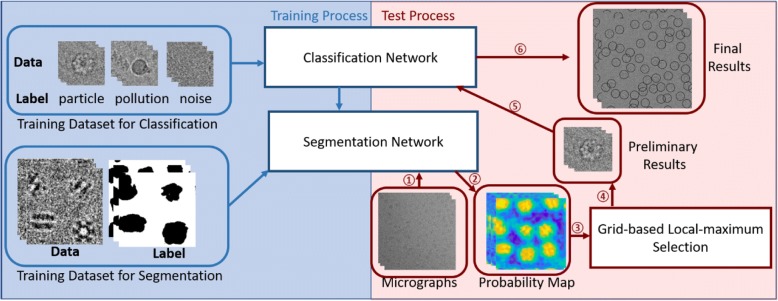
Cryo-electron microscopy (cryo-EM) has become a widely used tool for determining the structures of proteins and macromolecular complexes. To acquire the input for single-particle cryo-EM reconstruction, researchers must select hundreds of thousands of particles from micrographs. As the signal-to-noise ratio (SNR) of micrographs is extremely low, the performance of automated particle-selection methods is still unable to meet research requirements. To free researchers from this laborious work and to acquire a large number of high-quality particles, we propose an automated particle-selection method (PIXER) based on the idea of segmentation using a deep neural network.
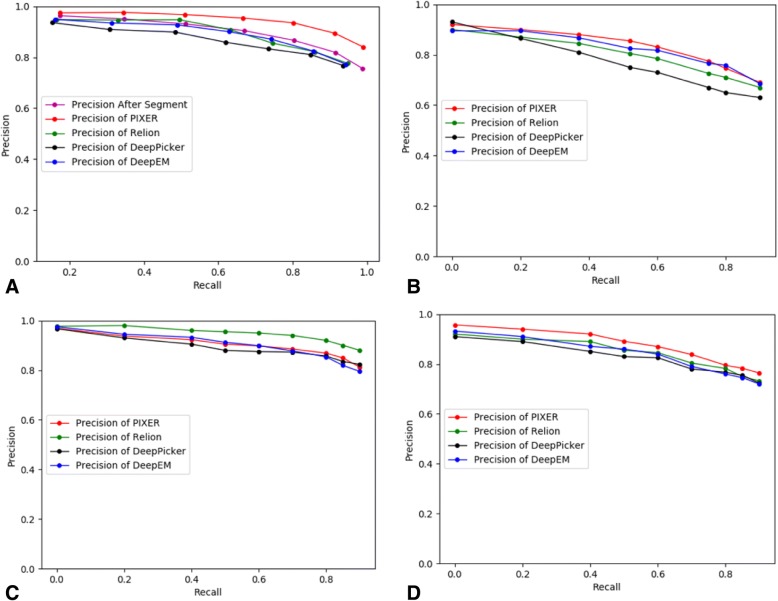
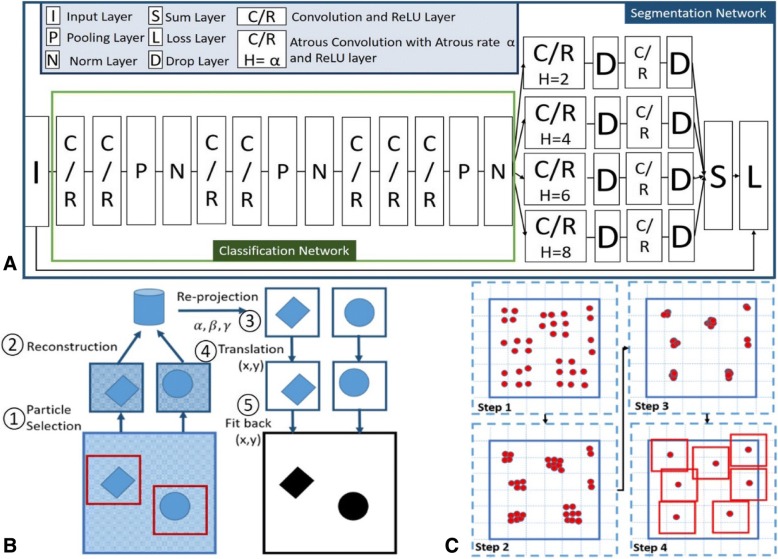
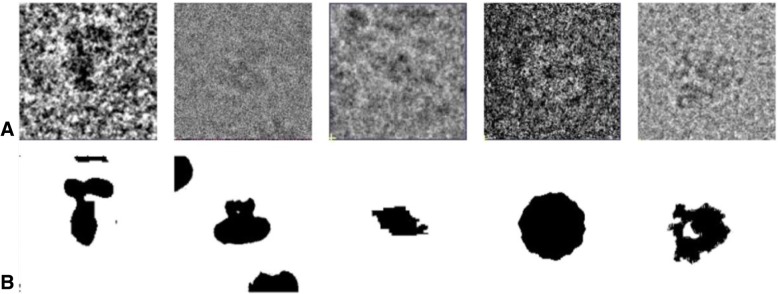
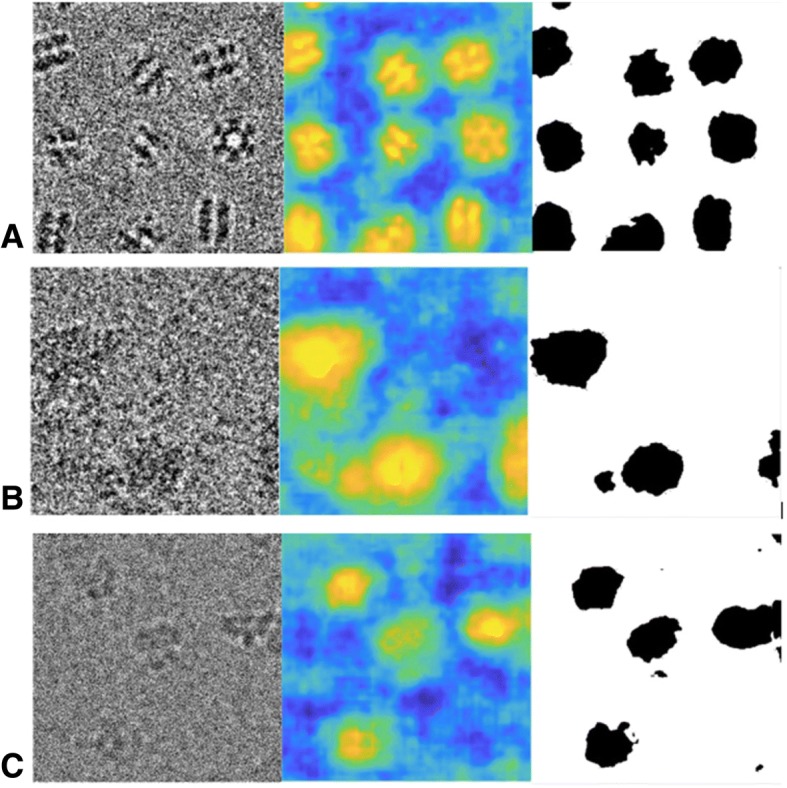
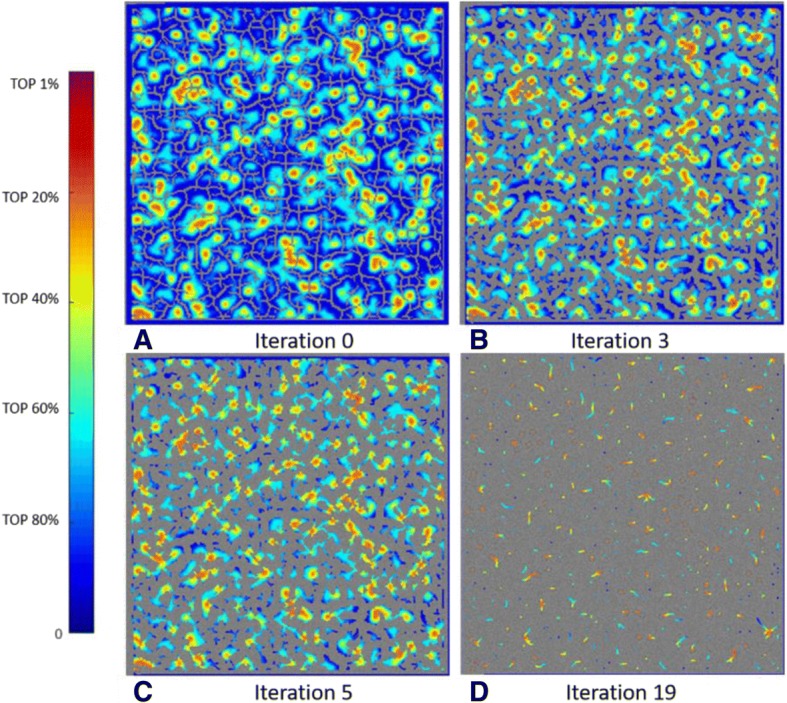
First, to accommodate low-SNR conditions, we convert micrographs into probability density maps using a segmentation network. These probability density maps indicate the likelihood that each pixel of a micrograph is part of a particle instead of just background noise. Particles selected from density maps have a more robust signal than do those directly selected from the original noisy micrographs. Second, at present, there is no segmentation-training dataset for cryo-EM. To enable our plan, we present an automated method to generate a training dataset for segmentation using real-world data. Third, we propose a grid-based, local-maximum method to locate the particles from the probability density maps. We tested our method on simulated and real-world experimental datasets and compared PIXER with the mainstream methods RELION, DeepEM and DeepPicker to demonstrate its performance. The results indicate that, as a fully automated method, PIXER can acquire results as good as the semi-automated methods RELION and DeepEM.
To our knowledge, our work is the first to address the particle-selection problem using the segmentation network concept. As a fully automated particle-selection method, PIXER can free researchers from laborious particle-selection work. Based on the results of experiments, PIXER can acquire accurate results under low-SNR conditions within minutes.
冷冻电子显微镜(cryo-EM)已成为确定蛋白质和大分子复合物结构的常用工具。为了获得单颗粒冷冻电子显微镜重建的输入,研究人员必须从显微照片中选择数十万颗粒。由于显微照片的信噪比较低,自动化颗粒选择方法的性能仍无法满足研究要求。为了使研究人员摆脱这项繁琐的工作,并获得大量高质量的颗粒,我们提出了一种基于深度神经网络分割思想的自动化颗粒选择方法(PIXER)。
首先,为了适应低 SNR 条件,我们使用分割网络将显微照片转换为概率密度图。这些概率密度图表明了显微照片中每个像素属于颗粒而不是仅背景噪声的可能性。从密度图中选择的颗粒比直接从原始噪声显微照片中选择的颗粒具有更强的信号。其次,目前没有用于 cryo-EM 的分割训练数据集。为了实现我们的计划,我们提出了一种自动化方法,使用真实世界的数据生成分割训练数据集。第三,我们提出了一种基于网格的局部最大值方法,从概率密度图中定位颗粒。我们在模拟和真实实验数据集上测试了我们的方法,并将 PIXER 与主流方法 RELION、DeepEM 和 DeepPicker 进行比较,以展示其性能。结果表明,作为一种全自动方法,PIXER 可以获得与半自动方法 RELION 和 DeepEM 一样好的结果。
据我们所知,我们的工作是首次使用分割网络概念解决颗粒选择问题。作为一种全自动颗粒选择方法,PIXER 可以使研究人员摆脱繁琐的颗粒选择工作。基于实验结果,PIXER 可以在几分钟内获得低 SNR 条件下的准确结果。