Leiden University Medical Center, Leiden, the Netherlands.
Orgentec Diagnostika GmbH, Mainz, Germany.
Arthritis Res Ther. 2019 Jan 18;21(1):28. doi: 10.1186/s13075-019-1815-0.
Rheumatoid arthritis (RA) is characterized by the presence of autoantibodies like rheumatoid factor (RF), anti-cyclic citrullinated peptide-2 (anti-CCP2), and anti-carbamylated protein (anti-CarP) antibodies. It is currently unclear whether changes in autoantibody levels are associated with disease activity/treatment outcomes and whether they are modified by treatment intensity. Therefore, we determined longitudinal changes in RA-autoantibody levels, the association between these changes and activity score (DAS) and treatment outcomes, and the effect of intensity of immunosuppressive treatment on levels.
In 381 seropositive RA patients from the IMPROVED study, we measured IgG, IgM, and IgA of anti-CCP2 and anti-CarP; IgM and IgA of RF; and IgG against four citrullinated and two acetylated peptides at 4-month intervals over the first year of treatment. Following initial prednisone and methotrexate (MTX), treatment was changed every 4 months aiming for DAS < 1.6. We investigated changes in autoantibody levels following treatment escalation versus tapering, and the association of levels with DAS over time, EULAR response, and drug-free remission (DFR) ≥ 1 year.
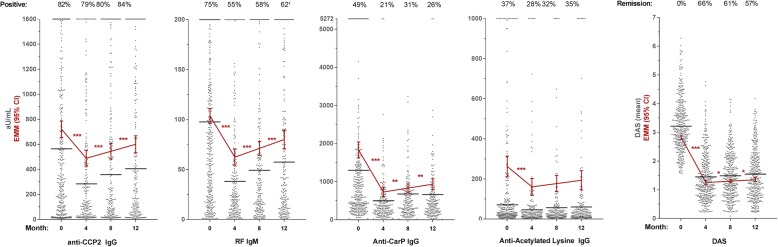
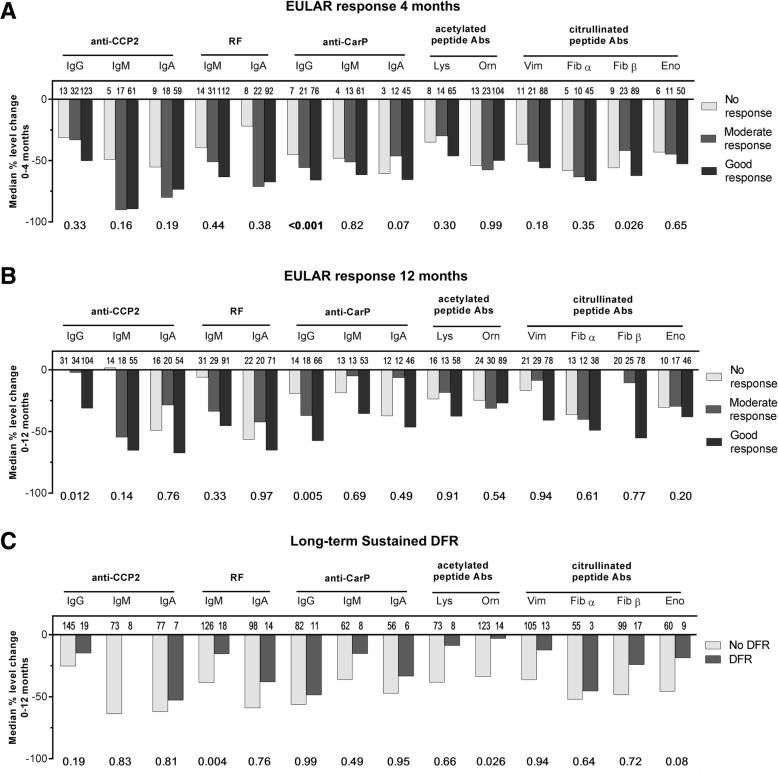
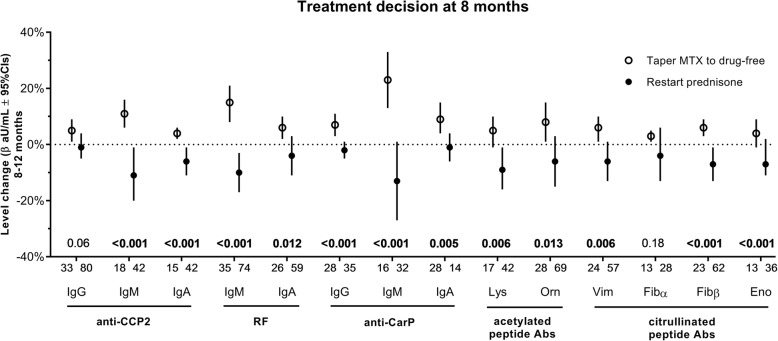
For all 14 autoantibodies, levels decreased from 0 to 4 months and then rose until 12 months. Following treatment escalation, autoantibody levels dropped markedly, while they rose following tapering: RF IgM levels, a representative autoantibody, dropped 10% after restarting prednisone and rose 15% aU/mL after tapering MTX (p < 0.0001). There was no association between autoantibody levels and DAS over time or EULAR response. Greater relative changes between 0 and 12 months did not predict DFR (0-12-month relative change RF IgM, - 39% for no DFR (n = 126) and - 16% for DFR (n = 18)).
Changes in RA-autoantibody levels are not associated with DAS or long-term treatment response, but reflect intensity of immunosuppression. This suggests that autoantibody levels are modifiable by current therapies, but that modifying levels is in itself of limited clinical relevance.
ISRCTN11916566 . Registered on 7 November 2006.
类风湿关节炎(RA)的特征是存在自身抗体,如类风湿因子(RF)、抗环瓜氨酸肽-2(抗-CCP2)和抗氨甲酰化蛋白(抗-CarP)抗体。目前尚不清楚自身抗体水平的变化是否与疾病活动/治疗结果相关,以及它们是否受到治疗强度的影响。因此,我们确定了 RA 自身抗体水平的纵向变化,这些变化与活动评分(DAS)和治疗结果之间的关系,以及免疫抑制治疗强度对水平的影响。
在 IMPROVED 研究的 381 例血清阳性 RA 患者中,我们在治疗的第一年每隔 4 个月测量 IgG、IgM 和 IgA 型抗 CCP2 和抗 CarP;IgM 和 IgA 型 RF;以及针对四种瓜氨酸化和两种乙酰化肽的 IgG。在初始使用泼尼松和甲氨蝶呤(MTX)后,每 4 个月进行一次治疗调整,以达到 DAS<1.6。我们研究了治疗升级与减量后自身抗体水平的变化,以及水平与时间的 DAS、EULAR 反应和无药物缓解(DFR)≥1 年的关联。
对于所有 14 种自身抗体,水平从 0 到 4 个月下降,然后在 12 个月上升。在治疗升级后,自身抗体水平明显下降,而在减量后则上升:RF IgM 水平,一种代表性的自身抗体,在重新开始使用泼尼松后下降了 10%,在减量 MTX 后上升了 15%/mL(p<0.0001)。自身抗体水平与时间的 DAS 或 EULAR 反应之间没有关联。0 到 12 个月之间的相对变化大小与 DFR 无关(0-12 个月的 RF IgM 相对变化,无 DFR(n=126)为-39%,DFR(n=18)为-16%)。
RA 自身抗体水平的变化与 DAS 或长期治疗反应无关,但反映了免疫抑制的强度。这表明,自身抗体水平可通过当前的治疗方法进行调节,但调节水平本身的临床相关性有限。
ISRCTN81534342. 于 2006 年 11 月 7 日注册。