Department of Biological Sciences, Korea Advanced Institute of Science and Technology (KAIST), Daejeon, 34141, Republic of Korea.
Center for Cognition and Sociality, Institute for Basic Science (IBS), Daejeon, 34126, Republic of Korea.
Nat Commun. 2019 Jan 18;10(1):314. doi: 10.1038/s41467-018-08282-8.
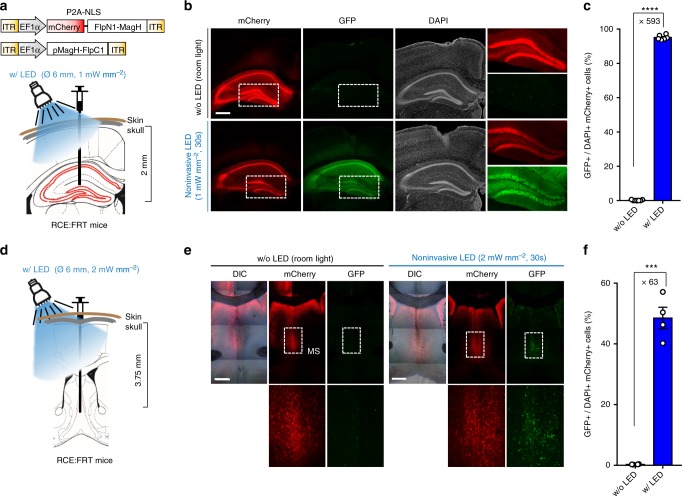
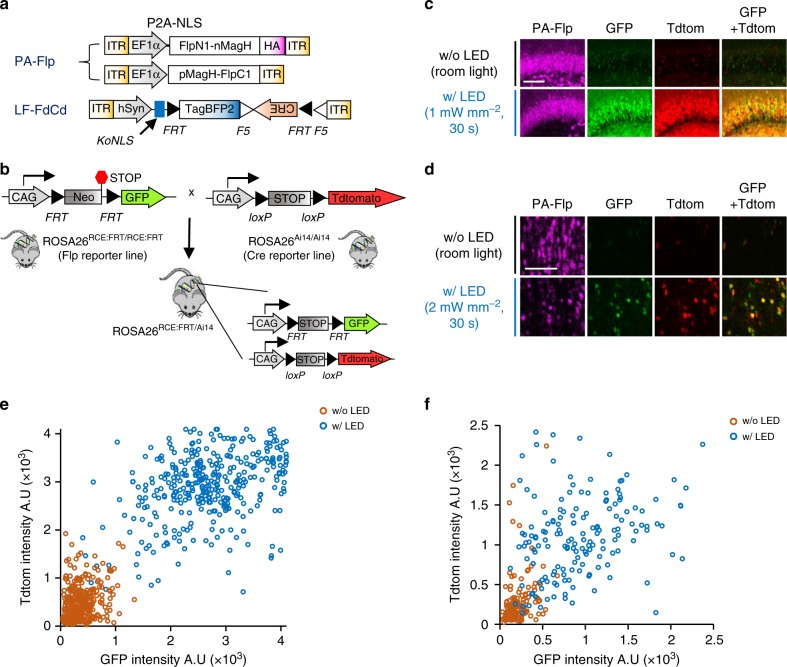
Spatiotemporal control of gene expression or labeling is a valuable strategy for identifying functions of genes within complex neural circuits. Here, we develop a highly light-sensitive and efficient photoactivatable Flp recombinase (PA-Flp) that is suitable for genetic manipulation in vivo. The highly light-sensitive property of PA-Flp is ideal for activation in deep mouse brain regions by illumination with a noninvasive light-emitting diode. In addition, PA-Flp can be extended to the Cre-lox system through a viral vector as Flp-dependent Cre expression platform, thereby activating both Flp and Cre. Finally, we demonstrate that PA-Flp-dependent, Cre-mediated Ca3.1 silencing in the medial septum increases object-exploration behavior in mice. Thus, PA-Flp is a noninvasive, highly efficient, and easy-to-use optogenetic module that offers a side-effect-free and expandable genetic manipulation tool for neuroscience research.
时空基因表达或标记的控制是识别复杂神经回路中基因功能的一种有价值的策略。在这里,我们开发了一种高灵敏度和高效的光激活 Flp 重组酶(PA-Flp),非常适合体内的遗传操作。PA-Flp 的高灵敏度特性非常适合通过非侵入性发光二极管照射来激活深层小鼠大脑区域。此外,PA-Flp 可以通过病毒载体扩展到 Cre-lox 系统,作为 Flp 依赖性 Cre 表达平台,从而激活 Flp 和 Cre。最后,我们证明了内侧隔区中依赖于 PA-Flp 的 Cre 介导的 Ca3.1 沉默增加了小鼠的物体探索行为。因此,PA-Flp 是一种非侵入性、高效且易于使用的光遗传学模块,为神经科学研究提供了一种无副作用且可扩展的遗传操作工具。