Section of Microbiology and MRC Centre for Molecular Bacteriology and Infection, Imperial College London, London, United Kingdom.
Institute of Structural and Molecular Biology, Birkbeck College, University of London, Malet Street, London, United Kingdom.
PLoS Pathog. 2019 Jan 22;15(1):e1007537. doi: 10.1371/journal.ppat.1007537. eCollection 2019 Jan.
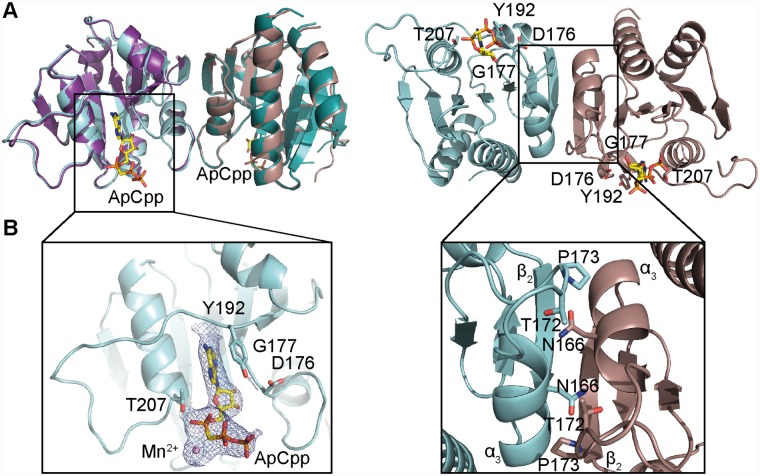
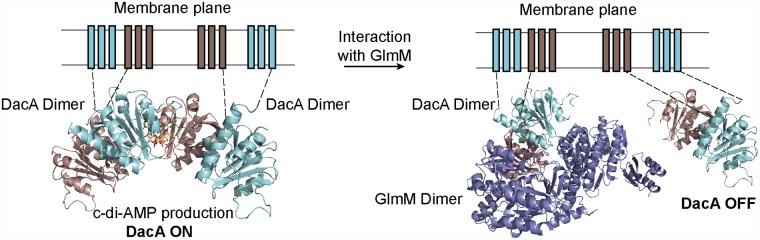
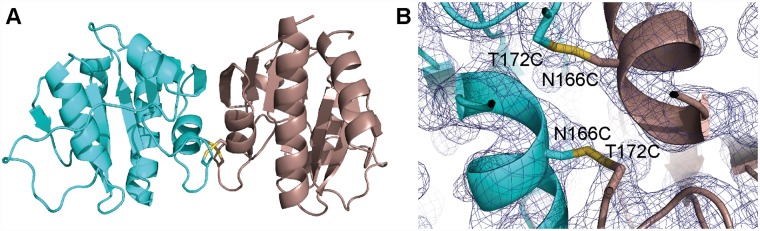
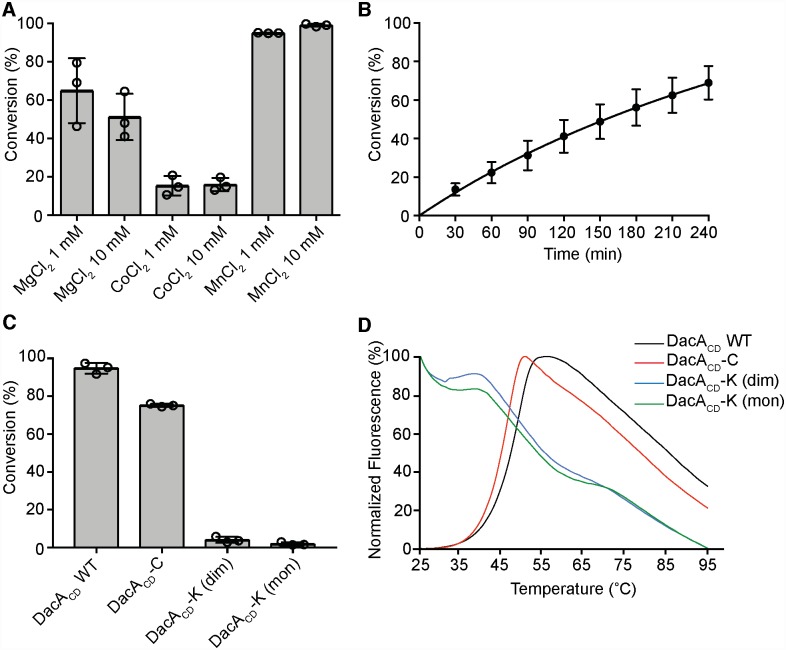
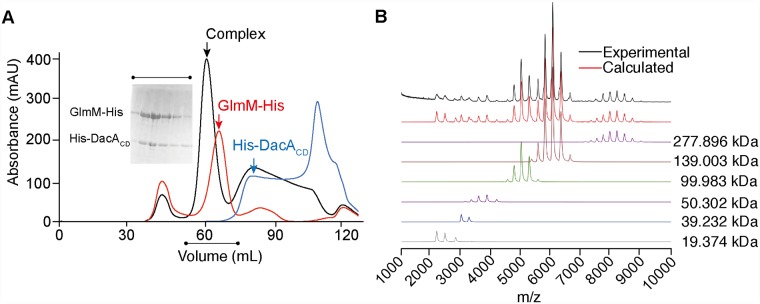
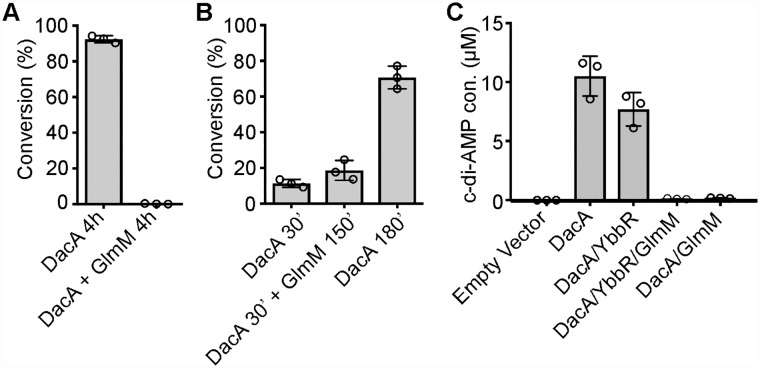
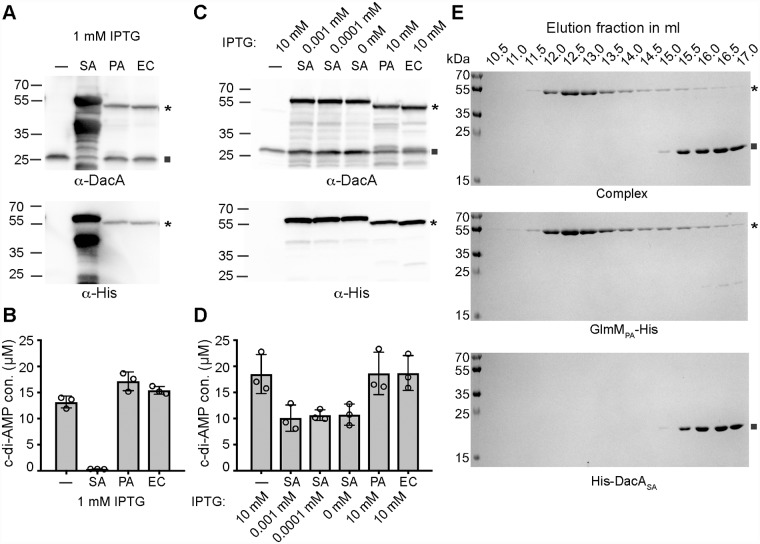
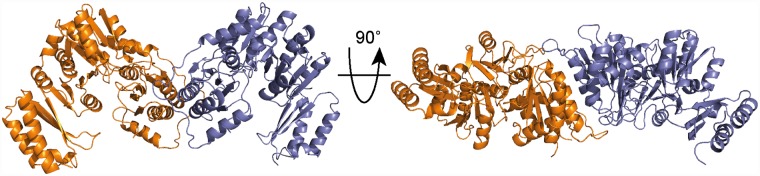
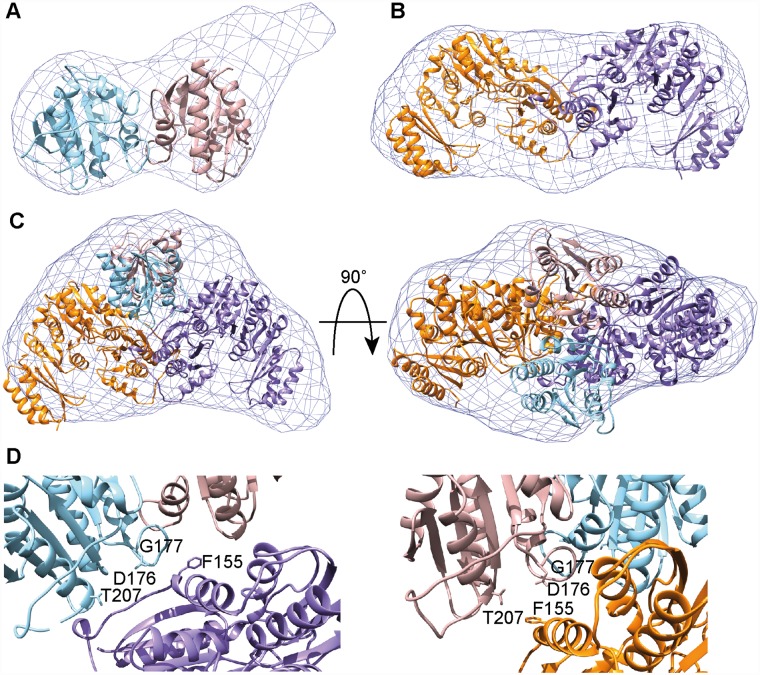
c-di-AMP is an important second messenger molecule that plays a pivotal role in regulating fundamental cellular processes, including osmotic and cell wall homeostasis in many Gram-positive organisms. In the opportunistic human pathogen Staphylococcus aureus, c-di-AMP is produced by the membrane-anchored DacA enzyme. Inactivation of this enzyme leads to a growth arrest under standard laboratory growth conditions and a re-sensitization of methicillin-resistant S. aureus (MRSA) strains to ß-lactam antibiotics. The gene coding for DacA is part of the conserved three-gene dacA/ybbR/glmM operon that also encodes the proposed DacA regulator YbbR and the essential phosphoglucosamine mutase GlmM, which is required for the production of glucosamine-1-phosphate, an early intermediate of peptidoglycan synthesis. These three proteins are thought to form a complex in vivo and, in this manner, help to fine-tune the cellular c-di-AMP levels. To further characterize this important regulatory complex, we conducted a comprehensive structural and functional analysis of the S. aureus DacA and GlmM enzymes by determining the structures of the S. aureus GlmM enzyme and the catalytic domain of DacA. Both proteins were found to be dimers in solution as well as in the crystal structures. Further site-directed mutagenesis, structural and enzymatic studies showed that multiple DacA dimers need to interact for enzymatic activity. We also show that DacA and GlmM form a stable complex in vitro and that S. aureus GlmM, but not Escherichia coli or Pseudomonas aeruginosa GlmM, acts as a strong inhibitor of DacA function without the requirement of any additional cellular factor. Based on Small Angle X-ray Scattering (SAXS) data, a model of the complex revealed that GlmM likely inhibits DacA by masking the active site of the cyclase and preventing higher oligomer formation. Together these results provide an important mechanistic insight into how c-di-AMP production can be regulated in the cell.
c-di-AMP 是一种重要的第二信使分子,在调节许多革兰氏阳性生物的基本细胞过程中发挥关键作用,包括渗透和细胞壁稳态。在机会性病原体金黄色葡萄球菌中,c-di-AMP 是由膜锚定的 DacA 酶产生的。该酶的失活导致在标准实验室生长条件下生长停滞,并使耐甲氧西林金黄色葡萄球菌(MRSA)菌株对β-内酰胺抗生素重新敏感。编码 DacA 的基因是保守的三基因 dacA/ybbR/glmM 操纵子的一部分,该操纵子还编码假定的 DacA 调节剂 YbbR 和必需的磷酸葡萄糖胺变位酶 GlmM,该酶是合成肽聚糖早期中间体葡萄糖胺-1-磷酸所必需的。这三种蛋白质被认为在体内形成复合物,以这种方式帮助微调细胞 c-di-AMP 水平。为了进一步表征这个重要的调节复合物,我们通过确定金黄色葡萄球菌 GlmM 酶和 DacA 的催化结构域的结构,对金黄色葡萄球菌 DacA 和 GlmM 酶进行了全面的结构和功能分析。在溶液中和晶体结构中均发现这两种蛋白质均为二聚体。进一步的定点突变、结构和酶学研究表明,多个 DacA 二聚体需要相互作用才能发挥酶活性。我们还表明 DacA 和 GlmM 在体外形成稳定的复合物,并且金黄色葡萄球菌 GlmM(而不是大肠杆菌或铜绿假单胞菌 GlmM)在不需要任何其他细胞因子的情况下充当 DacA 功能的强抑制剂。基于小角度 X 射线散射(SAXS)数据,该复合物的模型表明,GlmM 可能通过掩盖环化酶的活性位点并阻止更高的寡聚体形成来抑制 DacA。这些结果共同为细胞中 c-di-AMP 产生如何被调节提供了重要的机制见解。