Manning Jessica E, Cantaert Tineke
Laboratory of Malaria and Vector Research, National Institute of Allergy and Infectious Diseases, National Institutes of Health, Phnom Penh 12201, Cambodia.
Immunology Unit, Institut Pasteur du Cambodge, Institut Pasteur International Network, Phnom Penh 12201, Cambodia.
Vaccines (Basel). 2019 Jan 21;7(1):10. doi: 10.3390/vaccines7010010.
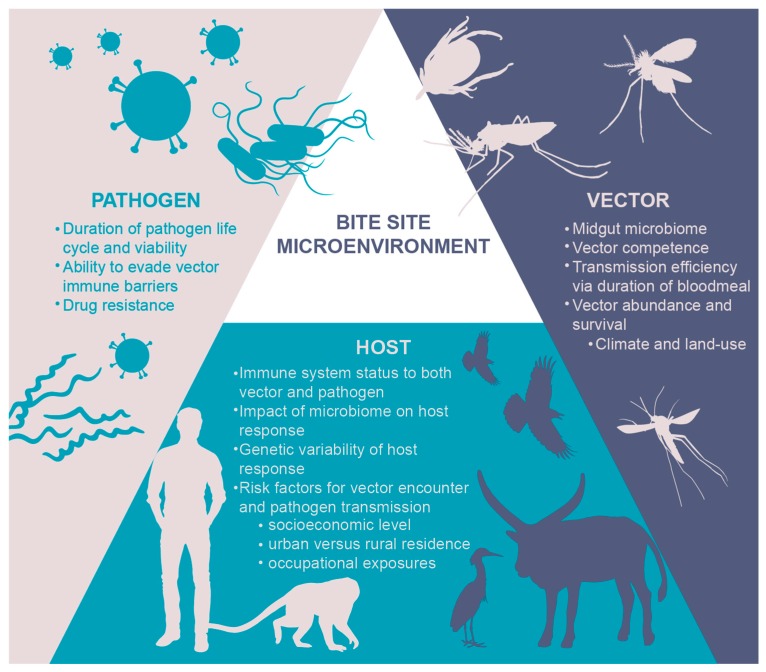
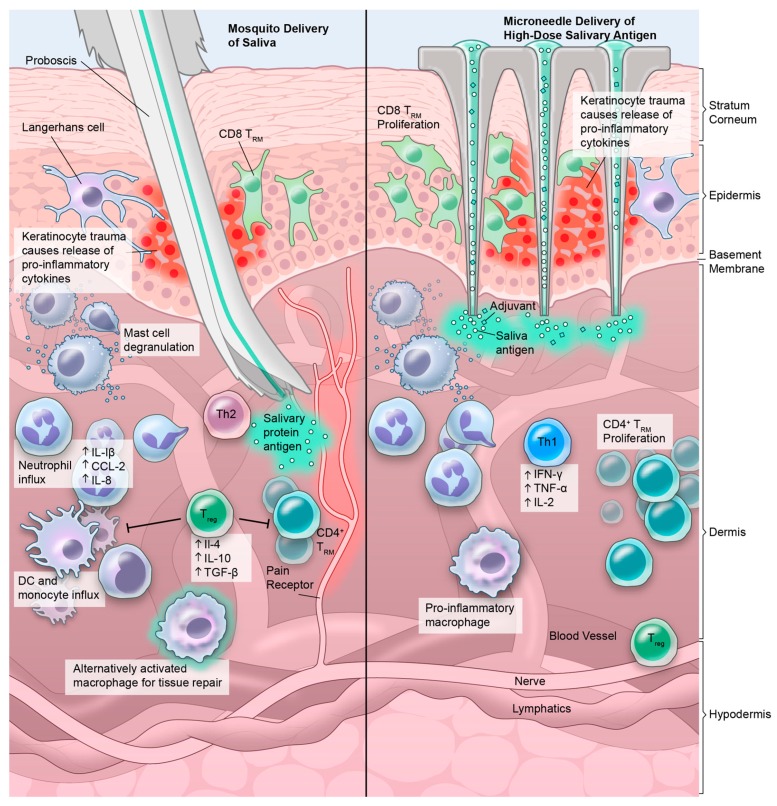
The current increase in vector-borne disease worldwide necessitates novel approaches to vaccine development targeted to pathogens delivered by blood-feeding arthropod vectors into the host skin. A concept that is gaining traction in recent years is the contribution of the vector or vector-derived components, like salivary proteins, to host-pathogen interactions. Indeed, the triad of vector-host-pathogen interactions in the skin microenvironment can influence host innate and adaptive responses alike, providing an advantage to the pathogen to establish infection. A better understanding of this "bite site" microenvironment, along with how host and vector local microbiomes immunomodulate responses to pathogens, is required for future vaccines for vector-borne diseases. Microneedle administration of such vaccines may more closely mimic vector deposition of pathogen and saliva into the skin with the added benefit of near painless vaccine delivery. Focusing on the 'micro'⁻from microenvironments to microbiomes to microneedles⁻may yield an improved generation of vector-borne disease vaccines in today's increasingly complex world.
当前全球范围内媒介传播疾病的增加,使得针对通过吸血节肢动物媒介将病原体传播到宿主皮肤的疫苗开发需要新的方法。近年来越来越受关注的一个概念是媒介或媒介衍生成分(如唾液蛋白)对宿主-病原体相互作用的影响。事实上,皮肤微环境中媒介-宿主-病原体相互作用的三元组可以同样影响宿主的先天和适应性反应,为病原体建立感染提供优势。要开发未来的媒介传播疾病疫苗,需要更好地了解这种“叮咬部位”微环境,以及宿主和媒介局部微生物群如何免疫调节对病原体的反应。通过微针接种此类疫苗可能更接近媒介将病原体和唾液沉积到皮肤中的情况,并且具有近乎无痛接种疫苗的额外好处。在当今日益复杂的世界中,关注从微环境到微生物群再到微针的“微观”层面,可能会产生新一代改进的媒介传播疾病疫苗。