Department of Biochemistry and Microbiology, Rutgers, the State University of New Jersey, New Brunswick, New Jersey, USA.
Department of Microbiology and Medical Zoology, University of Puerto Rico, School of Medicine, San Juan, Puerto Rico, USA.
Gut. 2019 Jun;68(6):1108-1114. doi: 10.1136/gutjnl-2018-317503. Epub 2019 Jan 22.
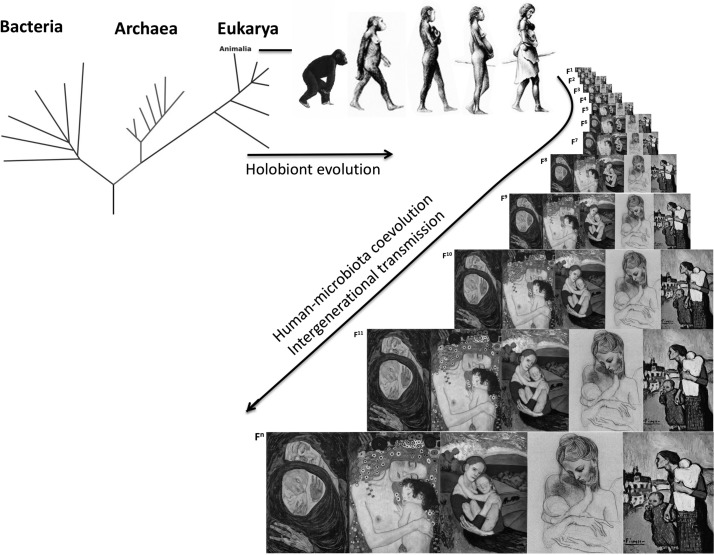
The host-microbiome supraorganism appears to have coevolved and the unperturbed microbial component of the dyad renders host health sustainable. This coevolution has likely shaped evolving phenotypes in all life forms on this predominantly microbial planet. The microbiota seems to exert effects on the next generation from gestation, via maternal microbiota and immune responses. The microbiota ecosystems develop, restricted to their epithelial niches by the host immune system, concomitantly with the host chronological development, providing early modulation of physiological host development and functions for nutrition, immunity and resistance to pathogens at all ages. Here, we review the role of the microbiome in human development, including evolutionary considerations, and the maternal/fetal relationships, contributions to nutrition and growth. We also discuss what constitutes a healthy microbiota, how antimicrobial modern practices are impacting the human microbiota, the associations between microbiota perturbations, host responses and diseases rocketing in urban societies and potential for future restoration.
宿主-微生物超生物体似乎是共同进化的,而二元体中未受干扰的微生物成分使宿主健康可持续。这种共同进化可能塑造了这个主要由微生物组成的星球上所有生命形式的进化表型。微生物群似乎通过母体微生物群和免疫反应对下一代产生影响。微生物生态系统在宿主免疫系统的限制下在其上皮龛位中发育,与宿主的时间性发展同时进行,为所有年龄段的营养、免疫和抵抗病原体提供早期调节生理宿主发育和功能。在这里,我们回顾了微生物组在人类发育中的作用,包括进化方面的考虑,以及母婴关系、对营养和生长的贡献。我们还讨论了什么构成健康的微生物组,现代抗微生物实践如何影响人类微生物组,微生物组扰动、宿主反应和在城市社会中急剧上升的疾病之间的关联,以及未来恢复的潜力。