Clark Thomas M, Jones Jessica M, Hall Alexis G, Tabner Sara A, Kmiec Rebecca L
Department of Biological Sciences, Indiana University South Bend, South Bend, Indiana.
Cannabis Cannabinoid Res. 2018 Dec 21;3(1):259-271. doi: 10.1089/can.2018.0045. eCollection 2018.
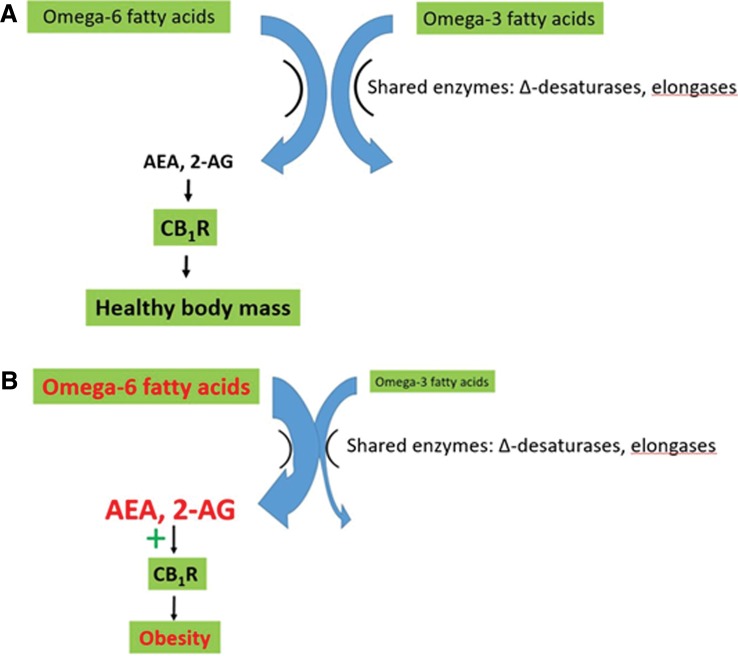
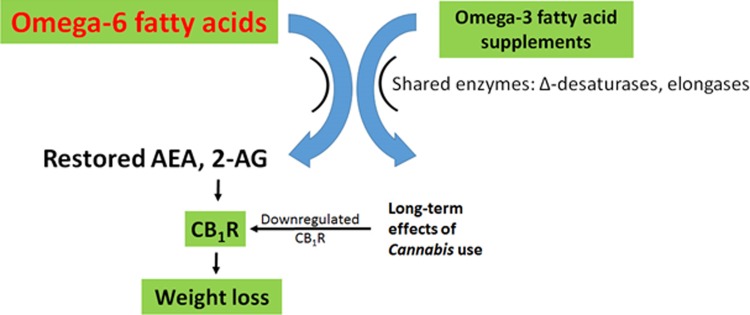
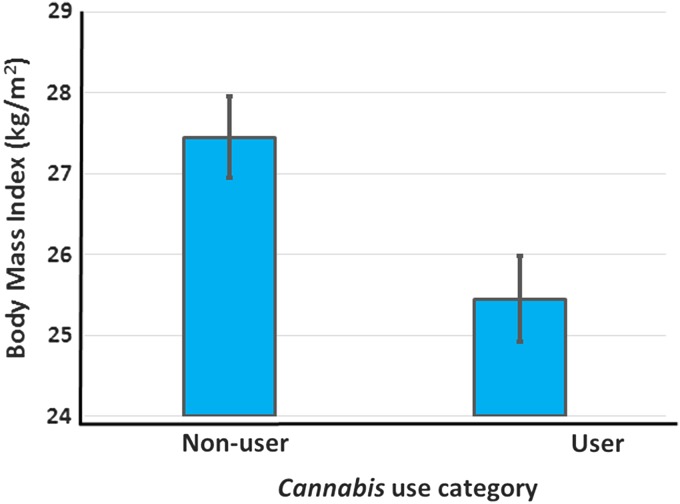
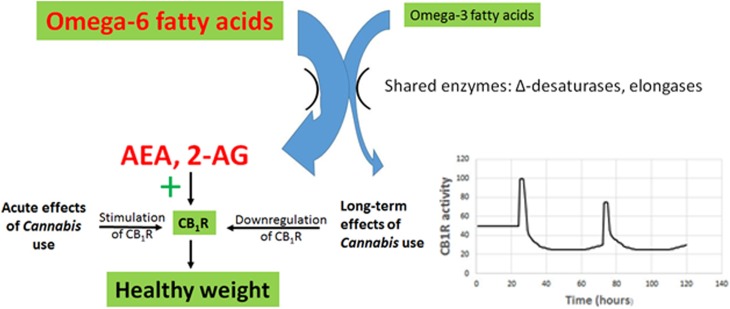
Obesity is treatment-resistant, and is linked with a number of serious, chronic diseases. Adult obesity rates in the United States have tripled since the early 1960s. Recent reviews show that an increased ratio of omega-6 to omega-3 fatty acids contributes to obesity rates by increasing levels of the endocannabinoid signals AEA and 2-AG, overstimulating CBR and leading to increased caloric intake, reduced metabolic rates, and weight gain. , or THC, also stimulates CBR and increases caloric intake during acute exposures. To establish the relationship between use and body mass index, and to provide a theoretical explanation for this relationship. The present meta-analysis reveals significantly reduced body mass index and rates of obesity in users, in conjunction with increased caloric intake. We provide for the first time a causative explanation for this paradox, in which rapid and long-lasting downregulation of CBR following acute consumption reduces energy storage and increases metabolic rates, thus reversing the impact on body mass index of elevated dietary omega-6/omega-3 ratios.
肥胖难以治疗,且与多种严重的慢性疾病相关。自20世纪60年代初以来,美国成年人的肥胖率增长了两倍。最近的综述表明,ω-6与ω-3脂肪酸的比例增加会通过提高内源性大麻素信号AEA和2-AG的水平、过度刺激大麻素受体(CBR)并导致热量摄入增加、代谢率降低和体重增加,从而导致肥胖率上升。大麻,或四氢大麻酚(THC),在急性接触期间也会刺激CBR并增加热量摄入。为了确定大麻使用与体重指数之间的关系,并为这种关系提供理论解释。本荟萃分析显示,大麻使用者的体重指数和肥胖率显著降低,同时热量摄入增加。我们首次对这一悖论给出了因果解释,即急性大麻消费后CBR的快速和长期下调会减少能量储存并提高代谢率,从而扭转饮食中ω-6/ω-3比例升高对体重指数的影响。